I bought a car in Malaga about a year ago, and the dealership told me that the DGT environmental label on the windscreen was all I needed.
That was it, that was the extent of what anyone told me.
Sorted, I thought.
I live on Calle Montaño, just off the edge of the Old Town, which puts me inside Malaga’s low emission zone.
Nobody at the dealership mentioned that residents inside the zone need to register their car separately, and I’m fairly convinced the dealership itself didn’t know that either.
So I didn’t do it.
Why would I, nobody had told me it existed.
The enforcement cameras went live on 30 November 2025, and it didn’t take long.
I got fined.
So did friends and family who’d driven over to visit my flat that same period.
Three fines in total, €100 each, €300 gone, and every single one arrived by post months after I’d actually done the driving, so by the time you open the envelope you’re trying to remember a random Tuesday from three months back.
I appealed all three.
I never heard back, not a word, and as of writing they’re still sitting there unresolved, not paid, not dropped, no reply.
I registered as a resident the moment the fines showed up, which gets you free, unrestricted access to the zone.
That’s the part that stings though, a sticker on the windscreen was never the whole story.
What Malaga’s ZBE Actually Restricts
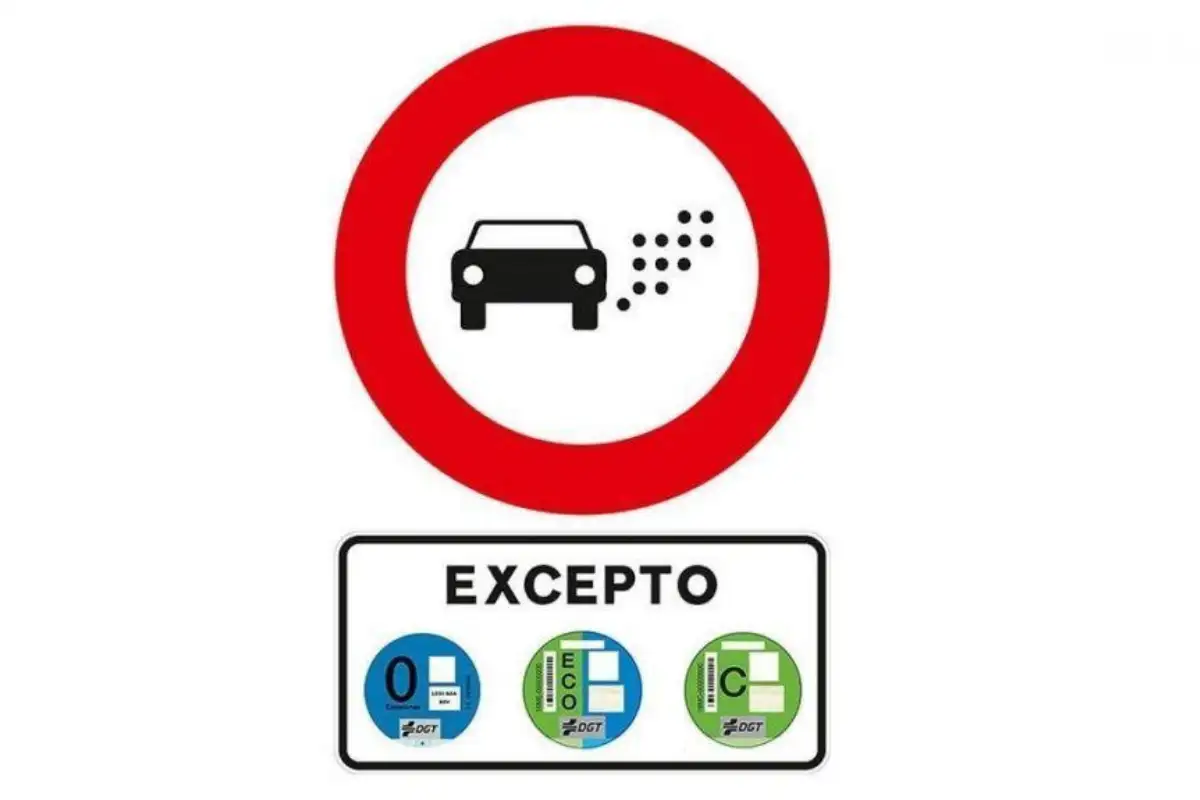
Cross into Malaga Old Town from any direction and you’re already inside it, no sign warning you the rules just changed underfoot.
Malaga’s ZBE (Zona de Bajas Emisiones), the low emission zone that decides which cars get to drive where, covers 404.03 hectares of the city centre.
That figure comes straight off the Ayuntamiento’s own site, and once you see it mapped out, it’s bigger than most people driving through it ever clock.
It’s not just the Old Town either.
The zone folds in the Centro Historico, the Soho district (all street art and specialty coffee these days), the Ensanche neighbourhood, the western seafront running along Paseo Marítimo, and the stretch from the port down to the Guadalmedina river.
That’s most of the parts of Malaga people actually live in, work in and eat lunch in, not some industrial ring you’d only pass through by accident.
If your daily route touches any of that, and for most people staying central it does, you’re inside the zone every single day, whether you clocked it or not.
The Streets That Mark the Boundary
The official boundary isn’t drawn on some vague map somewhere in a council office, it’s set out street by street, 31 named streets and plazas in total, each one marking exactly where the rules kick in. The ones you’ll actually recognise from behind the wheel:
- Paseo Marítimo Antonio Machado
- Avenida de Andalucía
- Avenida de Barcelona
- Paseo de Martiricos
- Alameda de Capuchinos
- Paseo Marítimo Pablo Ruiz Picasso
Cross any one of those without the right label, and the camera parked above it doesn’t care that you didn’t know.
The Court Just Annulled Part of It, and Fines Haven’t Stopped
On 6 May 2026, Spain’s Tribunal Superior de Justicia de Andalucía handed down a ruling that quietly undid one of the ZBE’s founding assumptions, the kind of story that never made it past a local news brief, but changes quite a lot if you’ve ever paid one of these fines.
Vox brought the legal challenge, and the court partially upheld it.
What got struck down was specific: the rule that let Malaga-registered vehicles drive through the zone freely regardless of their environmental label, while an identically labelled car registered outside Malaga got fined for doing the exact same thing on the exact same street.
The court ruled that distinction breaches the principle of equality, along with Spain’s constitutional protections for freedom of enterprise and market unity, article 38.
This isn’t some abstract legal technicality either.
It’s the exact clause written into the ordinance: an unlabelled or B-label car is only allowed into the zone “if domiciled in Malaga.”
Domiciled meaning registered as a resident’s car.
That domicile clause, the very thing that let me through for free once I sorted my own registration, is precisely what the court just knocked down.
By the time the ruling landed, around 12,000 fines had already gone out, and the number hasn’t slowed since.
Between 30 November 2025 and 30 June 2026, the council issued 35,257 fines total, an average of roughly 1,400 a week, peaking at 1,652 in a single week in February.
Here’s the part that catches people out: the ruling isn’t final.
The council can appeal to the Supreme Court, and as of mid-August 2026, no decision’s been made, their legal department is still preparing a report on what comes next.
The 30 November 2026 date, when B-label cars from outside Malaga were originally due to lose access completely, is now genuinely up in the air.
There’s a real opening here if you were fined and never resolved it.
The ruling gives you a path to reclaim the money, but it depends entirely on where your fine stands, whether it was appealed, already paid and closed off (“consolidated”), or still sitting open with nothing decided.
My three fines were appealed and never answered, not once, which as far as I can tell means they were never consolidated.
That might put me in a decent position to actually chase this now.
I don’t know how it ends yet though, so don’t take this as a guarantee, just as a reason to go check your own paperwork.
The DGT Sticker System (and Why a Windscreen Sticker Wasn’t Enough for Me)
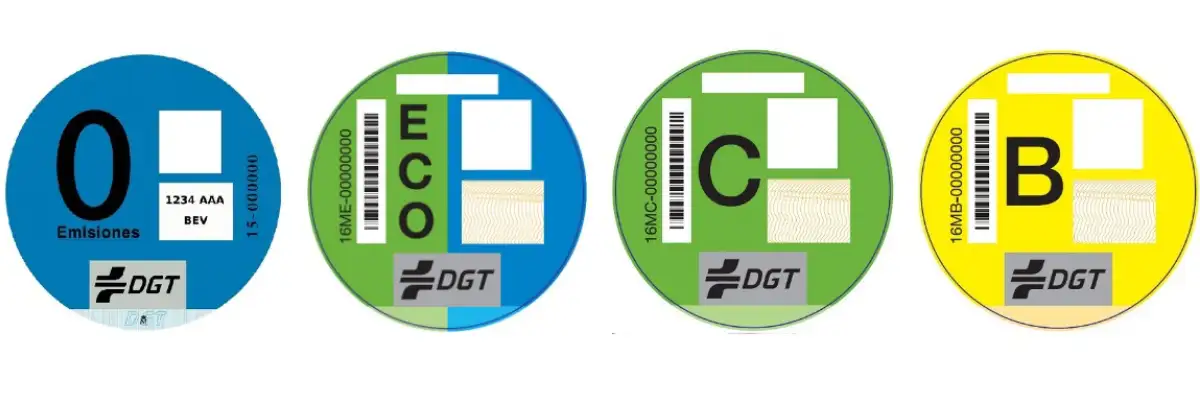
I stuck mine on within days of buying the car and figured that was the DGT box ticked.
It wasn’t, not even close.
There are four labels, they’re easy enough to get, and none of that saved me from three fines I’m still fighting to have answered.
The Four Stickers, In Plain Terms
Every car in Spain fits into one of four categories, and the label tells the cameras (and anyone parking near you) which one.
- CERO (blue): electric, hydrogen and plug-in hybrids with at least 40km of electric range. Always allowed, everywhere, no restrictions.
- ECO (blue and green): regular hybrids, plus anything running on CNG, LNG or LPG. Also always allowed.
- C (green): petrol cars from 2006 onwards, diesel from 2014 onwards. Allowed into the zone.
- B (yellow): petrol cars from 2001 to 2005, diesel from 2006 to 2013. Allowed, but only if the car is domiciled in Malaga itself, otherwise it’s restricted.
- No label at all: petrol before 2000, diesel before 2006. Same rule as B, only allowed in if the car’s registered address is in Malaga.
About 30% of vehicles in Spain don’t qualify for a label of any kind, which tells you how much older metal is still on the road.
And that domicile-only rule for B and unlabelled cars, the one about where the car’s actually registered, is precisely what a Spanish court has just spent months arguing over. More on that later.
How to Get One
Getting one costs about €5, occasionally closer to €6 if Correos tacks on shipping.
You buy it at any Correos branch, just bring your vehicle registration document and your ID, and they’ll print it on the spot.
Correos has branches all over the city, so you’re never far from one.
If you’d rather not queue, order it online at correos.es and it lands within 48 to 72 hours.
Authorised workshops and DGT offices can also issue one, so if you’re already at either for something else, it’s worth asking while you’re there.
It goes on the lower-right corner of the windscreen, visible from outside the car, that’s where the cameras (and traffic wardens) are trained to look.
Not sure which one you qualify for?
Open the miDGT app, it pulls up your vehicle’s official classification directly, no guessing involved.
Why I Got Fined Anyway
I bought my car about a year ago, and the dealership was very clear about one thing: stick the DGT label on the windscreen and you’re covered.
That felt like the whole job, so I didn’t think to double check anything else.
Nobody said a word about the fact that I live on Calle Montaño, right in Malaga’s Old Town, inside the ZBE itself, and that residents inside the zone have to register separately for free, unrestricted access.
I don’t think the dealership even knew that part existed.
Why would they, they sell cars all over the province, not just to people living three streets from the cathedral.
The cameras went live around the 30th of November.
I didn’t think about it again until the fines started arriving, weeks and then months later, by post, for driving I’d genuinely forgotten by the time the letter landed.
Three fines.
One for me, two for friends and family who’d driven over to see the flat in that same window.
€100 each, €300 total, for a mistake nobody realised they were making.
I appealed all three through the official channel, the one the letter itself tells you to use.
And then, nothing.
No approval, no denial, no update, just silence that’s lasted months and is still lasting now.
As soon as the fines showed up I registered the car properly, a declaración responsable, which you can do in person at Malaga’s Área de Movilidad or online if you’ve got a digital certificate, through the Movilidad section of the council’s Sede Electrónica.
The exact ZBE registration trámite isn’t listed by name on that page when I checked.
If you can’t find it, call 010 (Malaga’s council switchboard) and ask for Movilidad directly, that’s what got mine sorted.
This is a different registration to the one you do when you first buy a car in Spain, the national vehicle ownership transfer through the DGT.
Your dealership or gestoría usually handles that one. The ZBE registration is Malaga-specific, and it’s the one nobody tells you about.
It took maybe ten minutes.
Once it’s done, the cameras read your plate automatically and you’re free to drive in and out regardless of what label is stuck to your windscreen.
The appeals are still sitting there, unanswered, as far as I know.
And given what’s just happened in court over this exact rule, I have a feeling I haven’t heard the last of it.
Fines, Appeals and Who’s Exempt
Here’s where it gets personal for me: three fines, one appeal that’s still sitting unanswered, and a lot of questions about whether any of it will hold up.
Before I get into my own mess, let’s cover what a fine actually costs, how you appeal it, and who skips the whole thing.
What a Fine Actually Costs You
A fine for driving into Malaga’s ZBE without the right sticker costs €200, or €100 if you pay within 20 days.
That’s it, there’s no higher tier waiting for you if you get caught twice, or ten times.
Malaga hasn’t set up escalating fines for repeat offenders, at least not yet.
What a ZBE mistake actually costschecked August 2026
- DGT environmental sticker€5
- ZBE fine, paid within 20 days€100
- ZBE fine, paid after 20 days€200
What you don’t get is any dent in your driving licence.
No points come off, this is purely a financial penalty, not a black mark on your record.
The reason so many people are getting these fines at all comes down to the camera system.
There are 53 control points across the zone, feeding roughly 97 cameras that run day and night.
Every plate that passes gets checked against the DGT’s national vehicle database and, separately, against Malaga’s own padrón, the residency register, which is how the system knows whether you actually live inside the zone or not.
The numbers back up how busy those cameras have been.
Between 30 November 2025 and 30 June 2026, the council issued 35,257 fines, an average of about 1,400 a week.
One week in February 2026 alone hit 1,652.
That’s not a system easing people in gently.
How to Appeal
You appeal by filing what’s called “alegaciones,” and you’ve got 20 calendar days from the notification to do it.
Miss that window and the fine just becomes final, so don’t let it sit in a drawer.
The whole process runs through the Sede Electrónica, Malaga city council’s online portal at sede.malaga.eu.
To log in, you’ll need one of three things: a Cl@ve account, a Digital Certificate, or a DNIe (Spain’s electronic ID card).
If you don’t already have one of these set up, sort it out before your 20 days start ticking away, because getting a Digital Certificate issued isn’t a same-day job.
One practical thing that tripped me up: Chrome doesn’t always play nice with Spain’s digital certificate login systems.
If the login page won’t open properly, switch to Safari on a Mac or Firefox on Windows before you assume the whole portal is broken.
Here’s where things just got a lot more interesting.
On 6 May 2026, the Tribunal Superior de Justicia de Andalucía ruled that part of Malaga’s ZBE ordinance is illegal, specifically the rule that restricted non-resident vehicles by label while letting Malaga-registered vehicles with the exact same label circulate freely.
The court found that breaches the principle of equality, plain and simple.
It’s not final.
The council can still take it to the Supreme Court, and might well do.
But it does crack open a real path for reclaiming money already paid in fines, and it’s not automatic, it depends entirely on where your fine stands: already appealed, already paid and closed, or, like my own three, appealed and never answered at all.
I still don’t know how mine will end.
I’m not going to pretend otherwise, or invent a tidy ending where there isn’t one yet.
Who’s Exempt Without Registering
Not everyone has to register a sticker to drive through the ZBE, some vehicles are just waved through by design. The council’s exempt list includes:
- Public transport, meaning EMT buses
- Taxis
- VTCs, the private hire vehicles like Uber and Cabify
- Historic vehicles with an official classification under Royal Decree 1247/1995
- Lorries
- Healthcare vehicles, public or private, with prior authorisation
- State security forces
- Municipal services
- Private emergency services, think security, plumbing or funeral vehicles responding to an actual call
Separately, if you have a disability of 33% or more and hold a European disability parking card, you can register one vehicle for free access to the zone, no sticker needed.
Vans get a bit of breathing room too.
There’s a four-year grace period from the zone’s launch, running through roughly November 2028, during which every van, labelled or not, can enter freely.
Once that period ends, vans fall under the same domicile-based rules that already apply to cars.
Rental Cars, Tourists and Foreign Plates
Book a rental car in Malaga and you’re probably fine, most companies here run fleets new enough to qualify for a C, ECO or CERO label without you doing anything at all. That’s the good news.
If You’re Renting
Here’s the catch though: the sticker isn’t always actually stuck to the windscreen when you pick the car up.
Rental companies don’t seem to treat it as a priority, so don’t assume no sticker means no label.
Ask about the vehicle’s emissions classification before you book, not when you’re standing at the counter with a queue behind you.
If your accommodation happens to sit inside the ZBE, ask specifically for a hybrid or electric car, that way you’re not gambling on whatever’s left on the lot.
When you do pick up the car, check the windscreen.
If there’s a sticker, take a photo of it there and then.
It sounds excessive, but it’s the kind of proof you’ll be glad to have if a fine ever turns up asking questions.
Or skip the car altogether and lean on Malaga’s public transport, which covers the centre well enough that you may not need to rent anything at all.
Driving In on Foreign Plates
Here’s something a few Spanish motoring outlets have picked up on that I haven’t seen explained anywhere else: Malaga’s camera system reportedly only checks plates against the Spanish DGT database and the city’s own residency register.
Foreign-registered cars aren’t in either one, so right now they’re apparently slipping through without fines, regardless of whether the car would actually qualify to enter the zone.
Malaga’s city council hasn’t confirmed any of this itself, so take it as what it is, several outlets reporting a gap, not an official rule you can rely on.
That gap exists partly because Spain’s DGT doesn’t hand out its own environmental stickers to foreign-registered vehicles at all.
There’s no version of the Distintivo Ambiental you can buy or apply for if your car isn’t registered in Spain.
What Spain does do is recognise a handful of other countries’ own systems as roughly equivalent.
Germany’s Umweltplakette counts, so does France’s Crit’Air, along with Austria’s and Denmark’s own labels.
A French car carrying a Crit’Air 1 sticker, for instance, gets treated more or less like a Spanish CERO vehicle.
Where this gets frustrating is that none of it is actually spelled out anywhere official.
Malaga’s council pages don’t publish a formal table matching Euro emissions standards to these foreign stickers, and there’s no temporary permit process for visiting cars, whatever some other guides might claim.
If you’re driving in from outside Spain and want actual certainty rather than a workaround that could close tomorrow, contact Malaga’s Área de Movilidad directly.
There isn’t a clean numbered rule I can hand you here, because as far as I can tell, one doesn’t exist yet.
Where to Park If Your Car Doesn’t Qualify
Two of the free options sit right along the ZBE’s own boundary streets: up by La Rosaleda near Martiricos, and around Capuchinos and El Molinillo off Alameda de Capuchinos.
Both are white-line street parking, no machine, no time limit.
Martiricos gets busy on match days and empty most other times, with a short walk or a quick bus ride into the centre from there.
Capuchinos is quieter, about a ten-minute walk into town, and easier to find a spot in than El Ejido usually is.
For guaranteed parking, the Alcazaba underground garage has 543 spaces close to the Old Town, though you pay for it.
Further out and clear of the zone entirely, there’s Carlos Haya to the west, and El Palo and Pío Baroja to the east near the beach.
From any of these, the metro (Lines 1 and 2) or an EMT bus covers the rest of the way in, and renting an electric scooter works too if you’d rather skip public transport.
I cover every street option and its exact timings in the parking guide.
Other Costa del Sol Towns With Their Own ZBE
Torremolinos has had its ZBE running since January 2024, the longest of any town on this coast besides Malaga.
Marbella started provisionally in October 2024, in the historic centre and San Pedro, but no fines have gone out there yet.
I’m watching that one closer than the rest.
Malaga’s zone went through the same provisional, no-fines stretch for a full year before the cameras actually started charging anyone, mine ran from November 2024 to November 2025.
If Marbella follows the same timeline, that clock is still running.
The rest are further behind.
Estepona’s ordinance is approved and the cameras are out to tender, aiming for a 2026 rollout.
Fuengirola hasn’t drafted its rules yet, though most of the relevant streets are already pedestrianised.
Benalmádena hasn’t delimited a zone at all, still at the study stage.
Mijas restarted planning after the council changed in November 2024.
Vélez-Málaga is reviewing plans the previous administration drew up for the town centre and Torre del Mar.
Neither Marbella nor Estepona is fining anyone yet, so driving into either one right now carries none of the risk Malaga does.