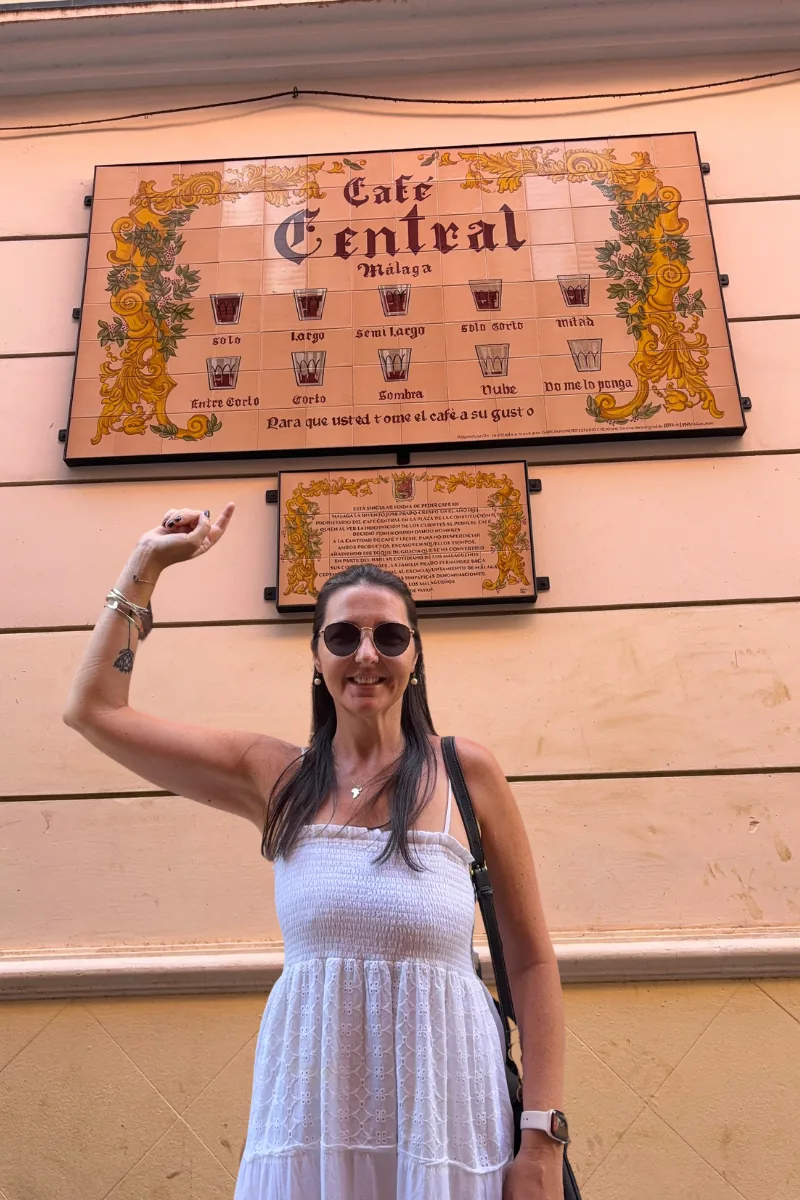
The café that invented Málaga’s nine coffee grades shut the same year we arrived here. We never got the chance to sit inside the original, not once, so everything about that room is borrowed from other people’s memories rather than mine. I’ll tell you what that timing has meant for finding coffee here since, further down.
I’ve lived in Málaga centro for over four years, and since we’re right in the middle of it we’re always going out for coffee, so I’ve worked my way through most of the nine by now. Learning the different types of coffee in Málaga is worth it. It takes one afternoon, it makes ordering fun instead of stressful, and it’s one of the loveliest small things about this city, that somebody cared enough about coffee to give it nine names.
Fair warning on the black end: I only drink it black before 2pm, when I’m still fasting, so once the grades turn milky I’ve got a lot more to say.
Below is the whole scale from strongest to milkiest, the one word most visitors actually want, and the joke tenth that locals really do order.
⭐ Don’t miss >> Where to stay in Málaga, my neighbourhood guide
Nine names, one drink
Ask for un café in Málaga and you’ll get a friendly pause, because you haven’t finished your sentence yet. Here, coffee isn’t one drink with milk optional, it’s nine named grades, and which one you get depends entirely on how much of the glass is coffee and how much is milk.
It’s a Málaga thing, properly local, and it started in one café in this city. You won’t find it in Madrid or Seville, which is part of why I love it.
When we first moved here we thought we had this covered. We’d walk in and say un café con leche, por favor, confidently, like people who’d done their homework. Then the man behind the counter would say, “¿mitad, sombra o nube?” and we’d stand there like we’d been asked a maths question.
That question isn’t him being difficult, it’s him being precise, and once you know the answer it’s the easiest exchange of the day.
The reason it matters is that the ends of the scale are barely the same drink. A solo is a small glass of black coffee and nothing else. A nube, which means cloud, is ninety per cent warm milk with a little coffee stirred through it, and it’s so gentle you could give it to someone who claims not to like coffee. Same order, same counter, same twenty seconds, wildly different glass.
And I’ll say this for the system: nobody here is precious about it. Say the wrong word and you’ll get the wrong coffee, and it’ll still be good, and you’ll know for next time.
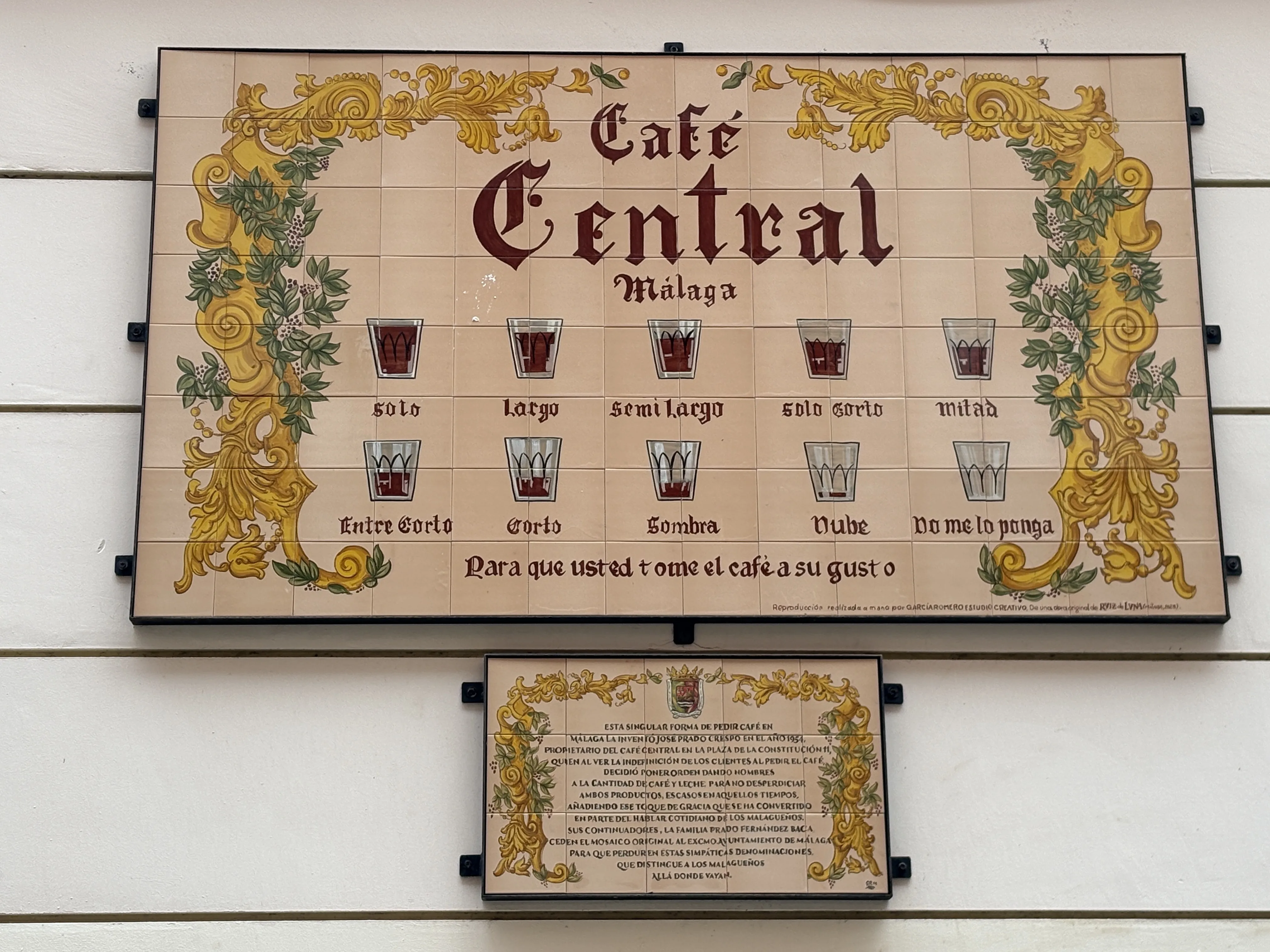
The full scale, strongest to milkiest
The scale runs from all coffee to almost all milk in nine steps, and once you see it laid out in order it stops being intimidating and starts being quite charming. Here’s each grade, what’s actually in the glass, and who it’s for.
The nine grades, strongest to milkiest
| Order this | Coffee / milk | What it means | Who it suits |
|---|---|---|---|
| Solo | 100 / 0 | Just coffee | Espresso drinkers, no compromise |
| Largo | 90 / 10 | Long | Black coffee with the edge taken off |
| Semilargo | 80 / 20 | Half-long | Softened, still clearly a black coffee |
| Solo corto | 60 / 40 | Short black | Stronger than half and half |
| Mitad | 50 / 50 | Half | Most visitors. Start here |
| Entrecorto | 40 / 60 | Between-short | Milky, with the coffee still leading |
| Corto | 30 / 70 | Short | Properly milky despite the name |
| Sombra | 20 / 80 | Shadow | A shadow of coffee through the milk |
| Nube | 10 / 90 | Cloud | Barely coffee, and lovely for it |
Here are a few of my favourite places to stay near the old town, close to the bars where you’ll actually be trying these:
⭐ Old town, central >> Palacio Solecio
⭐ Old town, mid-range >> Molina Lario
⭐ La Malagueta, beachfront >> Gran Hotel Miramar GL
Solo, largo & semilargo, the black end
Start here if milk isn’t your thing, because everybody writes this scale from the milky end and it’s not much help to you.
Solo is the pure one, a hundred per cent coffee, no milk at all. Largo, meaning long, is ninety per cent coffee with a ten per cent splash, and semilargo takes it to eighty/twenty, so you get a softening rather than a proper milky coffee.
Jethro takes his coffee close to black, barely a drop of milk, so largo or semilargo is where he actually lives on this list. He’s been handed a milkier grade than he ordered more than once, and he’s not quiet about it either time, which is the best argument I know for getting your word right before you say it.
I drink it black too, but only before 2pm. I do intermittent fasting, and coffee’s one of the only things I’ll let myself have before I eat. I grew up on South African coffee, then spent three years in Costa Rica, where it’s grown in volcanic soil and tastes nothing like either. Spanish coffee still reads as strong to me even after four years here, which is probably half of why I end up on the milky end for the rest of the day.
Mitad, the one you probably mean
If you read one paragraph here, read this one. Mitad means half, it’s fifty per cent coffee and fifty per cent milk, and it is almost exactly what most visitors are picturing when they ask for a café con leche.
So when the counter question comes, “¿mitad, sombra o nube?”, the safe and correct answer is mitad. One word, and you’ve ordered like you live here.
It’s also the grade I’d hand a first-timer without hesitating, strong enough to taste properly, milky enough to drink slowly on a terrace. It’s what I order myself most afternoons too, the safe middle when I’m not chasing all the way to the milky end.
Corto, entrecorto & solo corto, the confusing middle
I’m going to be honest, these three blur, and I don’t think anyone keeps them straight on the first go.
Corto means short and is thirty per cent coffee to seventy per cent milk, so despite the name it’s one of the milkier ones. Entrecorto sits just above it at forty/sixty. And solo corto, confusingly, is sixty per cent coffee to forty per cent milk, on the strong side of mitad rather than the milky side.
The trick that finally helped me is to ignore the words and remember only where each one sits relative to half. Everything with corto on its own is milkier than mitad, and solo corto is stronger.
Sombra & nube, the milky end
This is where I go when I know a place pours it strong, and I’m not sorry about it.
Sombra means shadow, which is such a good name, twenty per cent coffee to eighty per cent milk, just a shadow of coffee passing through. Nube means cloud and goes further still, ten per cent coffee to ninety per cent milk.
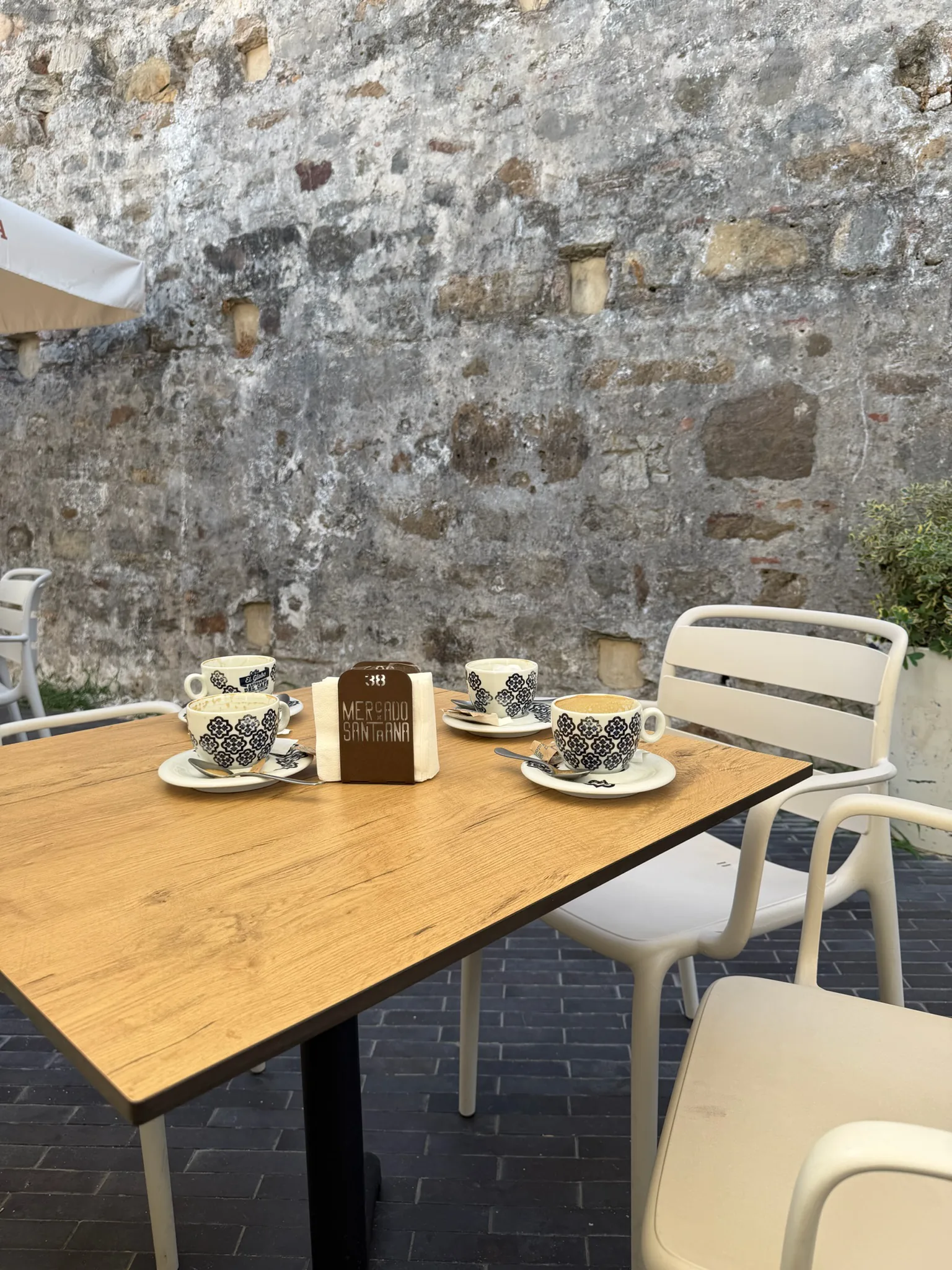
Casa Aranda is where I learned to ask for one. Their coffee runs on the Santa Cristina blend, and it’s strong enough that a mitad there tastes like a solo corto anywhere else, so I go straight to nube. Order two, and order the traditional churros and chocolate to go with them.
If you’d rather have someone walk you through Málaga’s food and drink scene instead of working it out coffee by coffee, I’d book a guided food tour. It covers a lot more than coffee, but you’ll come out the other end ordering everything like a local.
”No me lo ponga”, the joke tenth
There’s a tenth entry on the scale, and it’s no me lo ponga, which means “don’t put me one at all”. It’s an empty cup, it’s a joke, and locals genuinely say it.
That’s the whole gag. But it tells you how seriously this city takes its coffee, that even nothing got a name.
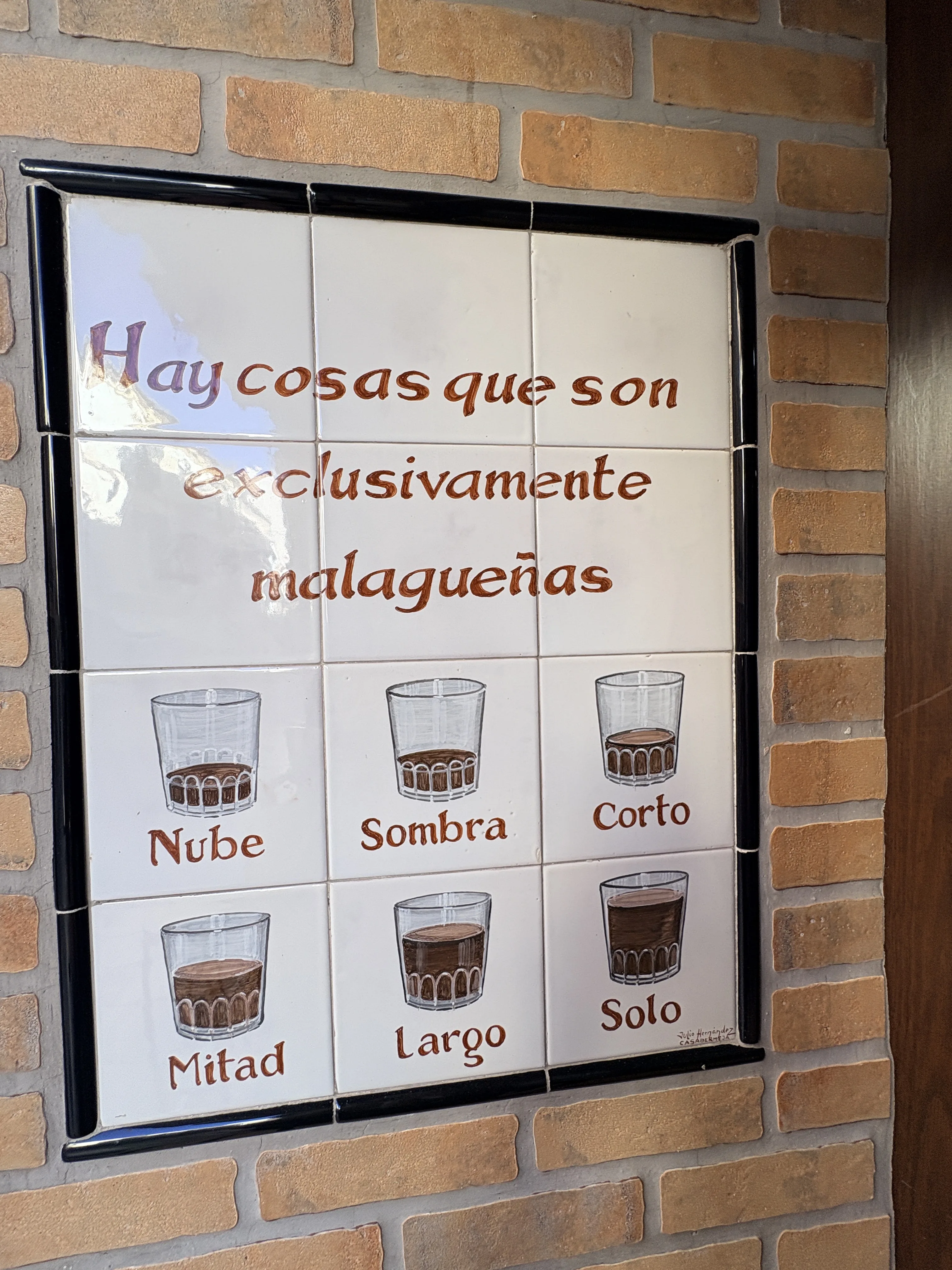
Bar Miguel, on Calle Dos Aceras, has its own version painted on tile by the door, six of the nine grades, proof the habit spread well beyond the one café that started it.
What you’ll actually be handed
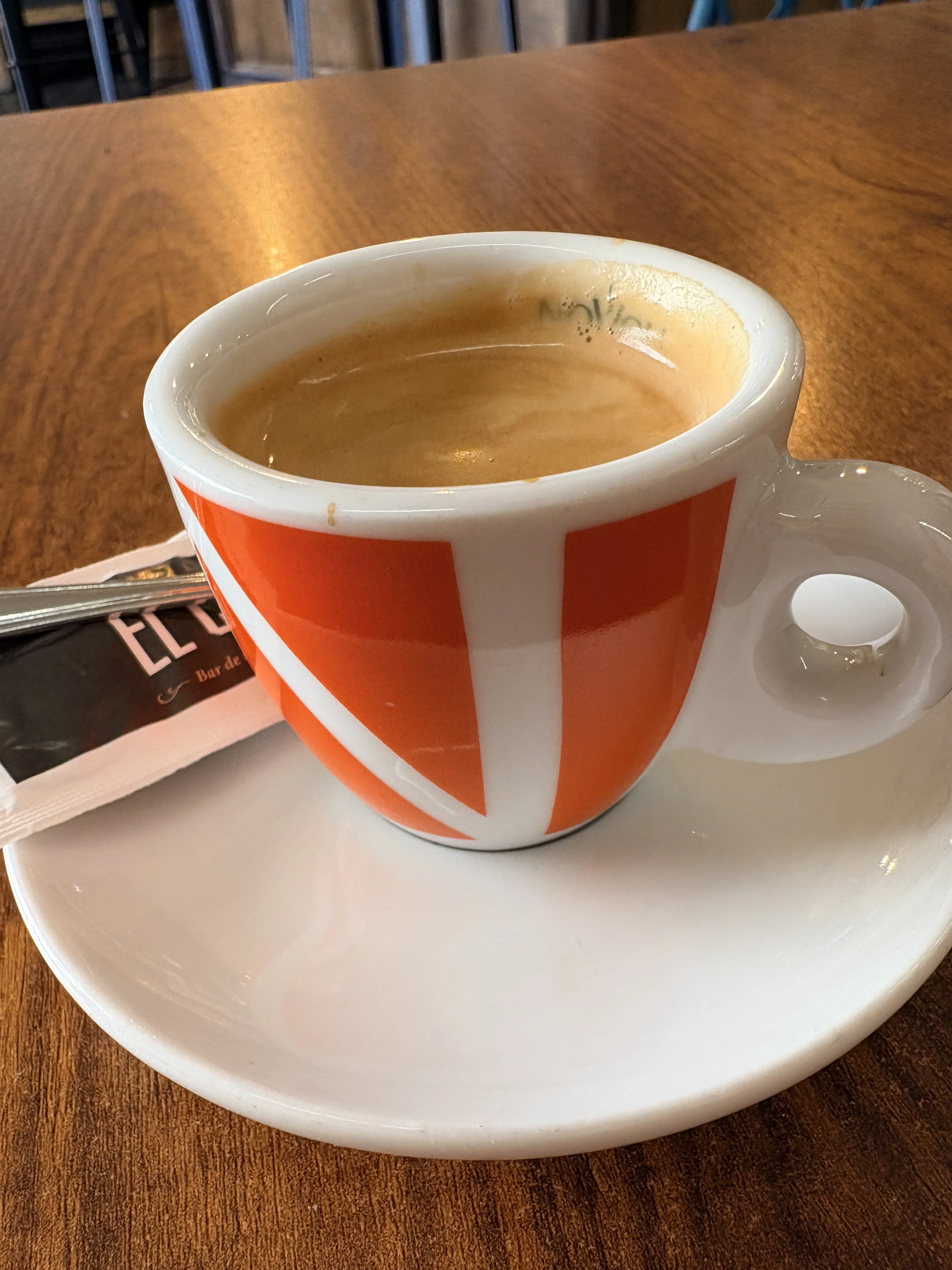
Order the same word at two different bars and you can get two noticeably different glasses, one pale and milky, the next one closer to what the first place would have called a sombra. You stand there for a second wondering whether you said it wrong.
You didn’t. That’s the part I’ve come to love, honestly. Nine names, and not a ruler in sight.
Nobody is measuring. It’s a person behind the bar with a jug of hot milk and a rough idea of where your word sits on the scale, and where it sits depends a fair bit on whose hand is on the jug.
The written sources don’t agree either. Solo corto is 60% coffee in most of them and 70% in others, some call entrecorto entre mitad instead, and whether corto or sombra has more coffee in it flips depending on which list you happen to be reading.
I’ve been here over four years and I still couldn’t tell you which version is correct, because I don’t think there is one. It’s a naming system, not a recipe.
So don’t expect exact measurements. One bar’s nube might be another’s sombra, and everything you’ve just read is a guide rather than a rule.
What’s worth doing is learning roughly where you sit rather than learning the percentages, and learning the word on either side of your favourite so you’ve somewhere to go when a place runs darker or milkier than you expected. Mine sits around mitad, with nube kept in reserve for the places I know pour it strong.
Jethro’s the opposite problem: he wants barely a drop of milk, and largo is the one word that gets heard the same way at every bar in the city. The soft end is where all the variation lives, which is exactly why I’ve learned to say the word either side of mine.
READY TO BOOK YOUR TRIP TO MÁLAGA?
🎟️ Best guided tours: I use GetYourGuide
🏨 Accommodation: Find hotels in Málaga
🚆 Trains and buses: I book through Omio
🛡️ Travel insurance: I use SafetyWing
How to order one without stalling
Walk in, wait to be seen, then say it straight: “Un sombra, por favor.” That’s the whole thing. Spanish bars reward the short version, and a hesitant “could I maybe get” only makes it harder for the person serving you, who has four other orders in their head.
A few small words are worth carrying in, because they do most of the work:
- en vaso, in a glass, which is the Málaga default for anything with milk in it and the way I drink mine
- en taza, in a cup, if you’d rather have a handle
- café para llevar, coffee to take away
- descafeinado, decaf, and here’s the trap: most places will serve you instant unless you ask for it de máquina, from the machine
Don’t ask for a latte or a flat white. They’ll smile politely, then give you a mitad, which is a perfectly good drink and also not what you ordered.
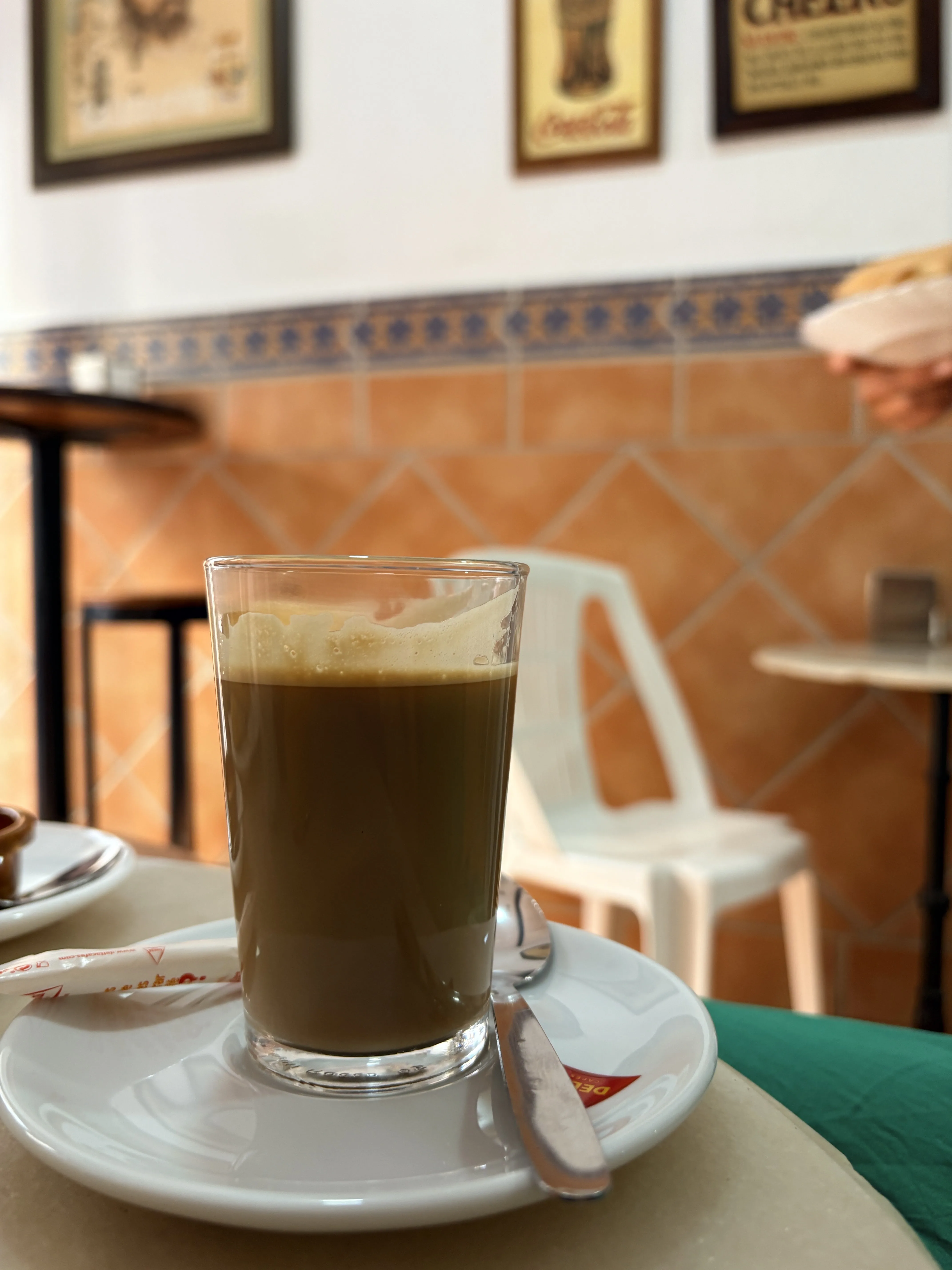
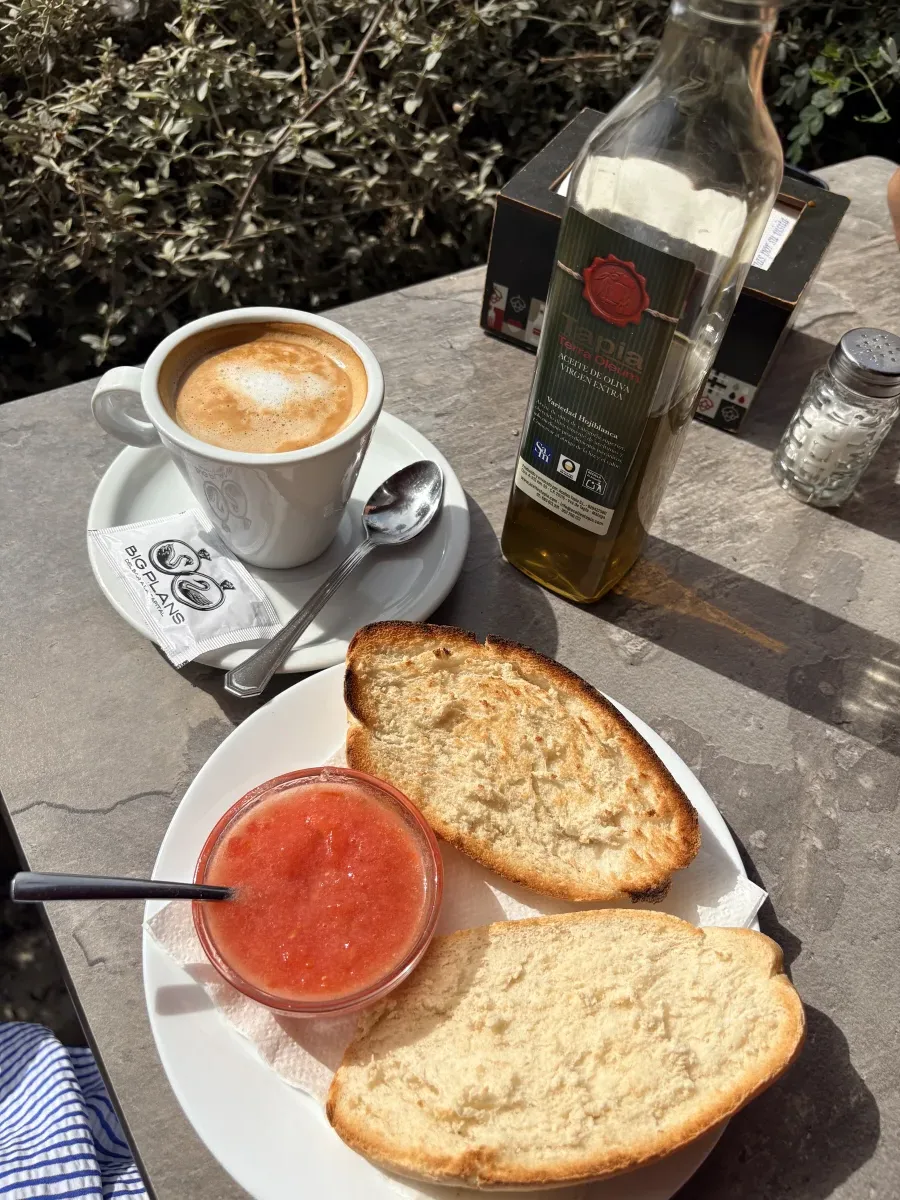
Then there’s what goes beside it, which is genuinely my favourite part of mornings here. A pitufo is a small filled bread roll, ham or cheese or tomato, usually with olive oil on it, and no, not a Smurf, although the word is the same. Before 11am they’re everywhere in the city, and a sombra with a pitufo mixto is the classic pairing.
If you want something bigger, ask for a mollete, the soft round bread from Antequera, toasted and topped with tomato and jamón. It’s lovely. Or a tostada, which is open toast with olive oil and tomato, or avocado, or tuna. Most of the bars I’d send you to for that are the same ones I’d send you to for a cheap plate of something at lunchtime.
Say the coffee and the food in one breath, “un sombra y un pitufo mixto”, and you’ll sound like you’ve been here a year. If you’d rather someone else pick the stops, a guided tapas tour covers most of this same ground.
What a coffee should cost in Málaga
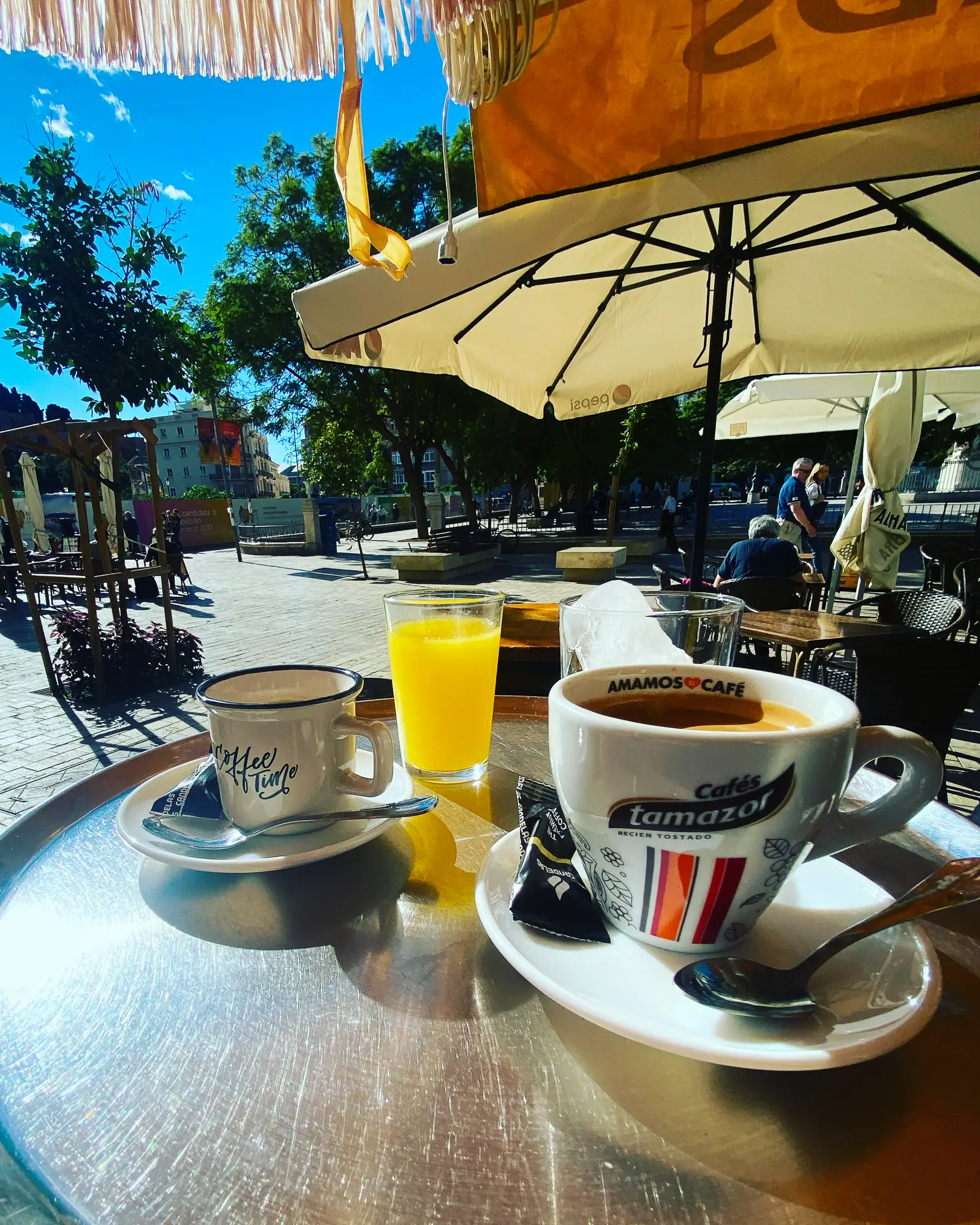
Cheap, and I’d defend that quite fiercely. Prices in Málaga for coffee are and should always be low, and if you’re paying more than 2-3 euros you’ve been overcharged.
A normal coffee at a normal bar is €1.20 to €1.80.
In the tourist areas it climbs to €2 to €3, which is where my patience runs out.
Speciality coffee is €1.50 to €3.50, and that one I’m happy about, because someone has done real work on the beans and it’s still under four euros.
The fix, when a board outside says €3.20, is not to argue. Walk one street back from the strip and try again. The bar on the second street is usually older, usually fuller of people who live here, and usually charging a euro and a half. It’s the same rule that works for eating well in the old town, one street off the main run and the prices change, and it’s easier to stumble onto if you’re actually staying in the old town rather than passing through.
Coffee here is cheap on purpose, and I’d like it to stay that way, so give your money to the second street.
The café that invented it, & what happened to it
The corner I want to point at is on Plaza de la Constitución, and there’s nothing on it now to tell you what it was. Café Central stood there, and there’s a document proving it was already on the plaza in 1920.
It got its final shape in 1954, when the owner, José Prado Crespo, bought the two cafés on either side of him, Café Suizo and Café Munich, and merged all three into one much bigger room.
Why 1954 needed a system at all
Coffee in post-war Spain was scarce and it was expensive, and a glass that came out wrong went straight back to the bar and got poured away.
That waste cost Prado Crespo real money, so he started paying attention to something his customers were already doing, which was holding up their fingers at the counter to show how much coffee they wanted in the glass.
He wrote the amounts down, gave them names, and put them up on the wall. He got to nine, then wanted a tenth to balance out the poster, and one of his employees suggested the joke one, less than a cloud, don’t bother pouring me anything at all.
It stayed a handwritten poster for eight years. The chart only became the azulejo everyone photographs in 1962, when the ceramicist Amparo Ruiz de Luna turned it into tile, and that’s my favourite part of the whole story, that a fix for wasted stock got handed to a ceramicist nearly a decade later and came back as something beautiful. Other bars on the plaza copied it, then bars across the province, helped along by the local roaster Cafés Santa Cristina using it in their advertising.
And then in January 2022, after more than a century on that plaza, Café Central closed for good.
If you’ve read about it anywhere else, you’ve almost certainly read about it as somewhere you can still walk into.
Why it’s such an easy café to get wrong
We moved to Málaga the same year the original shut, so by the time we came looking for it, there was nothing left on that corner to find. It’s an easy mistake for anyone chasing the name today, and here’s the shape of it.
Café Central closed in January 2022. But the name is still trading. It runs today as a speciality coffee roaster at Calle Santa María 2, which is a street off the plaza, with a second branch out at La Malagueta, and it shows the ten ways of ordering. So there genuinely is a Café Central you can sit down in, it’s just not the room any of this history happened in.
The tile isn’t in either of them. It hangs in a corridor at Colegio Los Olivos, the school the last owner’s children and grandchildren went to. I don’t know whether the public can go and see it.
What keeps catching people out is that most of what’s online about this still uses the present tense, and still tells you to go to the plaza and look at the tile on the wall.
Two of those instructions are wrong, and the third one sends you to a school.
So if a friend asks me, I send them to Santa María 2, four minutes from my flat, and I tell them the plaza part is history rather than an address. It’s a nice walk from anywhere in the old town anyway. If it’s a photo with the sign itself you’re after, that’s on Calle Ramón Franquelo, not the café counter, mounted outside where anyone passing can see it.
Is it worth making a thing of?
Yes, though not for the reason most people assume, because the coffee doesn’t taste any different for knowing the word, the reception does. Order a mitad in a neighbourhood bar and something small and nice happens, you stop being handed the tourist version of the interaction.
That’s the whole of the payoff, and I think it’s worth the ten minutes it takes to learn. It’s cheap, it’s local to this city and nowhere else, and people are pleased you bothered, the kind of thing that lands best if you’re staying somewhere with real neighbourhood bars nearby rather than on a tourist strip.
Now the limits. Nobody is going to be offended if you ask for a café con leche, you’ll get a coffee, it’ll be good, and the barista will not think less of you. Plenty of people here order two or three of the grades and never bother with the rest.
I’d also say don’t over-plan it. This isn’t a thing to build a morning around, it’s a thing to use, every day, in whichever bar happens to be nearest when you want to sit down.
The bit I’d actually push you on is knowing your own pattern rather than memorising all nine. I’m black before 2pm, mitad most afternoons, and straight to nube the moment I know a place pours it strong. Jethro sits at the other end of that, barely a drop of milk, ever. Between us we’ve worked through most of the chart, and the grades really do taste like different drinks rather than the same drink in different dilutions.
Common questions about coffee in Málaga
- Why is coffee served in a glass instead of a cup?
- Because glassware was cheaper and easier to come by than mugs in Andalusia after the civil war, and it simply stuck. There's a practical reason it survived, too: you can see the proportion of milk to coffee through the side of a glass, and proportion is the entire point of the system. If you'd rather have a cup, ask for it en taza and you'll get one.
- Is the Málaga coffee system used elsewhere in Spain?
- No. It's a Málaga thing and it doesn't travel much beyond the province. Ask for a nube in Madrid or Seville and you'll get a blank look, so elsewhere it's back to a café con leche or a cortado like the rest of the country.