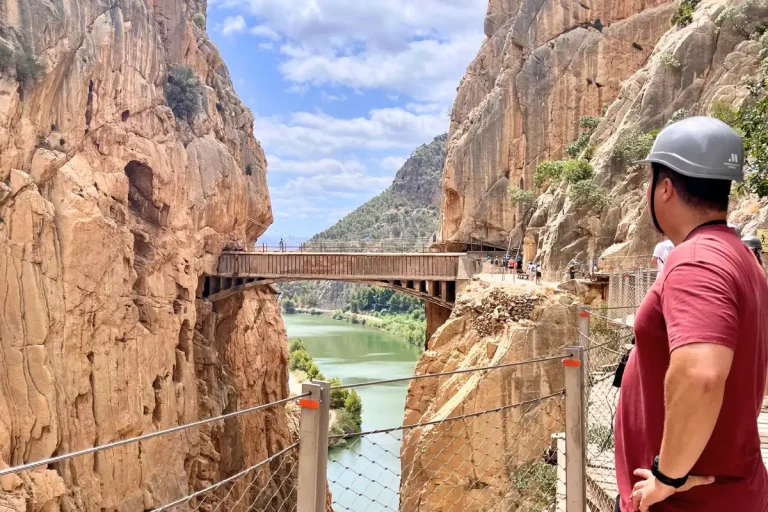
The Caminito del Rey is a 7.7-kilometre walkway pinned to the sheer cliffs of southern Spain’s Gaitanes Gorge, suspended up to 100 metres above the Guadalhorce River.
Once nicknamed “the world’s most dangerous path” after years of deadly neglect, it reopened in 2015 as a fully restored, safe (but still spectacular) hiking experience.
Walking narrow wooden boardwalks bolted to vertical rock faces, crossing a swaying suspension bridge high above the gorge, and watching eagles soar below you: this is one of Spain’s most unforgettable experiences.
And it’s just an hour from Málaga.
We’ve walked it, we’ve taken friends who were terrified of heights (sorry, Carolina), and we’ve learned exactly what you need to know to get the most from this incredible trail.
This guide covers everything: how to get tickets, how to get there, what to expect on the route, and insider tips that most guides miss.
What Is the Caminito del Rey?
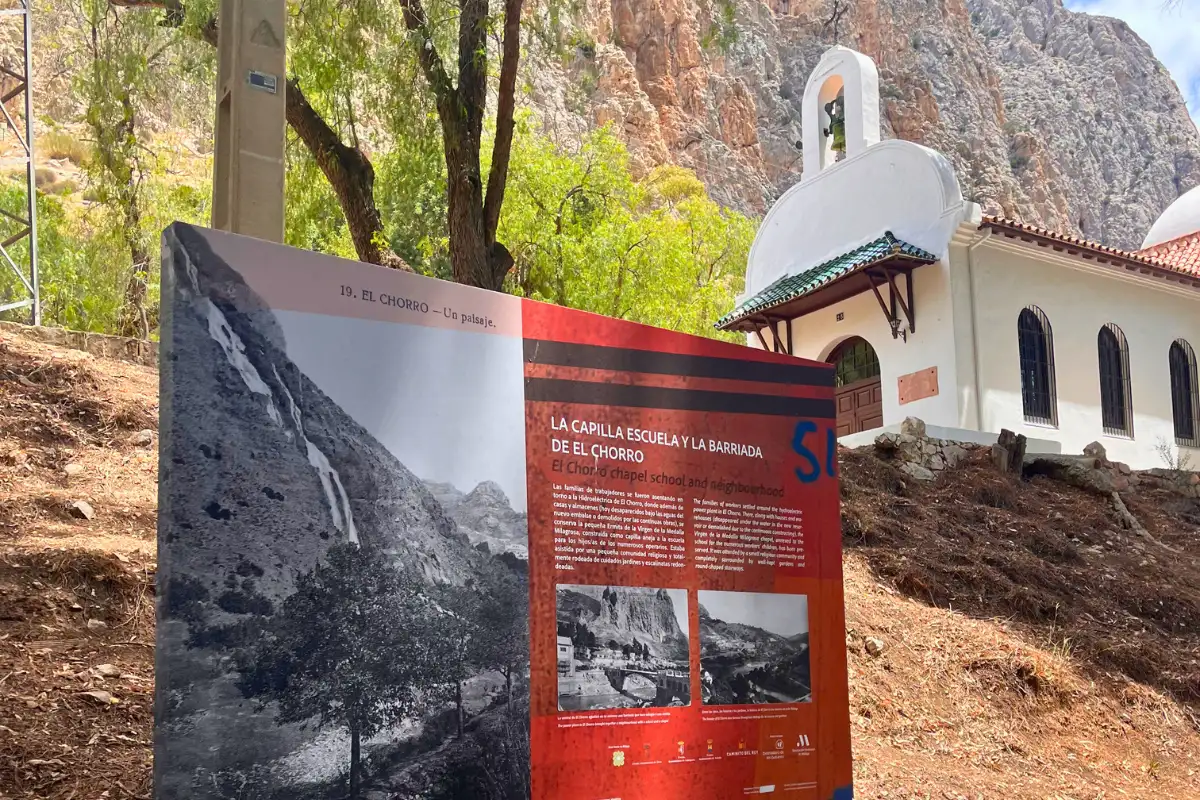
Caminito del Rey translates to “The King’s Little Pathway”, named after King Alfonso XIII, who walked it in 1921 to inaugurate the nearby dam and reservoir.
But the path itself dates back to 1905, built to transport workers and materials between two hydroelectric plants deep in the gorge.
For decades, it served its industrial purpose without fanfare.
Then, as the plants became obsolete, so did the path.
Maintenance stopped. Concrete crumbled.
Railings disappeared. Holes opened up in the walkway.
By the 1990s and early 2000s, the Caminito had become infamous among thrill-seekers and urban explorers. Despite official closures, climbers and adrenaline junkies would scale fences to traverse what remained, sometimes with fatal consequences.
Several deaths led to complete closure and years of debate about what to do with this engineering relic.
The answer came in 2015: a €5.5 million restoration project rebuilt the entire route using modern materials while preserving its historic character.
New wooden boardwalks, steel supports, glass viewing platforms, and safety railings transformed the death trap into a world-class attraction without losing the vertigo-inducing drama.
Today, over 300,000 people walk the Caminito del Rey each year.
It’s one of Andalusia’s most popular attractions and, honestly, one of the most memorable things you can do in Spain.
By Train

RENFE’s C-2 commuter line runs from Málaga María Zambrano to El Chorro-Caminito del Rey station, a scenic 45-minute journey through the Guadalhorce valley (around €6 each way).
The catch: El Chorro station is near the south (exit) end of the trail.
You’ll need to take the shuttle bus from El Chorro to the north entrance to start your walk. After finishing, you can walk back to El Chorro station (about 2.7km) for the train home.
Train schedule: Limited service, typically 2-3 trains per day in each direction. Check RENFE schedules and plan carefully, especially for return journeys.
By Organised Tour
The easiest option if you don’t want to worry about parking, shuttles, and timing. Tours from Málaga typically include:
- Hotel pickup and drop-off
- Entry ticket (often with priority access)
- All transport and shuttle logistics
- English-speaking guide (on guided options)
Tours range from €35-60 depending on whether they include a guided walk or just transport. Worth considering if you’re travelling solo or prefer hassle-free logistics.
What to Expect on the Trail
The full experience is 7.7 kilometres, but this breaks down into three distinct sections:
The Access Path (North Entrance to Boardwalks): ~2.7km
Your walk begins well before the dramatic cliffside sections. From the car park or bus drop-off, you’ll walk through a mix of:
- A long illuminated tunnel (from the Visitors Centre parking)
- Dirt paths through scrubland
- Views of the reservoir and dam
This section takes 30-45 minutes and serves as a warm-up. The scenery is pleasant but unremarkable, so save your camera battery for what’s coming.
The Boardwalks and Gorge: ~2.9km
This is why you came.
The wooden boardwalks begin once you reach the gorge entrance. From here, you’re walking paths barely a metre wide, bolted to vertical cliffs that drop 100+ metres to the turquoise Guadalhorce River below.
Key features you’ll encounter:
- The Valley of the Hoyo: The first section winds through the narrow Valle del Hoyo, with the old ruined path visible above.
- Glass viewing platform: A section with transparent flooring lets you look straight down to the river. Not for the faint-hearted.
- The Gaitanes Gorge: The narrowest point of the gorge, with walls just 10 metres apart, rising 400 metres above you. The scale is breathtaking.
- The suspension bridge: The grand finale. A 35-metre bridge spans the gorge at its widest point, swaying gently as you cross. It’s completely safe, but your brain will have opinions.
Can People with a Fear of Heights Do It?
Yes, I did.
The handrails are solid, the boardwalks feel secure, and there’s no actual danger.
But here’s the honest truth: if you have genuine vertigo or severe acrophobia, this will test you. The glass floor section and suspension bridge are the most intense moments.
Our friend Carolina has a moderate fear of heights.
She made it through, but there were moments of genuine distress on the suspension bridge. She’s glad she did it, but she also hasn’t stopped talking about how terrifying certain sections felt.
Tips for nervous walkers:
- Stay on the inside (cliff side) of the walkway where possible
- Don’t look down through the glass section if it bothers you
- Focus on the horizon rather than the drop
- Take your time (there’s no rush)
- Consider bringing someone supportive to walk with
Fitness Requirements
You need to be able to walk 7-8 kilometres over 3-4 hours with some gentle inclines.
If you can manage a moderate day hike, you’ll be fine. The pace is entirely up to you, and most people stop frequently for photos and to absorb the views.
Not recommended for: Anyone with serious mobility issues, heart or lung conditions that affect exercise capacity, or those unable to walk moderate distances on uneven terrain.
Best Time to Visit
By Season
| Season | Conditions | Crowds | Verdict |
|---|---|---|---|
| Spring (Mar-May) | Ideal temps (15-25°C), green landscape | High (book early) | Best overall |
| Summer (Jun-Aug) | Hot (30°C+), intense sun | Moderate (locals on holiday) | Book early slots |
| Autumn (Sep-Nov) | Pleasant temps, golden light | High Sep, low Nov | Excellent choice |
| Winter (Dec-Feb) | Cool but mild, possible rain | Low | Great for solitude |
Best months: April, May, September, and October offer comfortable temperatures and stunning scenery.
Avoid if possible: Midday in July-August unless you enjoy hiking in 35°C heat with no shade.
By Day of Week
- Weekdays (Tue-Thu): Fewest visitors, most peaceful experience.Easier to find tickets.
- Fridays: Busier than other weekdays but manageable.
- Weekends: Crowded. Spanish families, tour groups, day-trippers. Still enjoyable, but you’ll share the boardwalks with many others.
- Mondays: The trail is closed every Monday (plus Jan 1, Dec 24-25, Dec 31).
What NOT to Bring
- Large backpacks: Nothing over 5kg is permitted
- Tripods and selfie sticks: Not allowed on the boardwalks
- Drones: Strictly prohibited
- Pets: Not permitted for safety reasons
- Walking poles/canes: Not allowed (stability aids need advance permission)
- Umbrellas: Not practical and can be dangerous in wind
Rules and Restrictions
The Caminito has strict rules, and they’ll turn you away if you don’t comply:
Entry requirements:
- You must arrive at least 30 minutes before your slot
- Tickets are checked at multiple points, so have them accessible
- Official ID is required for children (to prove they’re 8+)
- Children under 18 must be accompanied by an adult
During the walk:
- Helmets are mandatory (provided free at the entrance)
- Stay on the marked path at all times
- No running, jumping, or climbing on railings
- No littering (there are no bins on the trail)
- No smoking on the boardwalks
- Follow staff instructions
What happens if it rains? The trail stays open in light rain.
In heavy rain or dangerous weather (high winds, storms), it closes for safety. If your slot is cancelled due to weather, you can reschedule through your account on the official website.
Opening Hours
| Season | Opening Hours | Last Entry |
|---|---|---|
| Summer (Jun-Sep) | 9:00am to 5:20pm | 5:00pm |
| Winter (Oct-May) | 9:00am to 2:50pm | 2:30pm |
Closed: Every Monday, January 1, December 24-25, December 31.
After the Walk: Where to Eat
After 3-4 hours of walking, you’ll be ready for food. The area around El Chorro has several options:
El Kiosko Restaurant (near north entrance): The most convenient option if you parked at P1. Simple Spanish fare: bocadillos, tapas, cold drinks.
Restaurante El Mirador (El Chorro village): Better food, terrace with gorge views. Worth the short walk if you have time.
Bar Estación (near El Chorro station): Basic but convenient if catching the train.
Or do what we did: drive to the nearby town of Ardales or Álora for a proper lunch. Both have charming plazas with local restaurants serving authentic Andalusian cooking at non-tourist prices.
Is the Caminito del Rey Worth It?
Absolutely. Without hesitation.
This isn’t a gentle nature walk.
It’s an experience that stays with you. The combination of dramatic scenery, engineering marvel, and that primal edge-of-your-seat sensation makes it one of Spain’s most memorable attractions.
Yes, it’s touristy.
Yes, you’ll share the path with others. But when you’re standing on a wooden board 100 metres above a turquoise river, watching vultures circle below you and limestone walls rise impossibly high on either side, none of that matters.
Just book early. Really, really early.
The Caminito del Rey is one of the best day trips from Málaga, and it’s easy to combine with a stop in Ardales or Álora on the way back.
Read more: Our slightly traumatic but totally iconic Caminito story (including what happened to Carolina on the suspension bridge).
Are There Toilets on the Caminito del Rey?
No. There are no facilities on the boardwalks or access paths.
Use the toilets at the visitors centre, restaurants, or car parks before starting. The walk takes 3-4 hours with no opportunity for a break.
Is the Caminito del Rey Wheelchair Accessible?
No. The trail includes uneven terrain, stairs, and narrow boardwalks that aren’t wheelchair accessible. Walking poles and canes are also prohibited for safety reasons, though you can request advance permission for stability aids.