I’ll be honest, when I first wrote this guide not a single one of these had happened to me. I’d only just arrived in Spain, and everything on the list was something I’d heard about from other people.
Then two did. In Granada a woman pressed a sprig into my hand and then wouldn’t leave me alone, asking for money in a raised voice, and I kept telling her I didn’t have any. In the end I dropped it, and off she went.
The other one is why I’m updating this at all. A man told me to park in an empty space, then asked me for money once I had, and because I pay for everything with my phone I didn’t have a coin on me. When I came back, my car had been keyed. It’s new, it’s going around, and it’s the first entry below.
I live in Málaga, which has fewer of these problems than the big tourist cities, and Barcelona is the worst for it. Those two are the only times it’s happened to me. Everything else here is what I’ve heard, from other people and from what the police publish.
Spain is among the safest countries in Europe for visitors. The real risk is petty theft where the tourist crowds are thickest: Las Ramblas in Barcelona, Puerta del Sol in Madrid. They repeat a small number of patterns, so they’re easy to recognise once you know them.
Here are sixteen tourist scams in Spain, where each one happens, and what to do.
Before you land: 112 is the free emergency line, works in any language across the whole EU, and 902 102 112 is the police line for tourists reporting a crime, answered in English from 9am to 9pm.
Is Spain safe for tourists?
Yes, and comfortably so: violent crime against visitors is extremely rare, and the vast majority of people come and go without a single problem. What you’re actually guarding against is petty theft, and mostly one kind of it, pickpocketing in the crowded tourist areas. Las Ramblas and Puerta del Sol come up again and again for a reason.
The Spaniards you’ll deal with day to day are friendly and helpful people. Pickpockets are a tiny minority working inside a very large crowd, and most visitors never meet one.
Scams are only one slice of staying safe here, though. For health, driving and natural hazards, there’s my wider guide to staying safe in Spain.
⭐ Don’t miss >> Where to stay in Málaga, my picks by neighbourhood
The two tricks behind almost every scam
Strip the costumes off and you’re left with two moves: distraction and pressure. Everything else on this list is one of those wearing a different hat.
Distraction first. A “helpful” stranger, an argument that breaks out next to you, something on your shirt, an item dropped at your feet. Your attention goes to the thing in front of you, and an accomplice goes for your pocket while it’s there.
Pressure is quieter and, I’d say, nastier. You’re put in an awkward social situation where paying feels easier than refusing.
A “gift” you didn’t ask for is already in your hand. A service you never requested has already been done. A scene is building and people are looking. Nobody forces you, and that’s the point.
Once you can name those two, you’ll spot a scam before it starts.
One more thing in your favour: scammers avoid locals, because locals know the tricks. The more you look like you know where you’re going, the less likely you are to be picked. Walk with purpose, don’t stop for strangers, keep moving.
The 16 scams, one at a time
1. The gorrilla, or parking “helper”
I got scammed. That’s the honest reason this guide has a new number one, and it happened in the most ordinary way possible: I was driving around looking for parking.
A homeless man told me to park in the empty spot. He doesn’t work for the council and he doesn’t own the car park, he just picks a space for you. And once you’ve parked, he asks for money. I never have cash on me, I pay for everything with my phone, so there was nothing to hand over. When I came back, my car was keyed.
These unofficial attendants are called gorrillas in Spanish, and they’ve been part of street life here since the 1990s. Showing a driver a space isn’t a crime. Intimidation, extortion and damaging a car are, and I’m not the only one: in Vigo a gorrilla was reported to the police for scratching the car of a driver who wouldn’t pay. I’ve heard it’s happening to a lot of people.
If you can help it, don’t park there. If you can’t, keep a few coins in the car for exactly this.
2. Pickpockets & phone snatchers
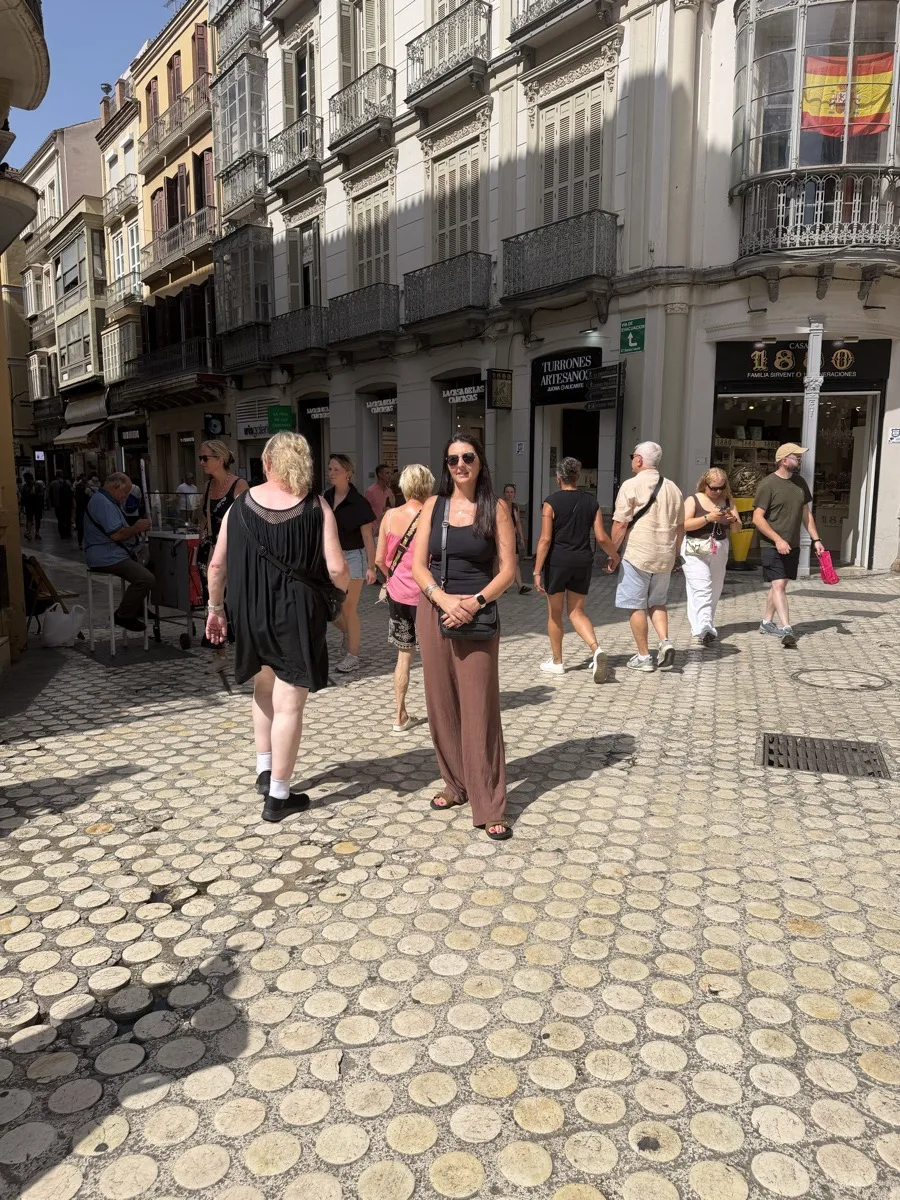
Somebody bumps you on the metro, or in the Sagrada Familia queue, and that bump is the whole trick. By far the most common thing that happens to visitors here, and not clever, just effective.
They work crowds in teams, one distracting while another goes for bags, visible phones and wallets in back pockets. Phone snatching is on the rise, phones pulled out of hands mid-photo or mid-map. Las Ramblas and La Boqueria market in Barcelona, Park Güell, Puerta del Sol in Madrid, metro stations, buses, anywhere a crowd gathers.
What helps:
- A cross-body bag with the zips facing your body
- Nothing valuable in a back pocket
- On public transport, bag in front and valuables in the front pockets of your clothes (the Spanish National Police’s own advice to tourists)
The second someone bumps or distracts you, check your things.
3. The stain on your shirt
Someone taps your arm and points at your shoulder, and there it is, a blob of what looks like bird droppings (it isn’t). Or mustard. Or something nobody can name. You look down, you start dabbing, and while your attention’s on the mess an accomplice is in your pocket.
There’s a second version where a stranger “accidentally” spills something on you instead, then apologises profusely and insists on helping you clean up. Their hands are busy on your jacket, and so are someone else’s on your bag.
The fix feels rude, which is sort of the point. Say thank you, don’t let anyone touch you, and walk to a bathroom or somewhere private to deal with it. Never let a stranger help clean your clothes. Whatever’s on your shirt will wait.
4. Rosemary & the friendship bracelet
I had the rosemary scam in Granada. A woman pushed the sprig into my hand and then wouldn’t leave me alone, asking for money in a very raised voice while I kept saying I didn’t have any. I dropped the lavender and she walked away. That was it.
That’s the whole routine. Someone friendly near a tourist site ties a bracelet round your wrist or presses a bit of rosemary into your palm, insisting it’s a gift. Once it’s on you they want paying, and if you refuse they make a scene and let the embarrassment do the rest.
You’ll meet it near the Alhambra, at the Sagrada Familia, in the big plazas and outside cathedrals, Seville’s especially. Around Málaga cathedral it’s lavender, and the sellers there are well known.
Hands in your pockets as you walk past. Don’t stop, don’t make eye contact, a firm “No, gracias.” If they touch you, step back immediately. And if it’s already in your hand, do what I did. Drop it.
5. The clipboard petition
The clipboard comes out somewhere in the tourist areas of Barcelona, Madrid or Seville, and the person holding it (often a young woman) wants one signature for deaf children, or homeless shelters, or cancer research. It takes no time at all.
Then comes the demand for a donation, and while you were reading the form an accomplice was often at your pockets. The petition is the distraction. It was never the point.
I wouldn’t stop for petition people at all. A firm no, keep walking, don’t take the pen. Real charities don’t collect signatures from tourists on the street, so the more worthy the cause sounds, the surer you can be it’s a set-up.
6. The plainclothes “police officer”
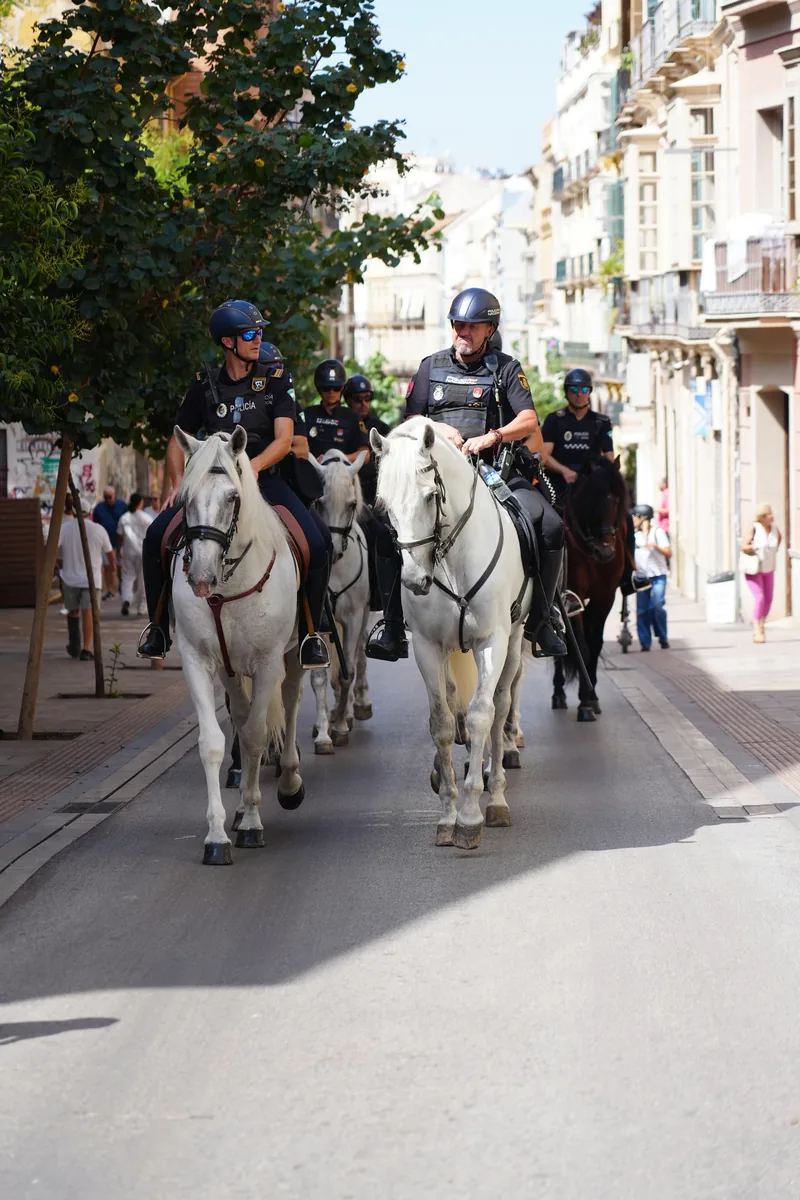
It starts with a chat. A friendly stranger gets talking to you, and then a second person arrives claiming to be a plainclothes police officer. ID, please. Then your wallet, “to check for counterfeit notes”.
Both of you hand them over, because your new friend does it without blinking. Your new friend is the accomplice. Once your cash is in the officer’s hands, some of it, or all of it, doesn’t come back.
Real police never check tourists’ wallets in the street. Not once, not for any reason.
Ask for identification and a badge number, and insist on going to the nearest police station before anything leaves your hands. A fake officer won’t take you up on that. They’ll just leave.
7. The taxi with the “broken” meter
This one annoys me most, because it gets you before the holiday’s even begun.
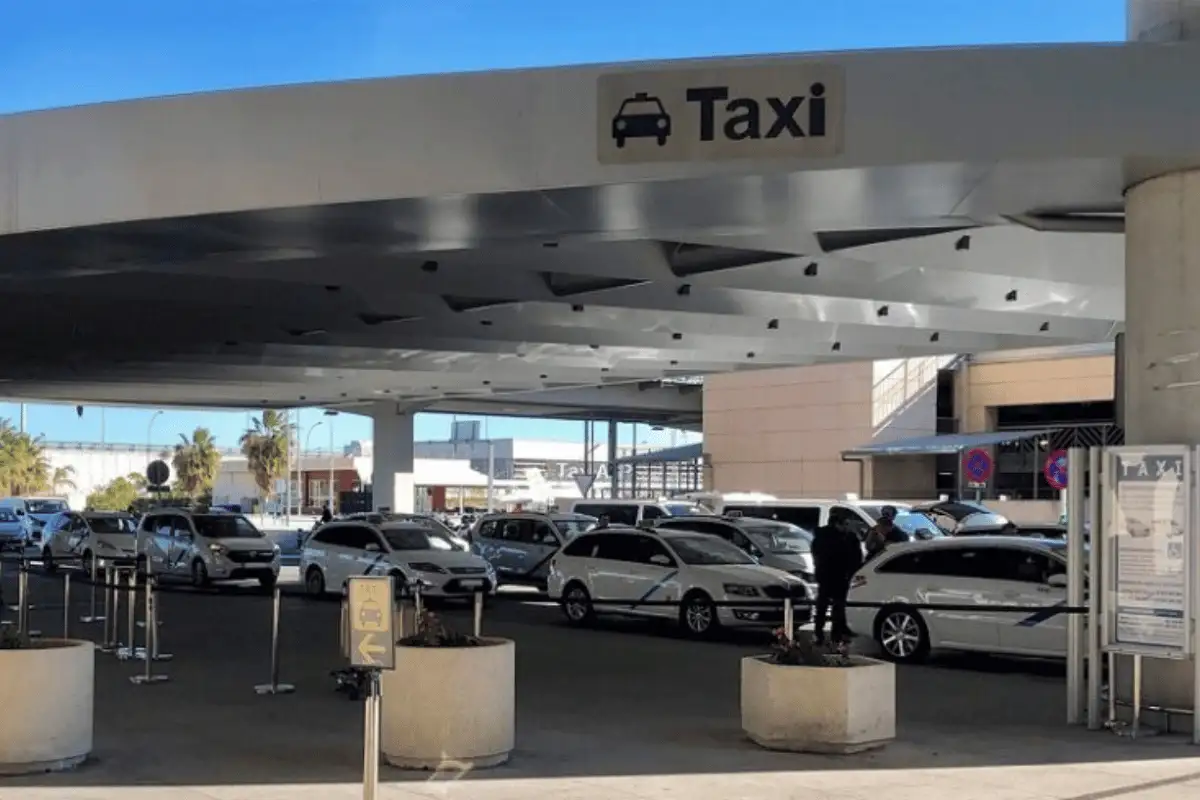
The meter’s broken, says the driver, or he never switches it on, and the fare at the end is a flat rate of his choosing, sometimes via the long way round, especially from the airport. Train stations and the tourist areas get it too.
Official taxis only (white with a coloured stripe in most cities, black with yellow doors in Barcelona), and the car doesn’t move until the meter’s on. The FreeNow and Cabify apps show the price before you get in. And know roughly what the ride should cost, because that’s the whole game.
On 2026 tariffs, Madrid airport to anywhere inside the M-30 ring road is a flat €33, any terminal, day or night, nothing extra for luggage or passengers. Barcelona airport has a €21 minimum fare and a €4.60 airport supplement, and the centre usually comes to €30 to €45 on the meter. From Málaga airport, the one closest to home for me, the centre is usually €20 to €25, and the minimum fare from the airport is €18.24 by day, €22.48 standard and €25.80 at night and on public holidays.
Far above that? That’s the scam.
If you’re coming into Málaga, a few places to stay from my own picks:
⭐ Old town >> Palacio Solecio
⭐ Soho >> Room Mate Valeria
⭐ La Malagueta >> Gran Hotel Miramar
8. The cup game
Someone always wins. That’s the part to hold onto, because it’s the only reason anyone stops. A street operator with three cups and a ball (or three cards and a bet on which one’s the queen) takes your money on where it’s hidden, a crowd forms, and a lucky punter walks off with a wad of cash.
The punter’s an accomplice. So is most of the crowd. The game is rigged, you’ll lose, and on the off chance you don’t, you won’t be allowed to collect. It can turn threatening, too, which is not how anyone wants an afternoon on Las Ramblas to go.
I haven’t seen it myself, but it’s reported over and over from Las Ramblas, Puerta del Sol and the busier pedestrian streets. My rule would be simple: don’t stop, don’t watch, walk past.
If you’ve already stopped and you’re feeling pressured, go into the nearest shop and ask the staff for help. There’s no version of this where you win.
9. The padded restaurant bill
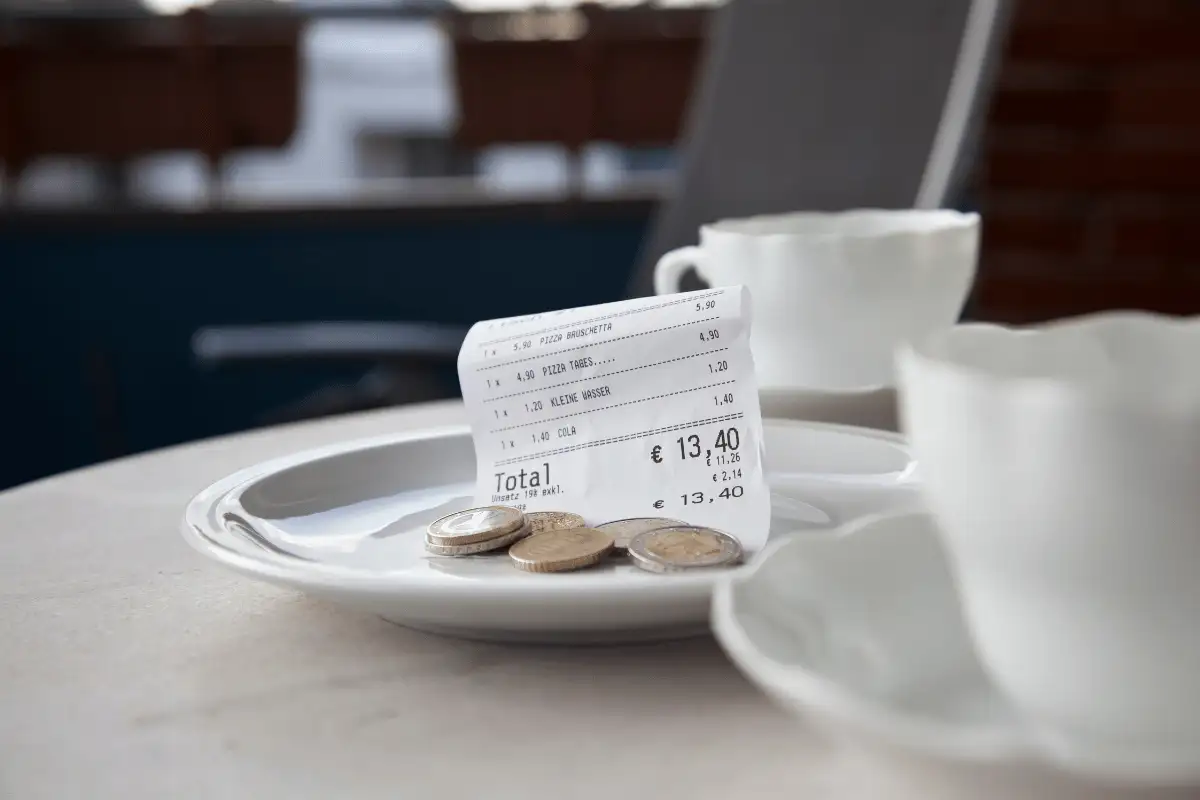
Sit down on a terrace in a tourist area and the bill that comes back may have been dressed up a little on its way to you. The usual additions:
- bread you didn’t order
- a cover charge nobody mentioned
- prices higher than the ones on the menu
- “mistakes” in the adding up that never fall your way
Then the variations. The menu outside shows one price and the menu inside (or the bill) shows another. Some places charge more on the terrace than inside. And the worst version is a menu with no prices at all, or just “market price” next to the seafood, and then a bill that’s astronomical.
I’d check the prices before I sat down, ask about cover charges and service up front, and read the bill before paying.
If a restaurant won’t show you prices, leave. It’s a massive red flag. Spanish law requires menus to display prices clearly, so a place that hides them has already told you what kind of place it is.
READY TO BOOK YOUR TRIP TO SPAIN?
🚗 Rent a car: I use Discover Cars
🏨 Accommodation: Find hotels in Málaga
🚆 Trains and buses: I book through Omio
🛡️ Travel insurance: I use SafetyWing
10. Cash machines: the helper & the skimmer
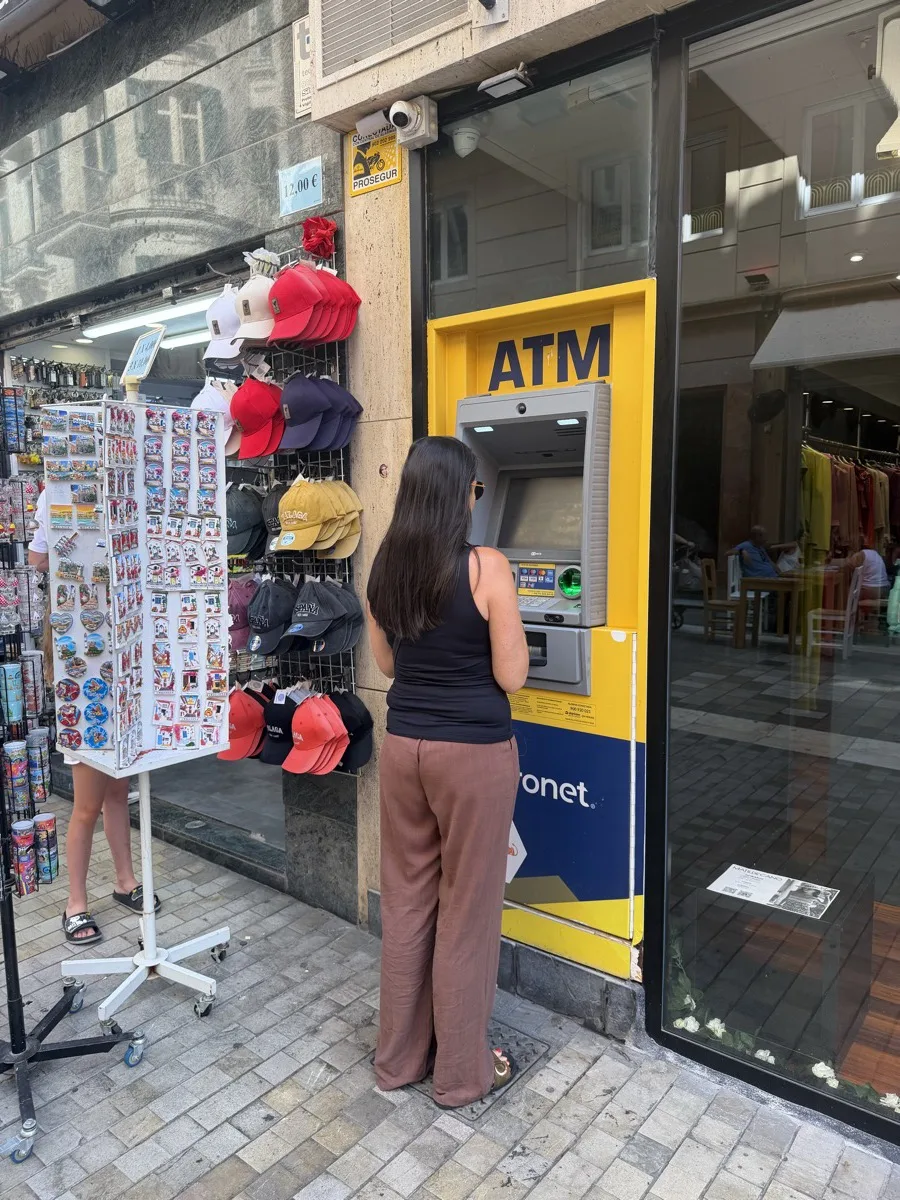
The statement arrives and there’s a withdrawal you never made. It got there one of two ways, and they look nothing alike.
The first is a person: you were wrestling with a Spanish-language screen at a busy machine in a tourist area, a stranger offered to help, and while “helping” they memorised your PIN or swapped your card for a fake. The second is a device fitted to the card slot that copied your card, with a hidden camera or a false keypad catching the PIN. No conversation needed.
Never accept help at a cash machine, and cover the keypad. Give the card slot a wiggle before you put your card in, because skimmers are often loose. Check the card you get back is yours, and check your statements.
The safest machines are inside bank branches during business hours, since they’re checked regularly. Avoid the standalone ones from operators like Euronet, which also charge high fees. And the Spanish police’s own tip: make sure nobody’s watching you at a cash point, because the distraction is how they take the money.
Do you need much cash at all? Not really. Cards are accepted almost everywhere in Spain, contactless included, and you won’t struggle in restaurants, shops or attractions. Keep some for small purchases, market stalls and the smaller bars in rural areas.
Take out only what you need for the day, keep it in a front pocket or a money belt rather than a wallet in your back pocket, and never flash a thick wallet when you pay. Thin wallet, easy holiday.
11. Your bag on the beach
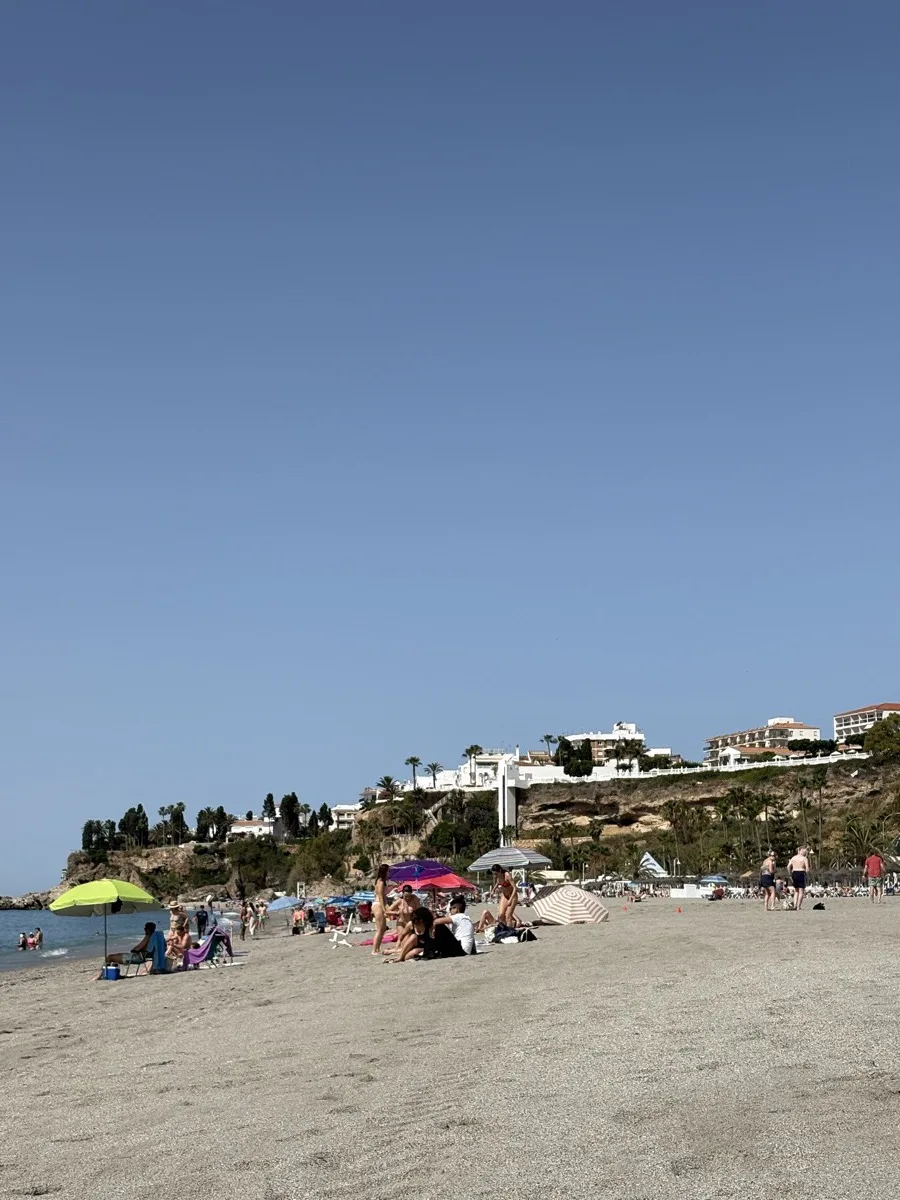
Leave the expensive things at the hotel. That’s the whole tip, really, and everything else is detail.
The bag-on-the-sand theft works because you’re in the water and can’t do anything about it: thieves watch for an unattended bag, they’re quick, and you come up from a wave to find your phone and wallet gone. It happens on every popular beach in Spain. Barceloneta in Barcelona is notorious for it.
So if you’re in a group, take turns swimming rather than all going in together. Get a waterproof pouch for your phone and cards and take them into the sea with you. And never leave valuables unattended on a towel, not even while you’re standing at the water’s edge.
The sea will still be there once someone’s minding the bag.
🛡️ Nearly everything on this list that costs you money is the kind of loss travel insurance pays back, as long as you have the denuncia to go with the claim. I use SafetyWing, which you can buy even after you’ve left home.
12. Hair braiding on the beach (the “hair touching” scam)
Visitors searching for this one call it “hair touching”, and I haven’t seen it myself, so I’m going on what they’ve reported on Tripadvisor. Women work Barceloneta beach in Barcelona offering to braid tourists’ hair for around €20, and the braids get done.
The trouble comes after, on the way off the beach, when a group of women (one account says about twelve) surrounds the visitor and demands the bag, phone, cash and bank cards included, with threats of violence for anyone who refuses. There’s a milder version, where the braider pockets the money and disappears with the job half finished, because she’s unlicensed and gone the moment police appear.
The hands in your hair are the distraction, and someone touching you uninvited is the moment to check your bag.
Say no before anyone touches you. If you want braids, a salon will do them. And keep the bag zipped and between you and whoever’s talking.
13. “Shall I take your photo?” & the mimes
The offer arrives with a smile, at a tourist site, from someone who’s noticed you and your travel companions with a camera out. Of course they’ll take the photo. And then, phone or camera in hand, they either want money for the favour or they’re already running with it.
The costumed version works the same way on the big plazas, and the cast is familiar: mimes, gladiators, cartoon characters, posing for a photo and then demanding payment, aggressively. The white-painted mimes on Plaça de Catalunya in Barcelona are the known ones.
Selfies are the fix. If you need someone else to hold the phone, pick another obvious tourist. And with anyone in costume, agree a price before the photo or don’t take one.
14. The sob story
Someone stops you, and the story is desperate and told well: medicine they can’t afford, a bus ticket home, food for their children, sometimes with documents to show you or an injured limb, and the documents and the injury can both be fake. The awkward part is that you can’t tell from the pavement, and I don’t think you should have to.
If you want to help, offer to buy the food yourself, or go with them and pay for whatever it is they say they need. A scammer refuses, because they never wanted the medicine. And if what you really want is to support people in need, an established charity online will put your money to work better than a stranger on a corner.
15. The restaurant voucher
Somebody friendly stops you with a voucher, a discount at a nearby restaurant, and it feels like a small piece of local luck. It isn’t. When you try to use it, the restaurant says it’s invalid or expired, and by then you’ve ordered and eaten and the full bill is yours.
Don’t take vouchers from strangers on the street, however friendly. Find your restaurants through reviews, through a recommendation you trust, or the old way, by walking past and reading the menu yourself. The good places don’t need to send someone out to find you.
16. The fake QR code on the parking meter
A sticker. That’s all it takes: a fake QR code stuck over the real one on a parking meter, which is what Spain’s National Police warned about in February 2025 and again in April, and it’s been seen in different parts of the country. Scan it and you’re on a convincing fake payment page, typing in your card details and personal data.
Down here in the south of Spain a lot of visitors drive a hire car, and pay for parking at exactly these machines.
The police say to look at the code before you scan it, and if it’s misaligned, looks tampered with, or is obviously a sticker on top of another surface, leave it. Check the web address before you type anything, and close it if the address looks wrong or has spelling mistakes. Pay through the council’s official parking app, downloaded from Google Play or the App Store, or at the machine itself.
A sticker can’t fake the machine.
Where it happens, city by city
Look at your own itinerary and you’ve already got the list. Las Ramblas, Puerta del Sol, the cathedral in Seville, the Alhambra: the places everyone goes are where the reports pile up, because that’s where the crowds are.
I’m not telling you to skip any of them. I’m telling you to be a bit more alert for the hour you’re standing there.
Barcelona
Walk Las Ramblas end to end and you’ll pass the full catalogue: pickpockets, cup games, clipboard petitions. La Boqueria market, just off it, is pickpocket territory. The queues around the Sagrada Familia bring bracelets and pickpockets, Park Güell brings pickpockets and the photo offer, and the metro gets its share.
On Barceloneta beach it’s unattended bags and the hair braiders. On Plaça de Catalunya it’s the costumed mimes. Of the four cities, this is the worst, and by a distance.
Madrid
Stand in Puerta del Sol for a minute and you’re in the middle of it: pickpockets and cup games. The metro is pickpockets. The airport and the train stations are taxi tricks and bag theft.
Other guides also report pickpockets along Gran Vía and clipboard collectors around Retiro Park and the Royal Palace. I can’t vouch for those, but they come up often enough to pass on.
Seville & Granada
You’ll be handed things. Around Seville cathedral it’s the rosemary women and the petitions. At the Alhambra in Granada it’s a bracelet or a sprig of rosemary, offered as a gift.
It isn’t a gift. Say no thanks and don’t put your hand out.
Málaga & the Costa del Sol
This is home, so I’ll be honest with you: we don’t have as many issues down here, and it’s not as bad as Barcelona. The one everybody knows is the lavender sellers around the cathedral, running the same gift-then-pay routine as the rosemary in entry 4.
You hear of the odd pickpocketing on the trains and so on, but not walking around Málaga. The same tricks exist here at lower volume, on the beaches and in the old-town crowds, though I haven’t seen them myself.
Make of this what you will: of Spain’s thirteen police desks for foreign tourists (the SATE offices), four are on the Costa del Sol, in Málaga, Marbella, Estepona and Benalmádena. That’s more than anywhere else in the country.
Málaga’s is inside the main tourist office on Plaza de la Marina, open 9am to 8pm from April to October and 9am to 6pm the rest of the year.
At the airport taxi rank the minimum fare is €18.24 by day, up to €25.80 at night and on holidays, and the centre usually comes to around €20 to €25. Know that number before you get in.
Habits that stop nearly all of it
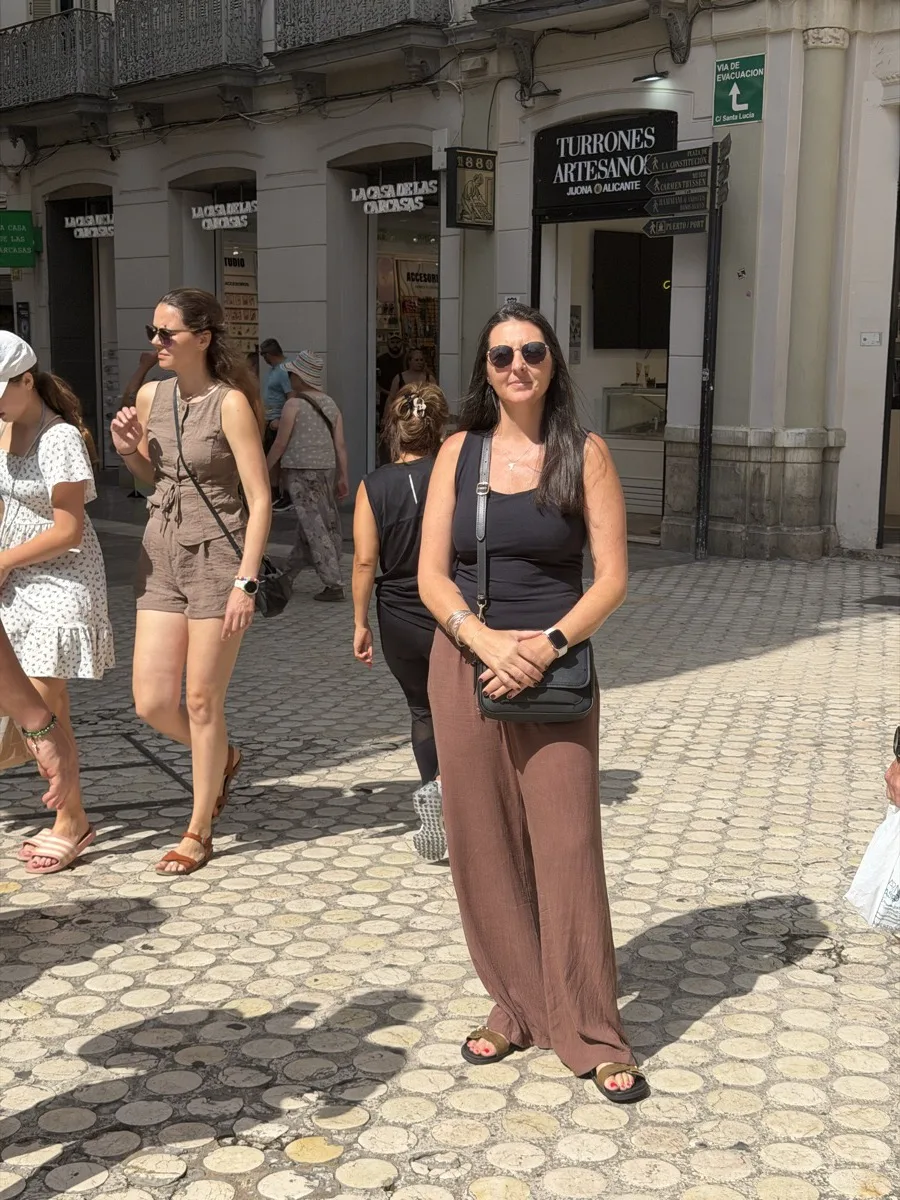
Most of what’s above comes down to hands, pockets and a bit of setting up before you leave home. Nothing on this list is clever. That’s why it works.
- A cross-body bag with the zips facing your body.
- Phone in a zipped front pocket, not in your hand while you walk.
- Wallet anywhere except the back pocket.
- Only the cash you’ll need that day; cards work almost everywhere.
- Passport in the hotel safe; a photocopy or a photo goes out with you.
- Photos of your passport and cards saved to the cloud.
- Transaction alerts switched on, so you know the moment a card is used.
- 112 and 091 saved in your phone, and 902 102 112, the police line for tourists.
- FreeNow and Cabify installed, and offline maps downloaded, before you fly.
- Metro stations and queues get your full attention.
- Strangers with gifts, petitions or help you didn’t ask for get a no thanks.
- Travel insurance that covers theft (I use SafetyWing).
The Spanish National Police put out their own leaflet for tourists, and three things in it are worth adding. Don’t post your holiday plans on social media. Keep an eye on your luggage even while you’re checking in at the hotel.
And their free AlertCops app lets you alert the police with your location, whether you’re the victim or a witness. Put it on your phone tonight.
If it happens to you

The first call is to your bank, not the police. Block the cards before you’ve moved.
Whoever took them has a friend you didn’t notice, and you’re not going after either of them. It isn’t worth it.
Then it’s phones and paperwork, in that order.
- 112The emergency number. Free, multilingual, works across Spain and the whole EU
- 091National Police: reporting a crime, a theft, a lost passport, or just information
- 092Local police: minor incidents, traffic, lost property
- 061Ambulance and urgent medical care
- 902 102 112National Police line for tourists reporting a crime. English and French 9am to 9pm, Italian and German 9am to 3pm
The paperwork is one document, the denuncia, the first thing your insurer asks for. Any police station can do it.
For theft or robbery of belongings, documents or a vehicle where nobody was violent, you can start it online at policia.es, then sign it at a station within 72 hours or it isn’t valid. Violence or intimidation, and it has to be in person.
If you’d rather skip the language barrier, the National Police run thirteen SATE offices for foreign tourists, with interpreters who’ll help you file the report, cancel cards, contact your embassy and track down family.
They’re in Madrid, Málaga, Marbella, Estepona, Benalmádena, Benidorm, Gandía, Manacor, Playa de Palma, Ibiza, Mahón, Seville and Granada. Málaga’s is inside the main tourist office at Plaza de la Marina 11 (9am to 8pm April to October, 9am to 6pm the rest of the year, closed 1 January and 25 December). Madrid’s is at the Comisaría de Centro, Calle Leganitos 19, every day 8:30am to 10pm.
Barcelona’s missing from that list because Catalonia has its own force, the Mossos d’Esquadra. Their tourist desk is at La Rambla 43, 10:30am to 7:30pm, and the main old-town station for a report is Carrer Nou de la Rambla 76-80, open 24 hours. Check both before you travel, either may have moved.
Lost the passport too? Your embassy or consulate issues emergency travel documents. Then the insurance claim goes in, denuncia attached.
The report is the bit people skip, and it’s the only bit the insurer cares about.