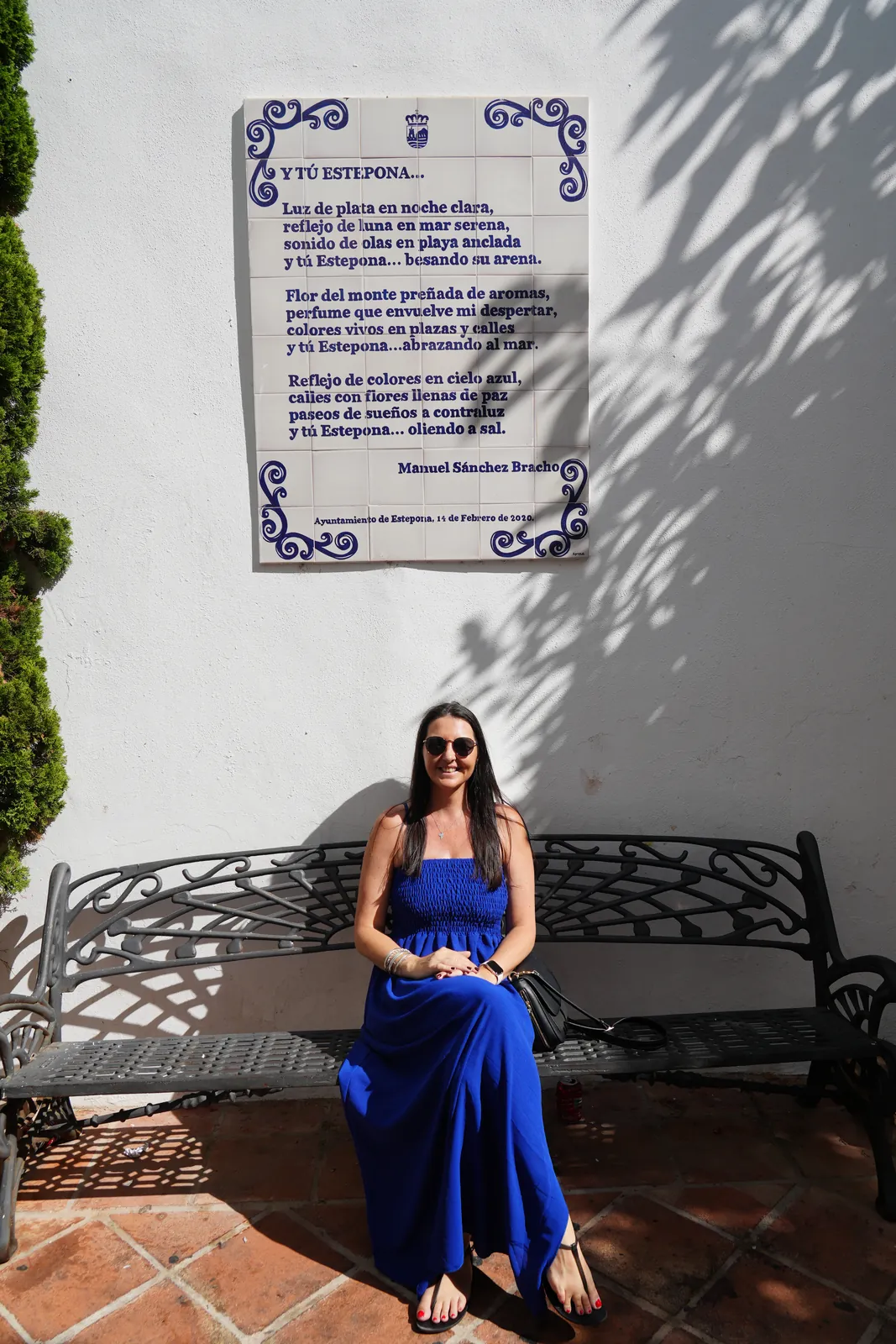
We set out one morning to find every poem on Estepona’s Poetry Route, the Ruta de la Poesía, all forty-plus ceramic plaques built into the walls and pavements of the old town. We got through the packed cluster in the historic centre, then hunger won and we stopped for lunch instead of finishing the rest.
Missing plaques didn’t ruin it. Walking that one cluster in the old town, poem after poem set into the same few streets, was worth the morning on its own, finished or not.
⭐ Don’t miss >> Where to stay near Estepona, my Marbella area picks
Poems hiding in plain sight across Estepona’s old town
Walk far enough through the old town and you’ll start noticing them, small ceramic plaques set into walls and set flush into the pavement, each one carrying a poem. Some are in Spanish, some in English, some in French, and a few in other languages again. There’s no ticket, no gate, no opening hours, you just wander and they turn up.
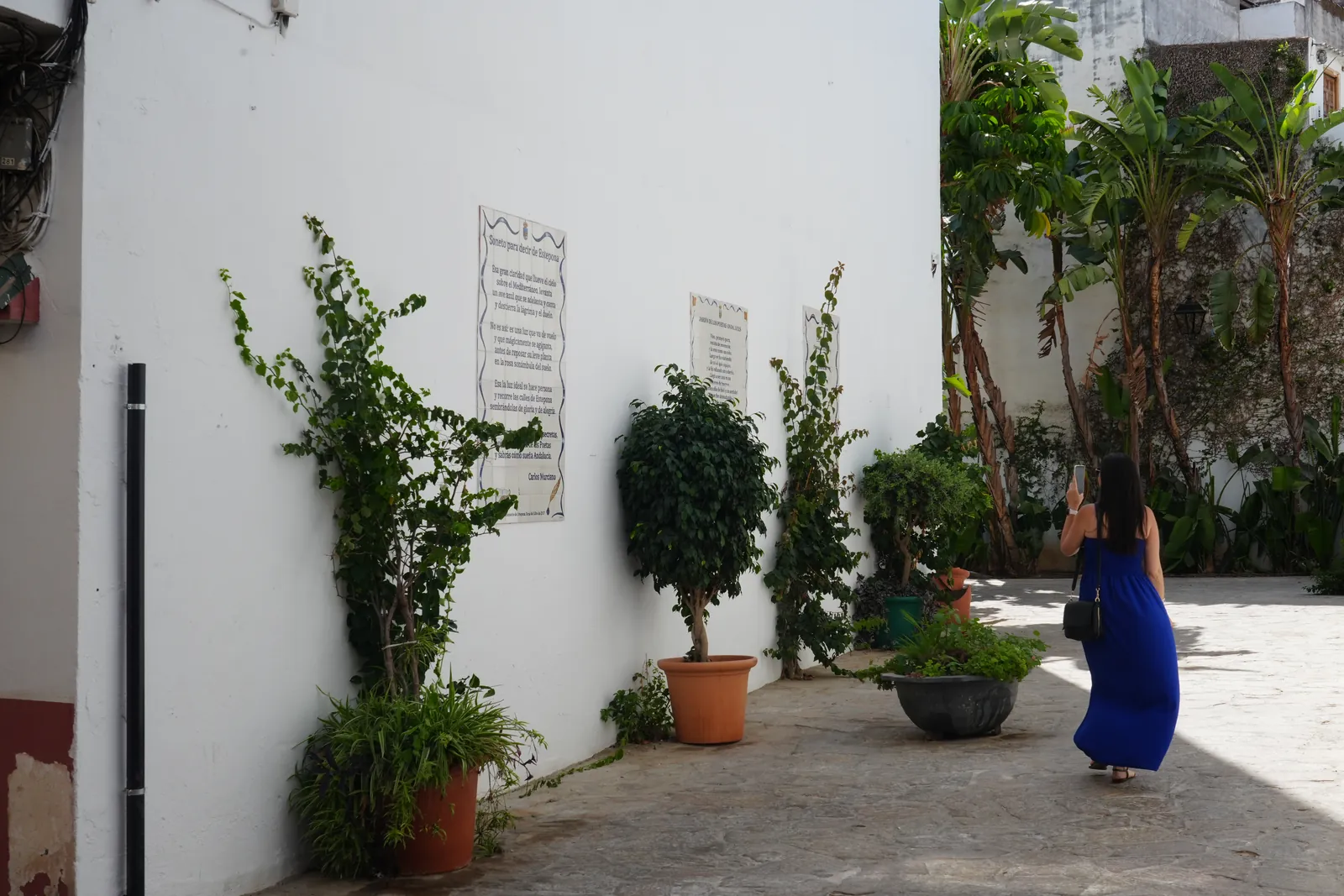
The tourist office on Plaza de las Flores hands out a little printed leaflet mapping all the numbered stops, and there’s no fixed order you’re meant to walk it in, you’re free to start anywhere and let it pull you around.
Where the leaflet falls short
What it doesn’t tell you is that the plaques aren’t spread evenly across town. A couple sit down near the seafront by the Ermita del Carmen, a handful more are tucked out east near Plaza de Paco de Lucía, and the rest, most of them, are packed into the historic centre itself. Work off the leaflet alone expecting one neat, evenly spaced trail and you’ll end up crisscrossing the same streets more than once.
Where the poems actually cluster, and where they don’t
Once you know that, the whole walk makes more sense. The bulk of the plaques bunch together in the historic centre, around Plaza del Reloj, Plaza Begines, the Jardín de los Poetas Andaluces and the little streets branching off them. The seafront pocket and the eastern one near Plaza de Paco de Lucía are worth a detour if you’ve got time, but they’re not what makes the route feel complete.
Where to start
We started right on the seafront promenade, parked up next to La Menina de Estepona, that giant Velázquez-style menina statue you genuinely cannot miss. From there we climbed into the old town and looped through Castillo de San Luis, which carries its own plaque, a sonnet set into the castle walls alongside a 17th-century map of the town, up to the Torre del Reloj.

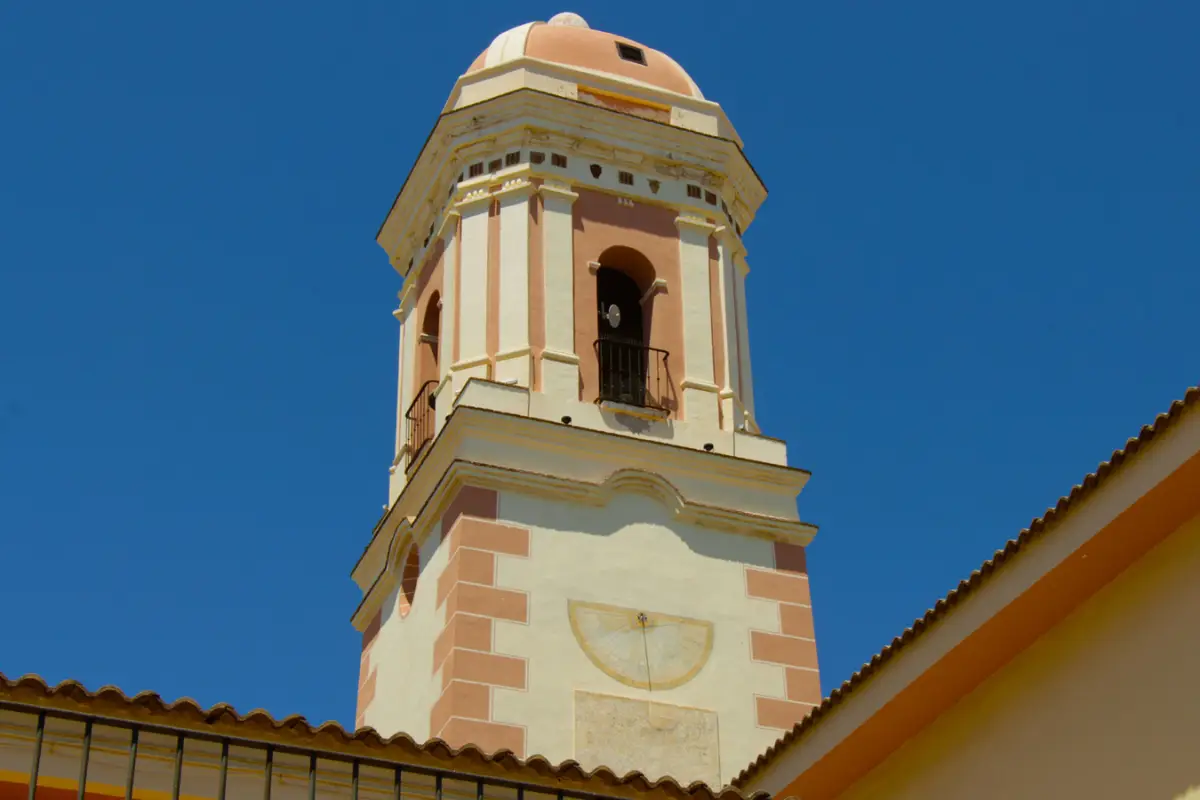
The Torre del Reloj is the clock tower, the one you’ll have already spotted over the rooftops without knowing what it was. From there it’s a short drop down into Plaza del Reloj, where a plaque by journalist Luis del Olmo, written for the painter Antonio Montiel, sits right on the steps up to the square, then on to Plaza Begines.
From Plaza Begines we swung past two more plazas before the Jardín, Plaza Manuel Alcántara at the corner of Calle Botica and Calle Sirena, then Plaza de Antonio Gala on Calle Guadiana, both proper little squares with their own bust and their own poems, more on both in a minute. Plaza Begines feeds straight into the Jardín de los Poetas Andaluces after that, the passage where the bronze busts and the Jiménez and Murciano plaques live.
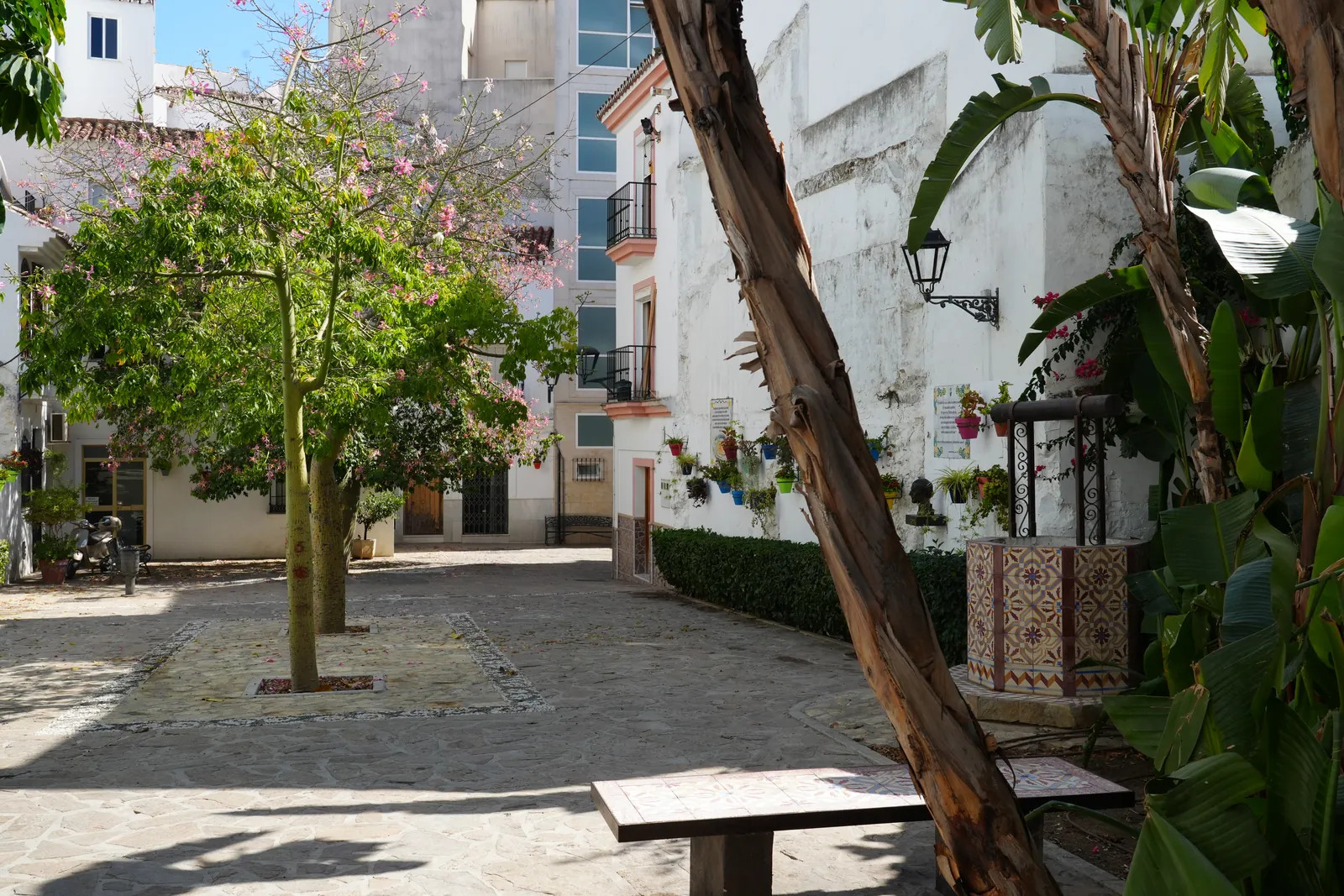
Past that it’s Plaza del Ajedrez, then out into Plaza de las Flores itself. Casa de las Tejerinas, the old mansion on that square, is where the tourist office actually sits, the same one handing out the leaflet I mentioned earlier.
There’s a bit of a climb getting up from the seafront, nothing serious, and the streets do exactly what you’d hope once you’re up there, narrow and whitewashed, flower pots stacked along every windowsill, wrought-iron balconies leaning out over your head. You turn a corner expecting more of the same alley and suddenly you’re standing in a tiny plaza with nobody else in it. That’s the real charm of this walk, not any single poem, just the town opening up around you one plaza at a time.
If you’re staying over rather than doing this as a day trip, here are a few of my favourite places to stay along the coast in Marbella:
⭐ Old Town >> Hotel Claude, my pick for first-time visitors
⭐ Beachfront >> Gran Meliá Don Pepe, five-star below Golden Mile prices
⭐ Golden Mile >> Marbella Club Hotel, the original 1954 resort
⭐ Puerto Banús >> Hotel PYR Marbella, best value near the marina
Tile by tile through the old town
Some of the plaques catch you at eye level before you even clock what they are, a small square of hand-painted ceramic set into a whitewashed wall, wrought-iron balconies and pots of geraniums crowding in around it, so pretty you almost miss the poem for the setting. Others are underfoot, worked right into the paving stones, so you end up reading someone’s verse while you’re watching where you step.
The languages are half the fun of it. Keep walking these narrow streets and small plazas and you’ll pass poems in Spanish, English, French, Arabic and more, nobody pointing them out, you just have to keep your eyes open for the next tile.
A few worth stopping for
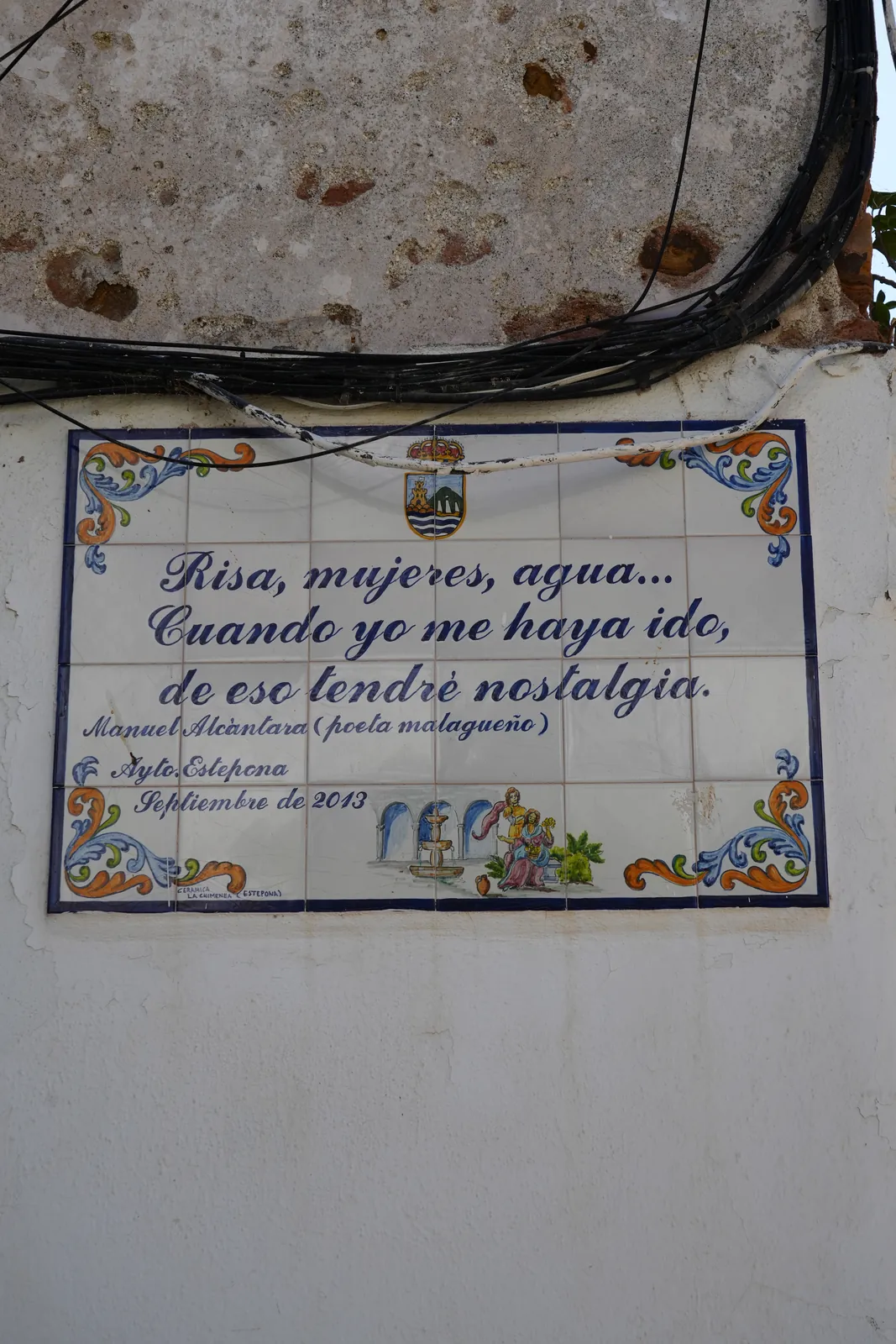
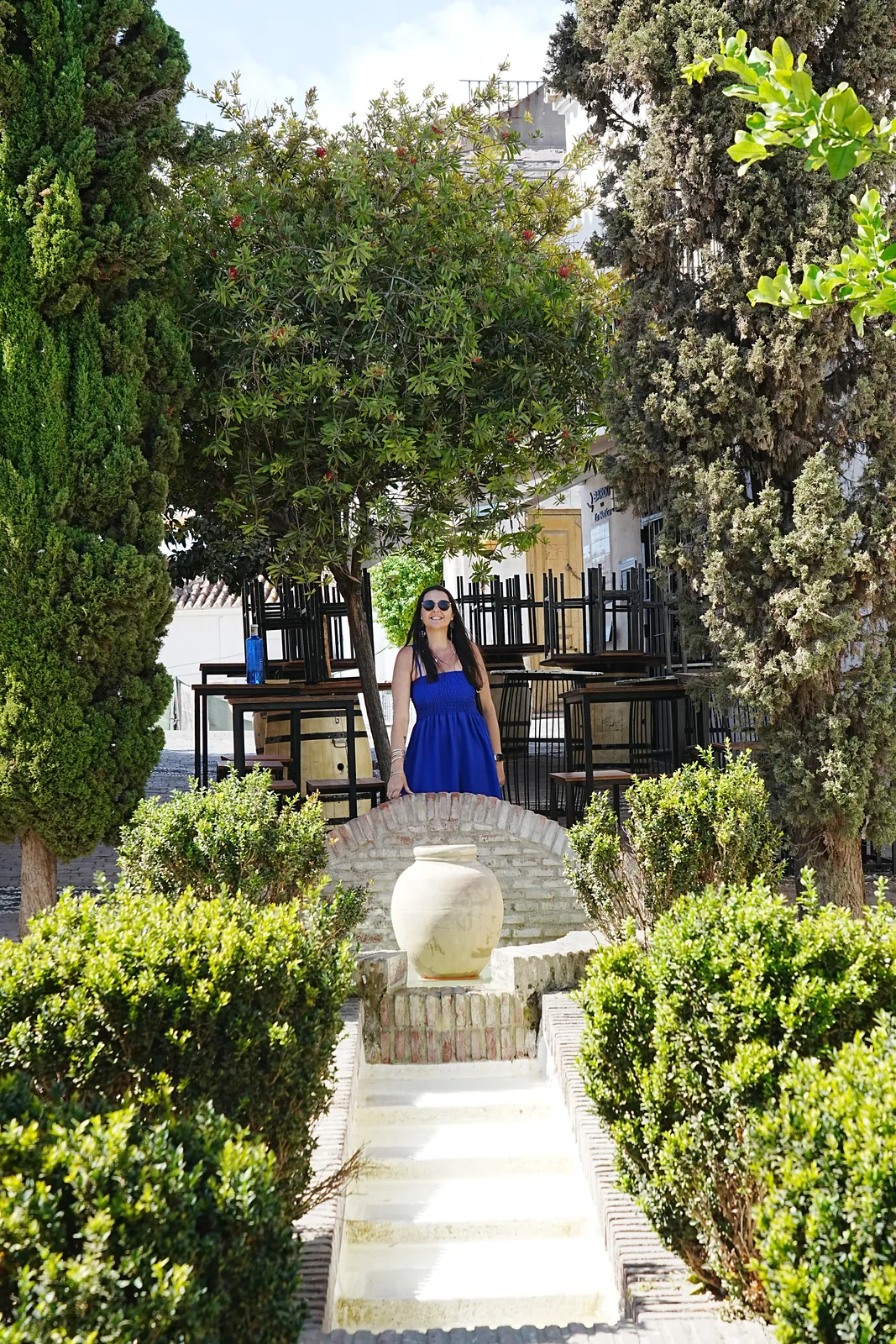
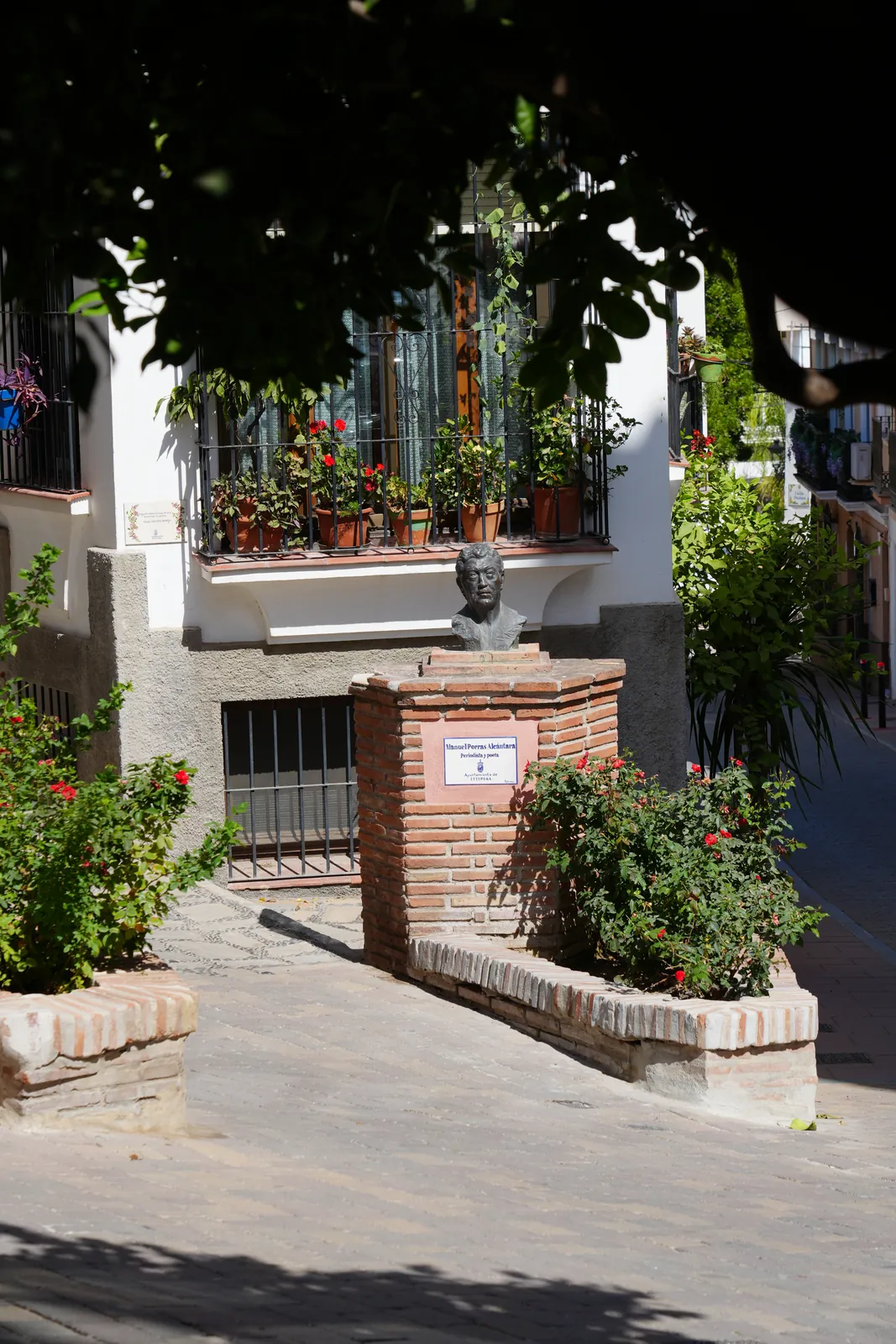
Keep an eye out for Manuel Alcántara’s “Risa, mujeres, agua…”, tucked under a tangle of cables on a wall that’s seen better days. He gets more than one tile too, Manuel Alcántara has his own plaza, at the corner of Calle Botica and Calle Sirena, an Arab-inspired fountain, orange and cypress trees, his bust under his full name, Manuel Porras Alcántara, and several more of his poems set into the walls around it.
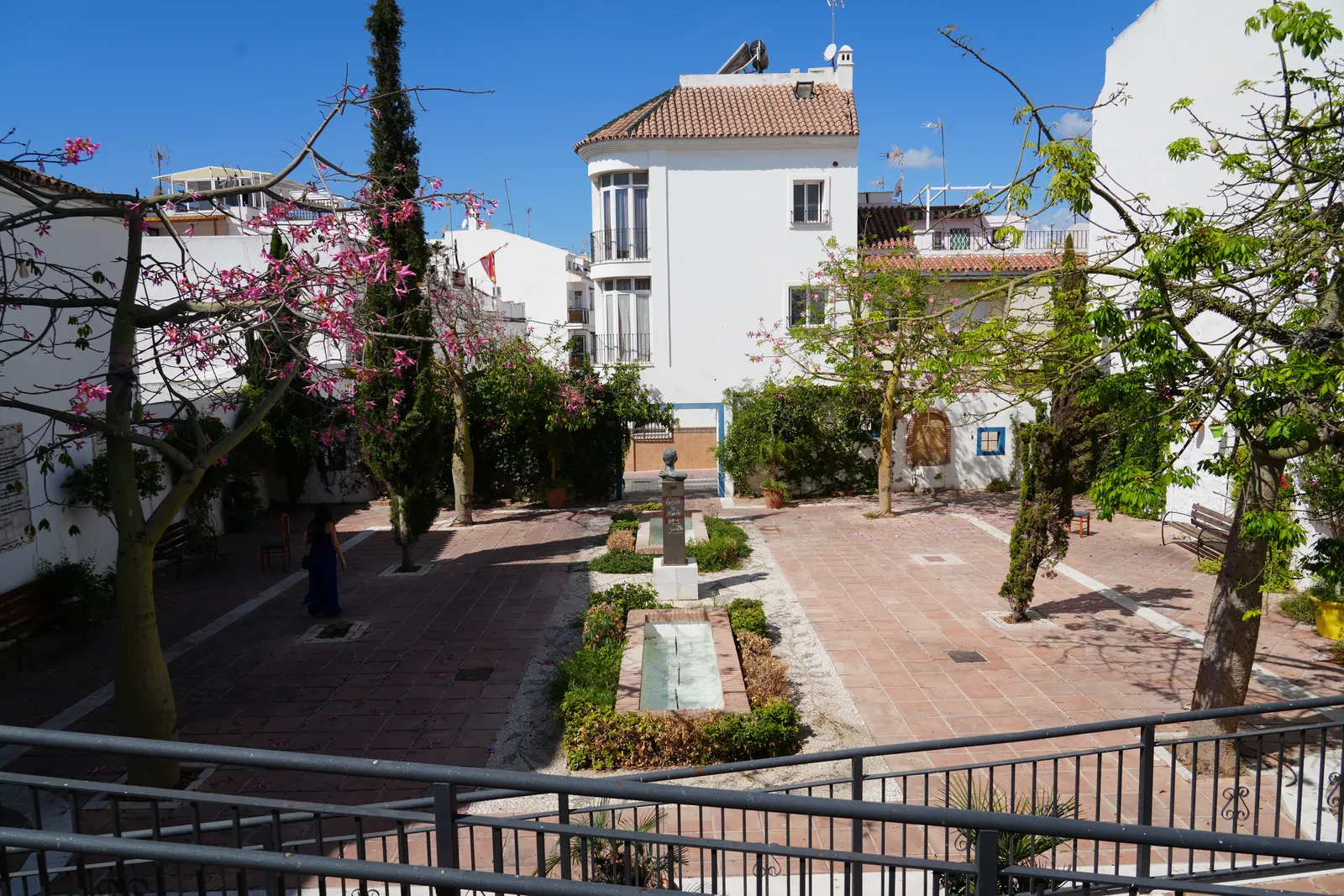
The plaza itself is the nicer version, cypress trees, stone steps, a brick archway with a ceramic urn on top.
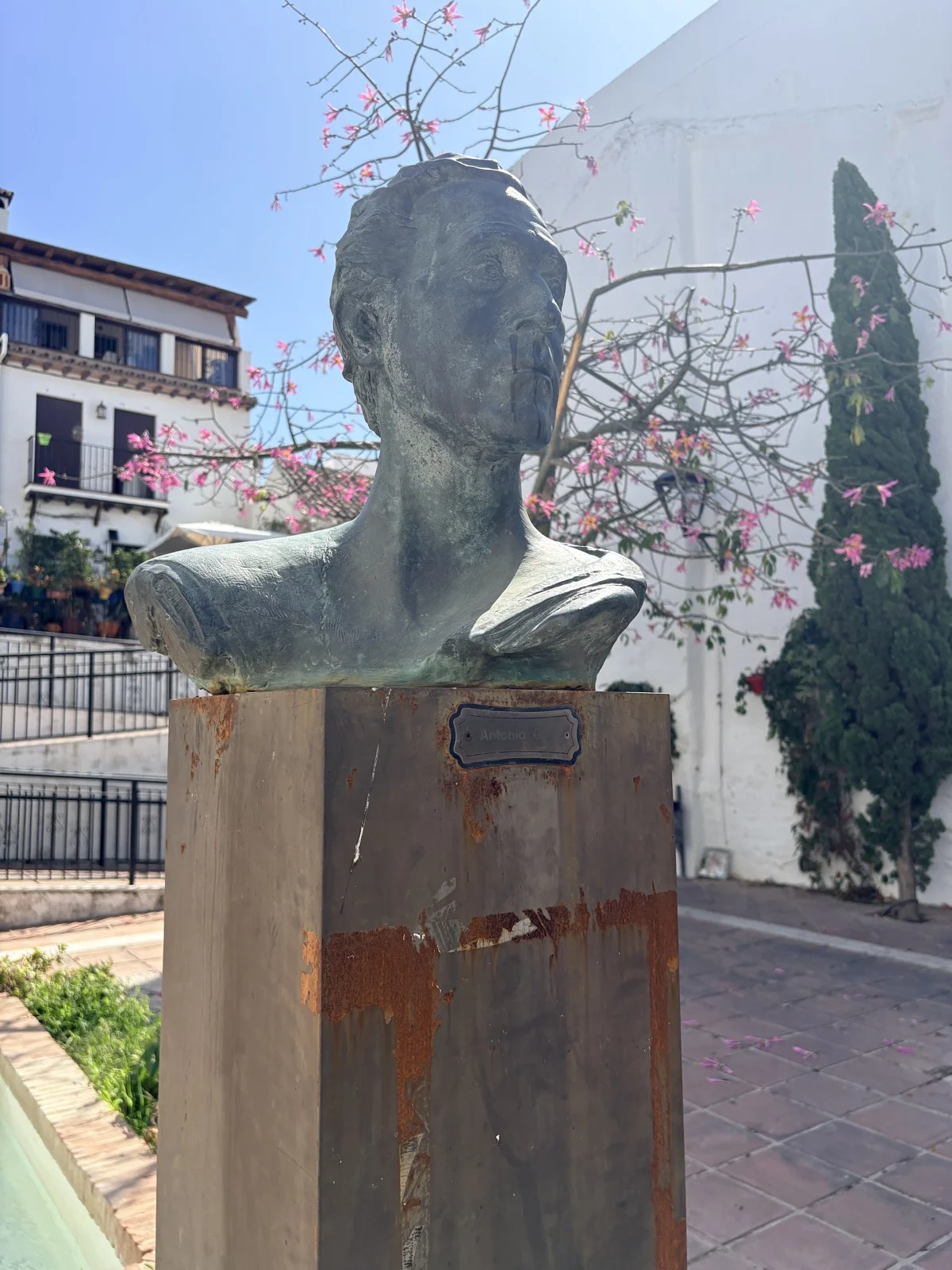
The bust itself sits on a brick pillar wrapped in roses on the plaza’s edge.
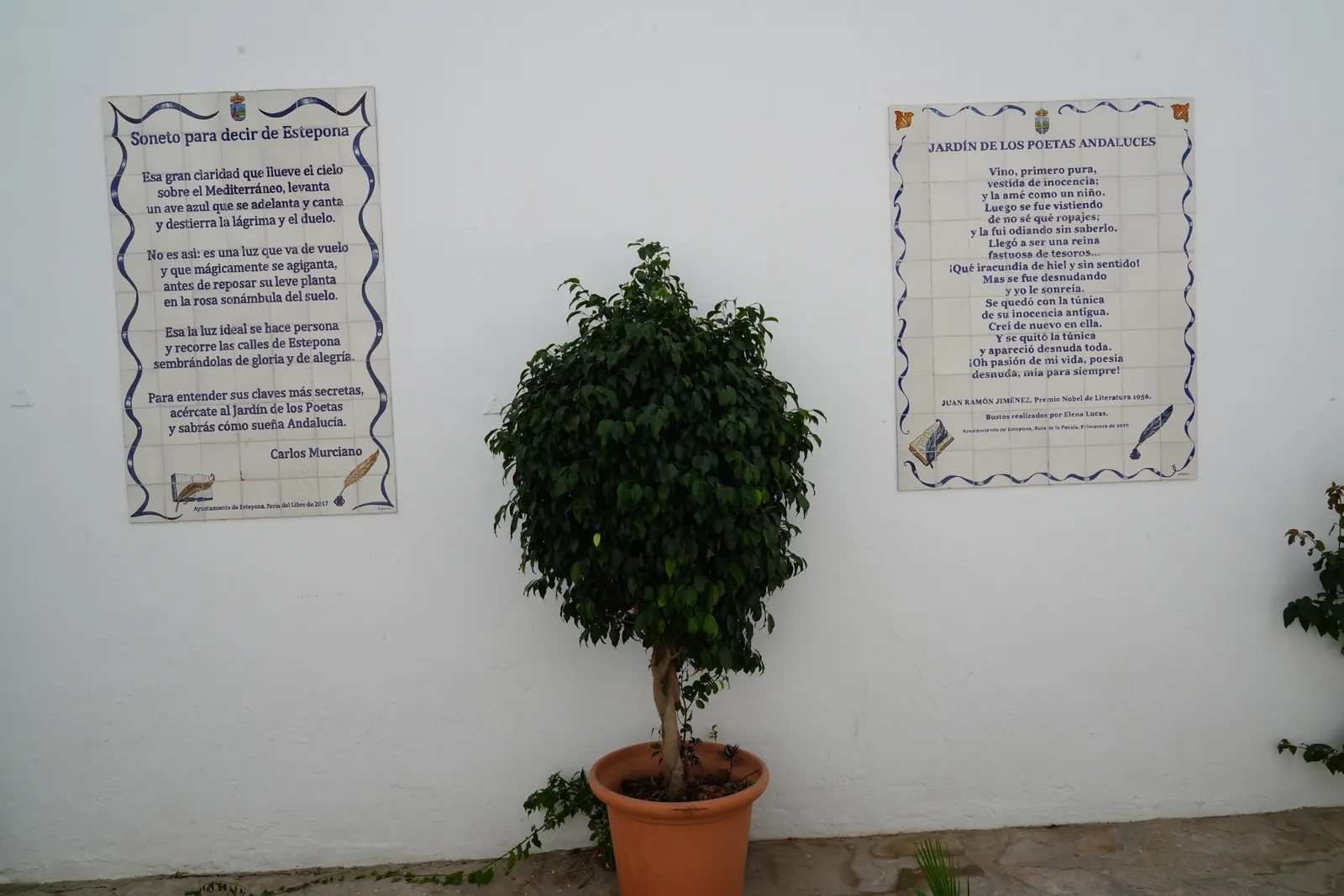
In the Jardín de los Poetas Andaluces, Juan Ramón Jiménez’s Nobel-winning “Poesía desnuda” sits right next to Carlos Murciano’s sonnet for the town, two of Spain’s biggest poetic names sharing one small courtyard. And don’t miss Manuel Sánchez Bracho’s “Y tú Estepona…”, found on a bench where you can actually sit down and read it properly instead of craning your neck, more on that bench in a minute.
Not every stop on the route is ceramic, either. Antonio Gala gets a bronze bust of his own, up in the plaza that carries his name, marking his sonnets on the route.
Step back and it’s a proper little plaza, a reflecting pool, benches, cypress and silk floss trees in bloom.
🎟️ Prefer a guide? >> A small-group Estepona old town tour covers the plaques, the murals and the history in one go, with someone who actually knows which ones to point out.
Slide down the steps at Pasaje Manuel Sánchez Bracho
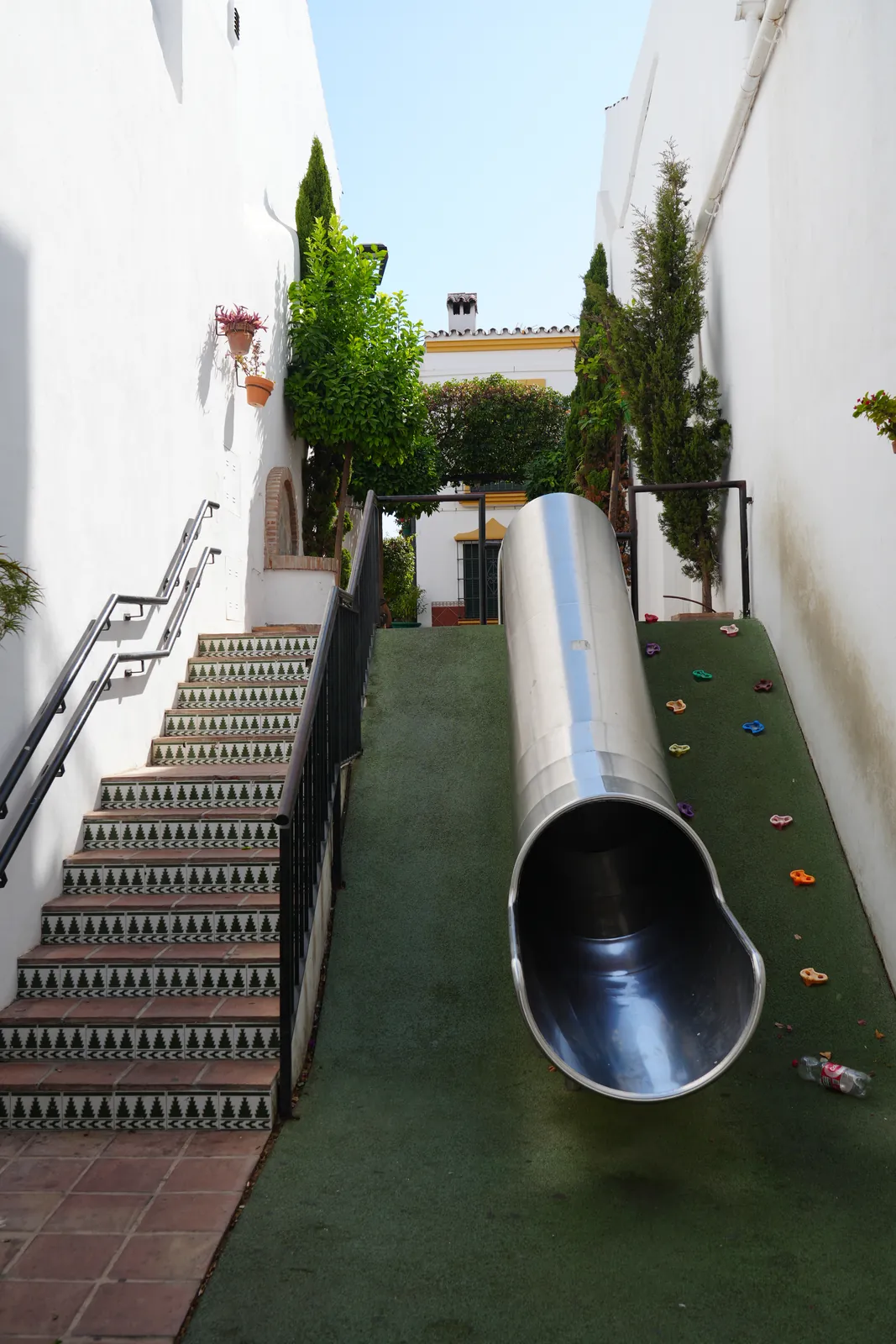
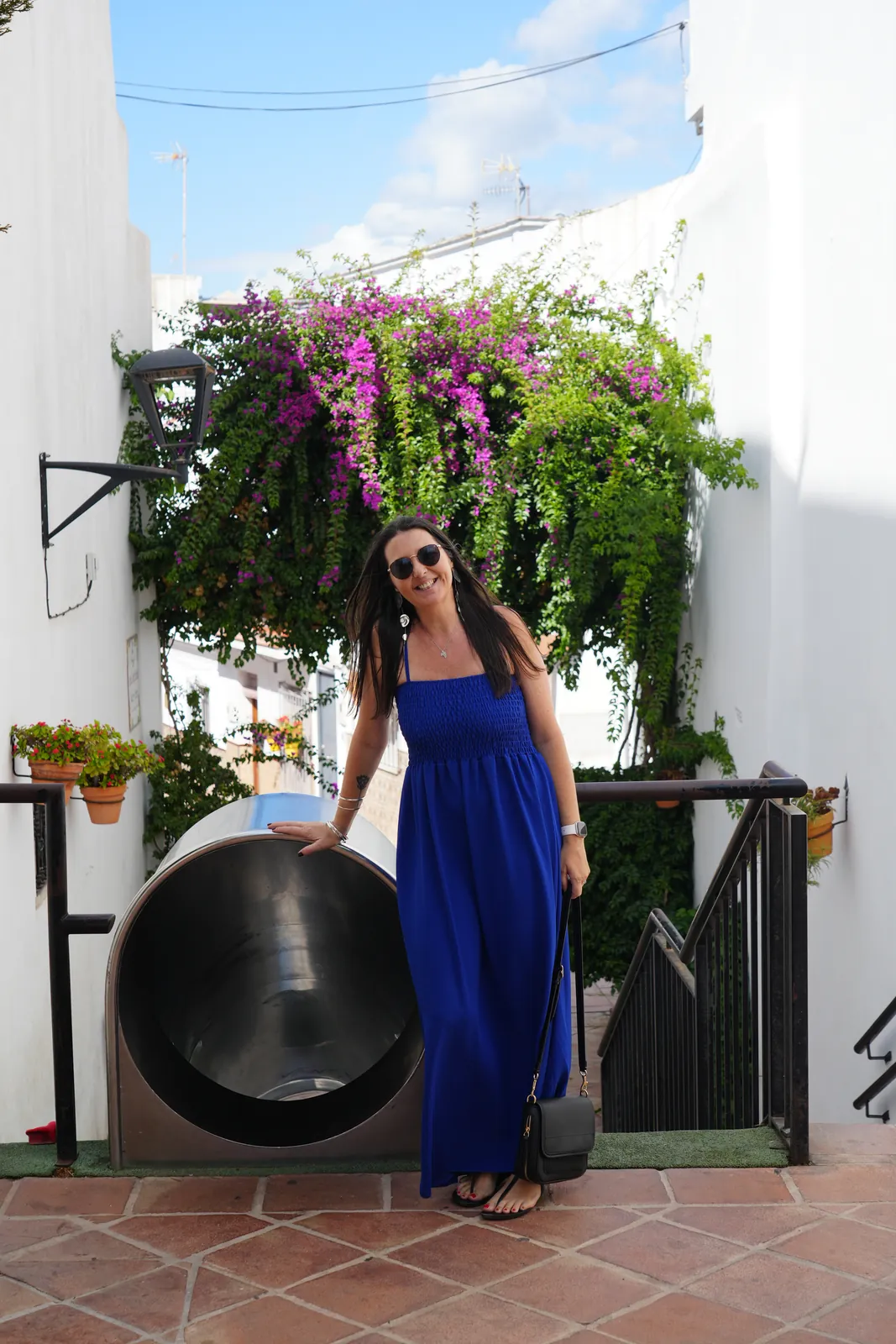
I was walking the poetry route, past Jardín de los Poetas Andaluces and Plaza Begines, when I ducked into Pasaje Manuel Sánchez Bracho on my way to Calle Portada. I wasn’t looking for anything, just cutting through. There’s an ordinary tiled staircase in there, a bit worn, bougainvillea growing overhead. Right next to the steps, there’s a stainless steel tube slide.
It’s kid-sized, not some big drop, and the landing at the bottom is soft. It’s bolted straight into the street, not fenced off in a playground somewhere. Beside it, small coloured climbing holds are set into a turf incline, so instead of walking back up the stairs, you can climb the grass and go down again.
At the bottom there’s a wrought-iron bench next to a ceramic plaque, “Y tú Estepona…”, the same poem by Manuel Sánchez Bracho I mentioned earlier. Turns out the whole passage is named for him too.
He was born in Estepona in October 1944, on this exact spot, and went on to serve two terms as mayor. In between (and alongside it) he taught at a local school for 25 years, and wrote as a poet, novelist and flamenco historian. The town dedicated the passage to him in February 2020.
Why there’s a slide here at all
Estepona already tried this once, bigger, and it went wrong fast. In May 2019 the town hall put up a much larger stainless-steel slide in a park, it turned out too steep, people got hurt, and the town hall shut it down and pulled it out within 24 hours. It became a bit of a local joke. They promised a slide would come back somewhere in the city, and this one, smaller, kid-sized, tucked into a passage instead of a park, is that promise kept.
I went down it myself and filmed the whole run for the Reel. There’s no ticket booth, no attendant, nothing, it’s just a slide built straight into the pavement, free and outdoors, with no one standing there to ask permission from.
READY TO PLAN THE REST OF YOUR TRIP TO ESTEPONA?
🚗 Rent a car: I use Discover Cars
🎟️ Best guided tours: I use GetYourGuide
🏨 Accommodation: Find hotels in Marbella
🚆 Trains and buses: I book through Omio
🛡️ Travel insurance: I use SafetyWing
We made it through the old town, then lunch won
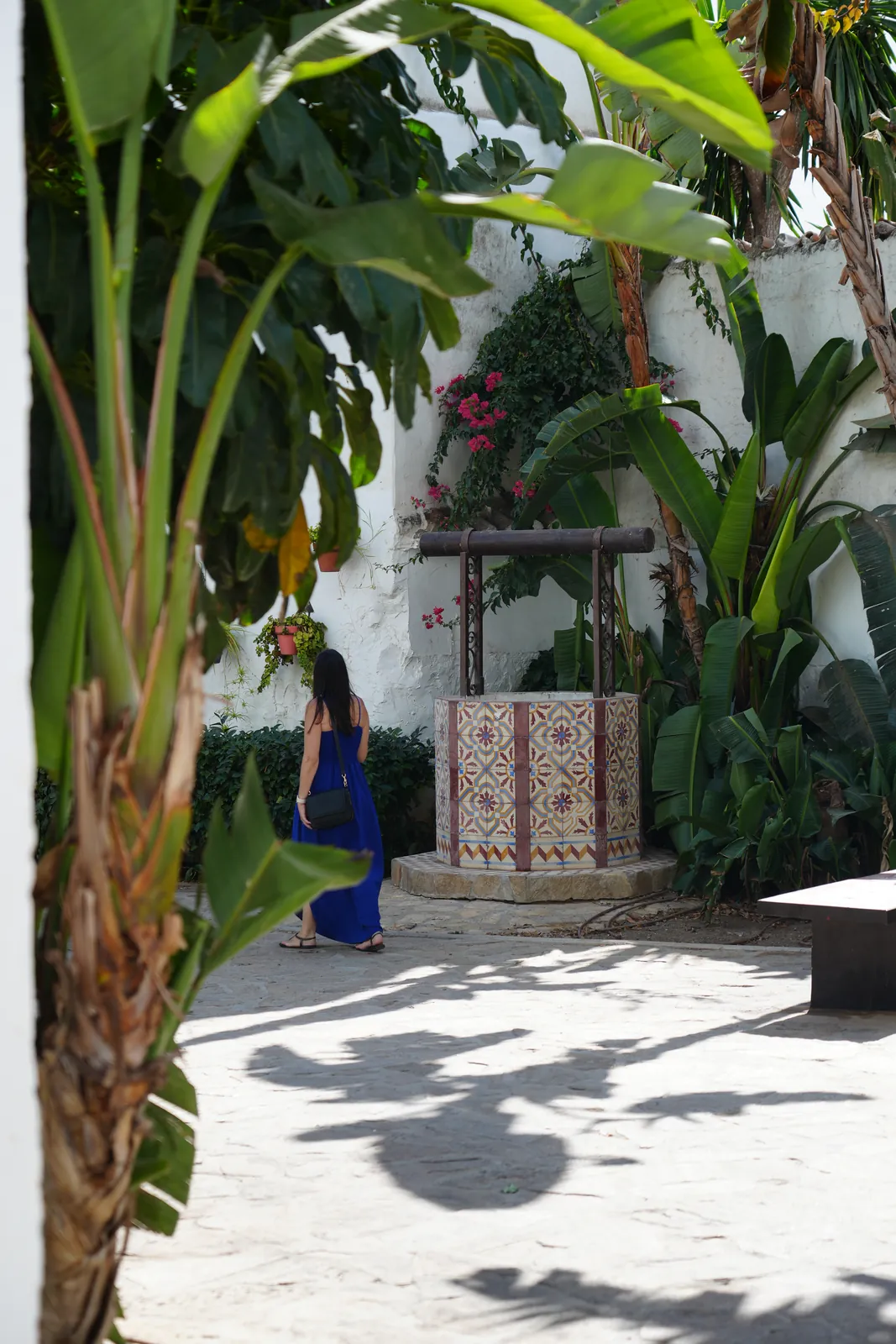
We set out that morning determined to find every single poem on the route. We worked our way past the Castillo de San Luis and the Torre del Reloj, through Plaza del Reloj and Plaza Begines, past Plaza Manuel Alcántara and Plaza de Antonio Gala, into the Jardín de los Poetas Andaluces, over to Plaza del Ajedrez, past the Casa de las Tejerinas and into Plaza de las Flores. It’s a proper loop, and a lovely one, whitewashed lane after whitewashed lane opening up into these little squares.
By the time we came out the other side of Plaza de las Flores, we were hungry and wanted lunch. Honestly, that’s the whole reason we stopped looking for more poems.
What we skipped, and didn’t regret
We never made it down to the pocket of the route near the Ermita del Carmen, closer to the seafront, or across to the stops out by Plaza de Paco de Lucía. Both are officially part of the Ruta de la Poesía, and we just didn’t walk that far that day. We don’t regret it either, once lunch was sorted we were straight onto Estepona’s murals instead, which is a whole other story.
The practical bit
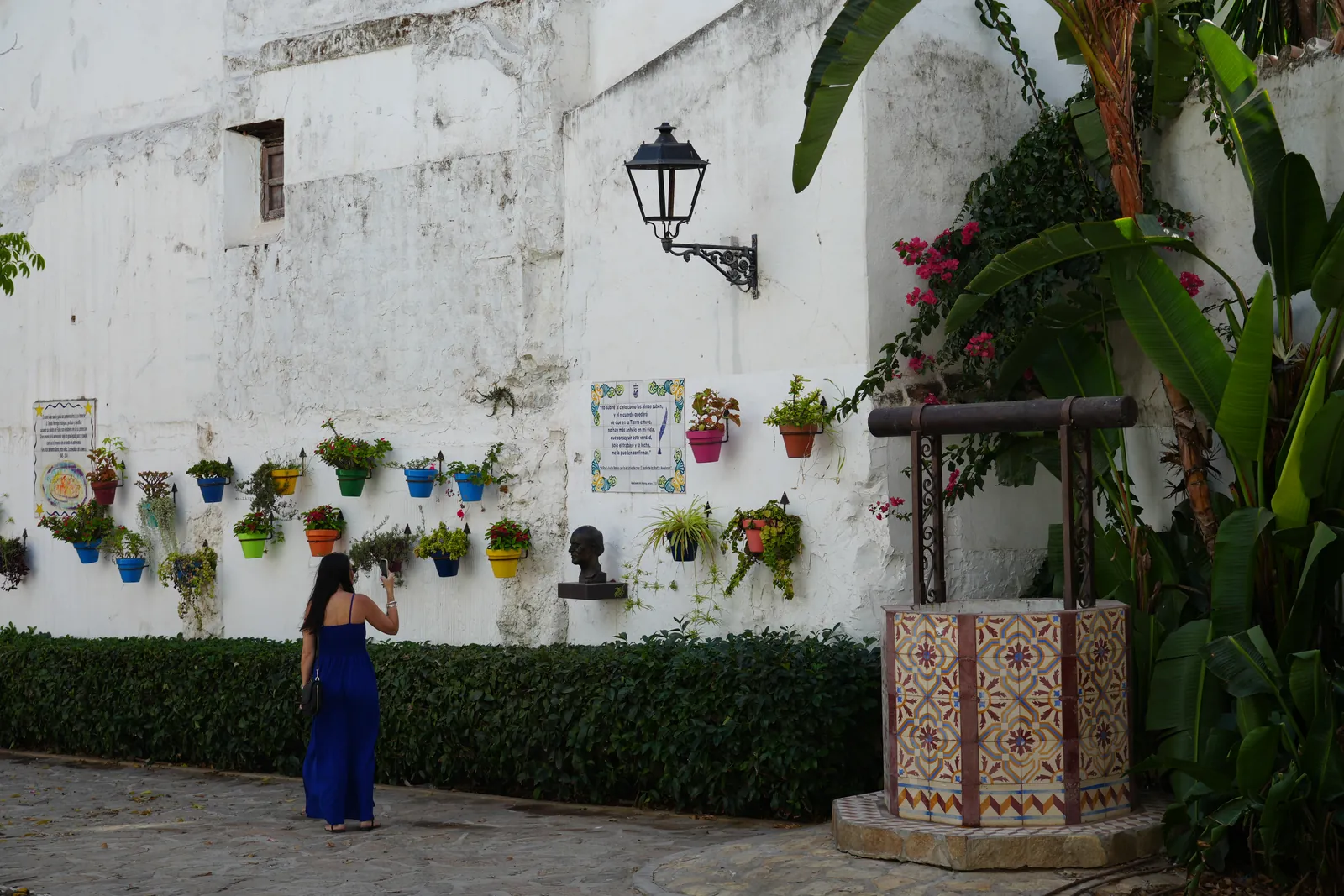
Wondering how long to set aside? If you’re doing the full official Ruta de la Poesía, all 30-plus plaques scattered across town, the town’s own tourism office puts it at 45 minutes to an hour, walked at an easy pace. Stick to the dense cluster in the historic centre, where most of the plaques are anyway, and you’re done in well under that. There’s no official time for the short version, but it’s a fraction of the full walk.
If you’re staying over rather than doing this as a day trip, Hotel Claude in Marbella’s Old Town is a twenty-minute drive up the coast and the pick I’d make.
Either way, it’s an easy one. Estepona’s old town is compact, there’s a short climb up from the seafront but nothing serious after that, and you won’t need a ticket or a set of opening hours. The plaques live outdoors and they’re not going anywhere, so you can wander past them whenever suits you.
Getting there and parking
Sort the car before you start walking, not after. I’ve laid out where to leave the car before you set off on foot, so check that first. If you’re driving down from further along the coast, I always book through Discover Cars to compare rental options before I arrive.
Pair it with
This walk is an hour at most, not a whole day, so build it into something bigger. I’ve got the murals, the Orchid House and the rest of Estepona’s highlights mapped out if you want to make a full day of it. Or if you’d rather someone else handle the whole loop, a guided walking tour of the old town covers the same ground with none of the doubling back.
Wear shoes you don’t mind standing around in. That’s the whole packing list.