By mural six, I’d stopped trusting Google Maps completely. It kept sending me here, there and everywhere off Paseo Marítimo, back on myself, down side streets that didn’t have a single painted wall on them, while the murals I actually wanted sat behind an orange tree, three floors up, or half hidden by the very palm trees planted to make the street look nice.
Jethro and I walked the whole Estepona murals route on 20 September 2026. I parked at Paseo Marítimo, paid under five euros for the whole visit, and came home a bit footsore but honestly charmed. What follows is what I wish someone had handed me before I set off with my phone out, squinting at a blue dot that had no idea where I actually needed to stand.
I’ve already given the murals a mention in my wider guide to Estepona, but this is the full walk, one photo per wall, start to finish.
Getting the official Estepona murals map (and where it stops helping)
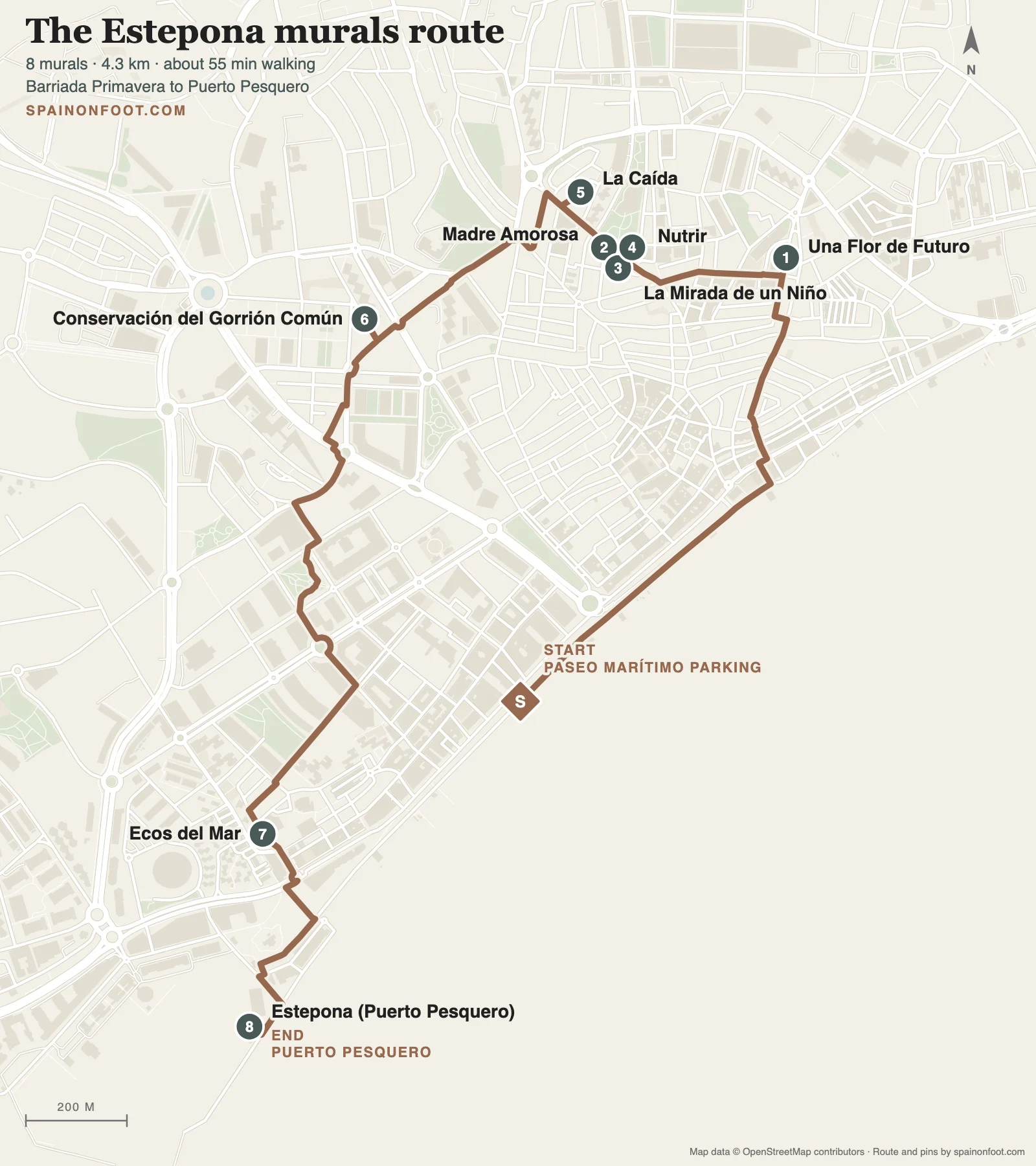
There’s a free paper map at the tourist office on Plaza de las Flores, and if you’re the sort of person who likes something physical in your hand rather than a screen, grab one before you start. Estepona’s council also has a digital version of the route online, which is where I started, on my phone, like someone who should have known better.
Here’s the thing nobody else really mentions when they write these routes up: Google Maps is actually bad at this particular job. It’s brilliant at getting you to a restaurant or a hotel, because a restaurant has a door and an address and Google Maps only needs to get you within a few metres of it. A mural doesn’t have a door. It has a wall, and that wall might be facing away from the street the pin drops you on, or three storeys up above a corner you’ve already walked past, or growing an orange tree directly in front of it.
More than once, I missed a piece entirely, only to double back and realise the artwork wasn’t where the pin said, it was around the corner, or higher up than eye level, or behind something that hadn’t been there when the map was made.
Once I clocked that, I stopped trusting the blue dot and started just looking up, a lot, at every building I passed, which turned out to be the better strategy anyway.
Where the route actually starts
I started from the car, parked right on Paseo Marítimo in the centre, which cost under five euros for the whole few hours I was out. It’s an easy, central spot to leave the car and just start walking.
Some locals point people toward Calle Tereza as an alternative starting spot, since a cluster of murals sits close together there. Looking back, that’s probably the smarter entry point if you want to hit the density early rather than warming up on the scattered ones first.
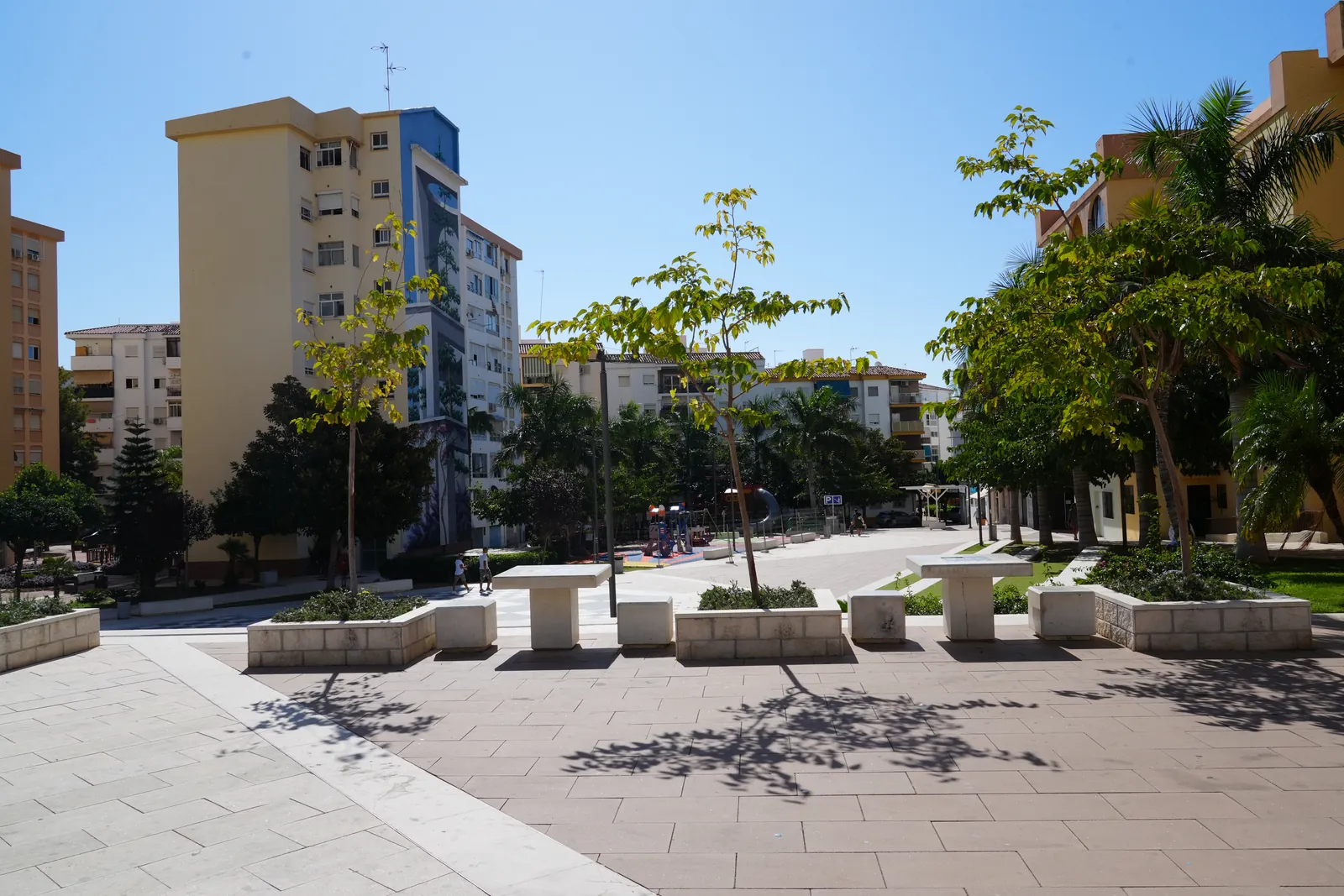
What caught me off guard is that almost none of this route runs through the old town. I’d pictured cobbled lanes and whitewashed balconies, the kind of streets Estepona’s other photogenic corners are known for. Instead, the vast majority of the murals live in Barriada Primavera, a residential neighbourhood of ordinary apartment blocks, washing lines, parked cars, kids on bikes.
It’s not what you’d call scenic on its own terms. But that’s sort of the point. Someone decided these blank walls deserved better than being blank, and now they’re covered in some of the best public art I’ve seen anywhere in Spain.
The murals through Barriada Primavera
Here’s how they came at me, more or less in order, working through Barriada Primavera one street at a time.
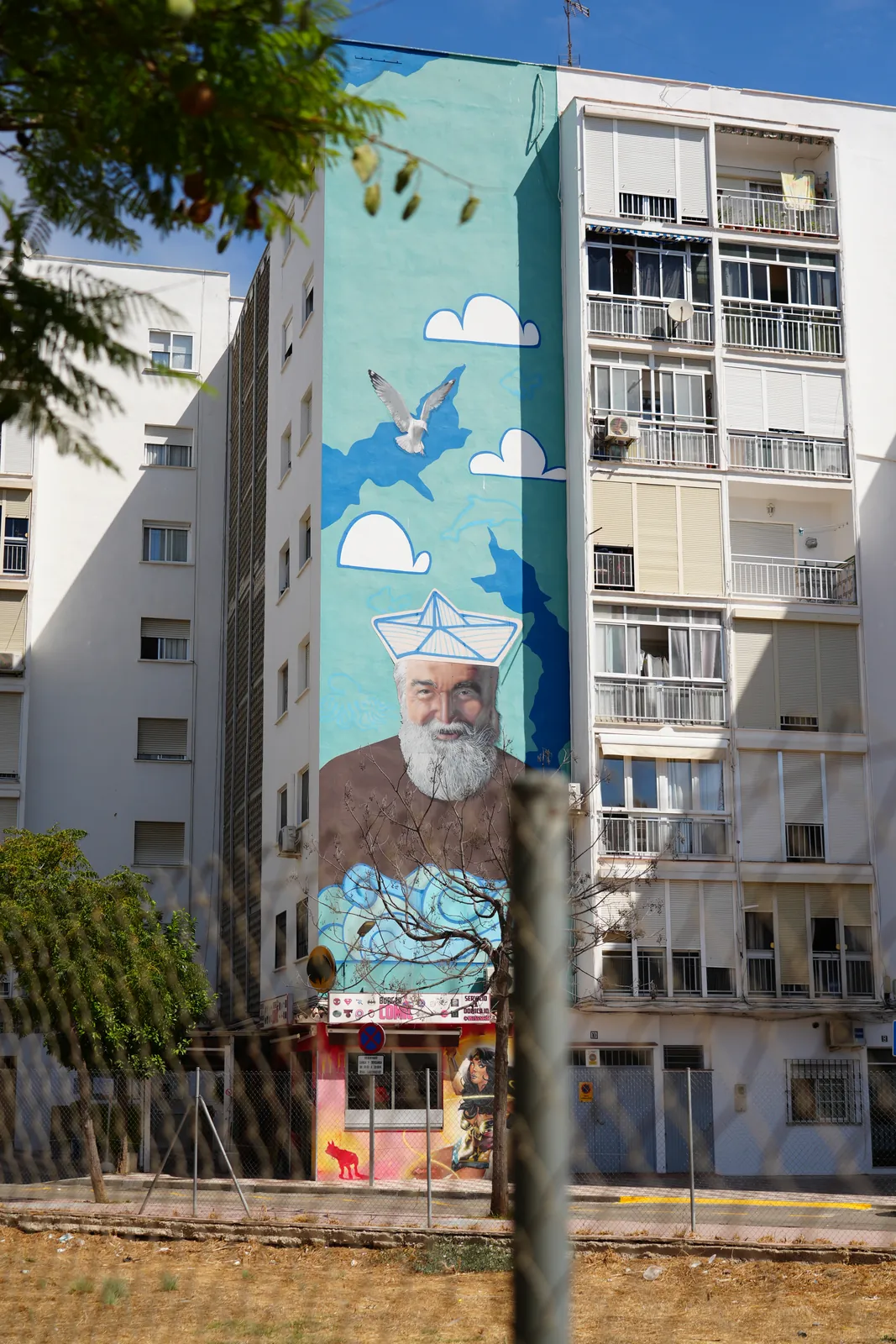
The bearded sailor
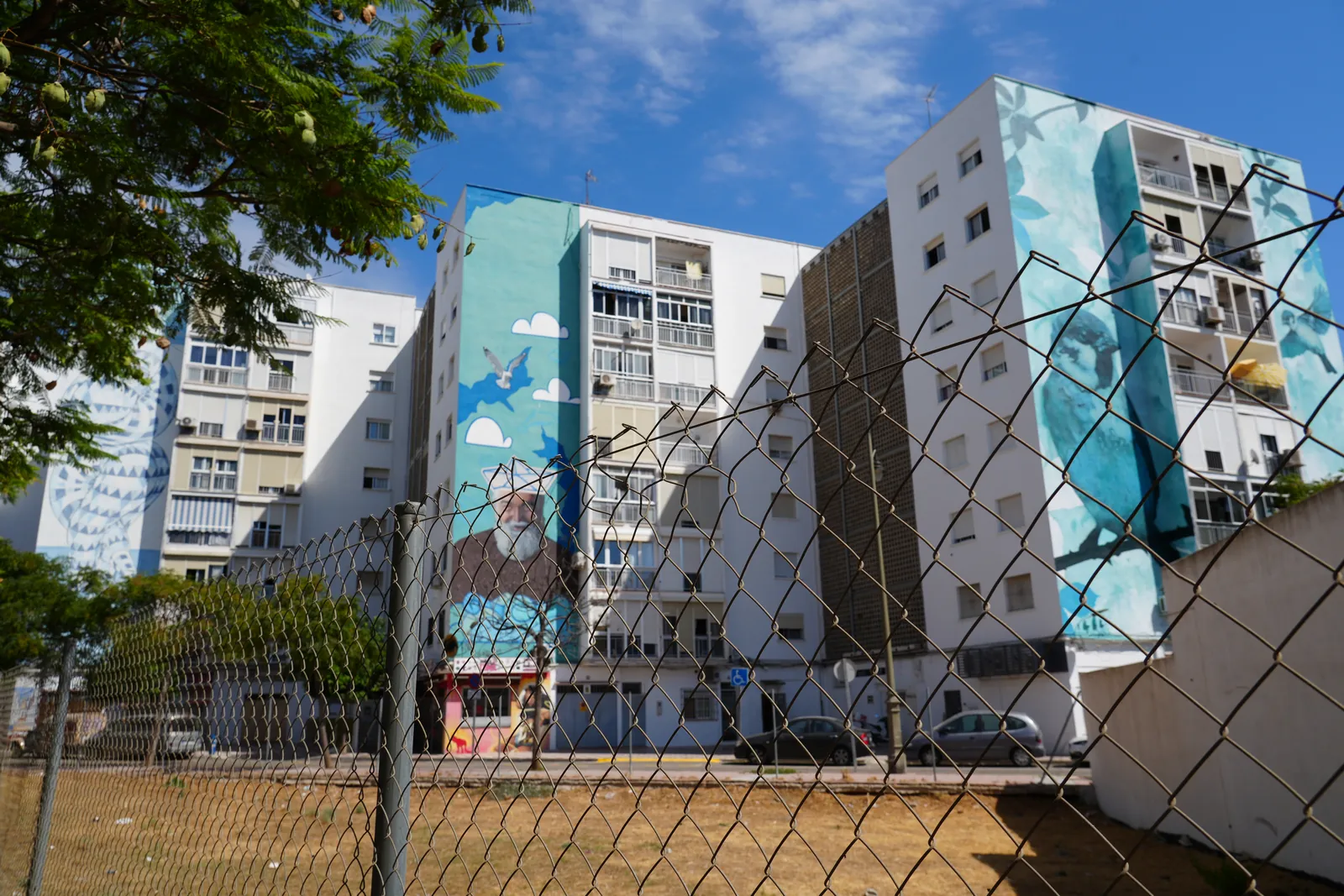
He’s folded himself a hat out of paper, or someone’s painted it that way, white and creased like something a kid would fold on a rainy afternoon. Behind him there’s a pale teal sky, one seagull caught mid-flap above his shoulder, and the whole piece runs the full height of a narrow building squeezed between two others. No signature I could find anywhere on it, which turned out to be true for a fair few pieces on this walk.
There’s something properly charming about a mural this daft, four storeys of painted paper hat and not a shred of self-importance.
Turning the corner into a giant sparrow
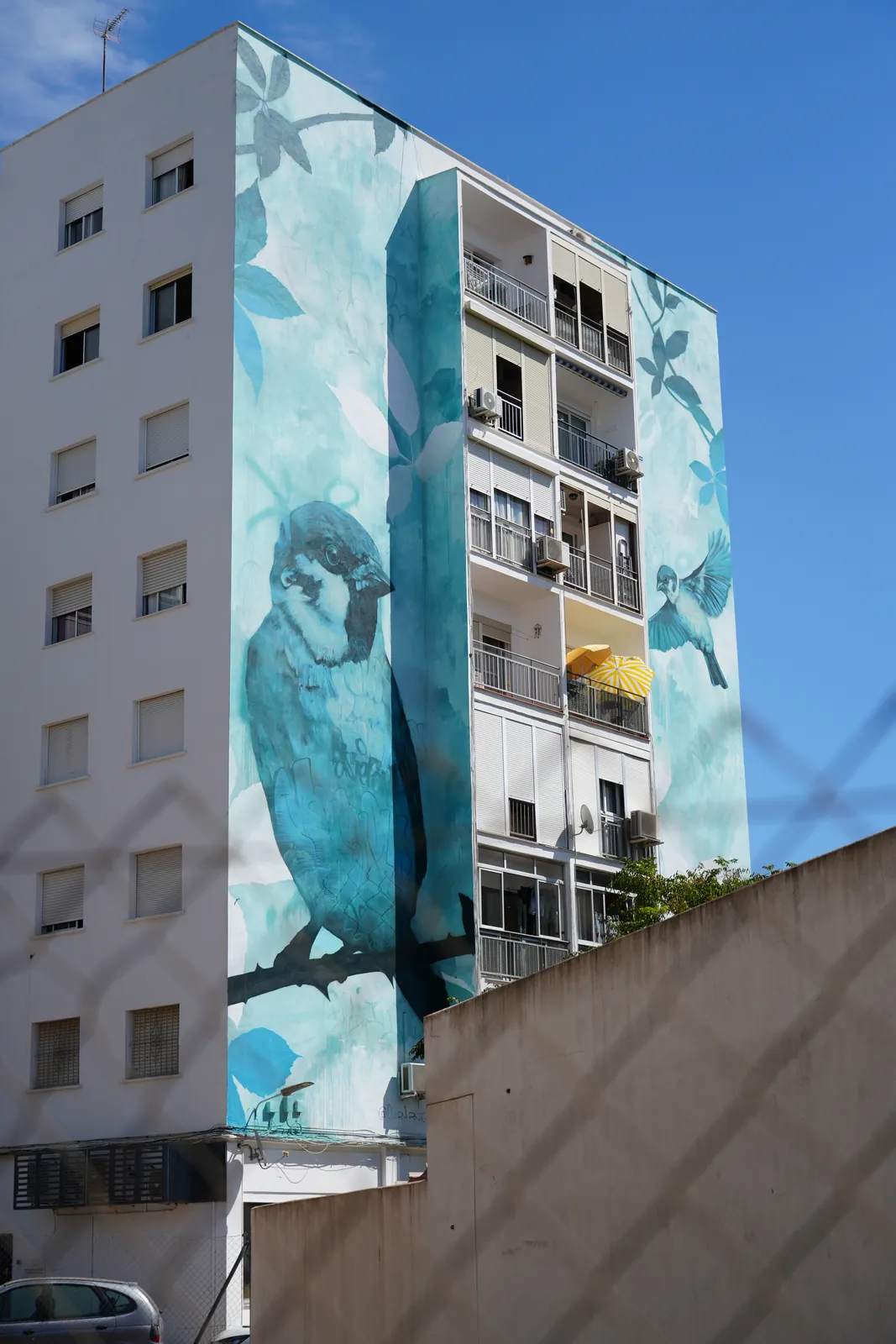
Jethro and I turned onto the next street and there it was, wrapping right around the corner of a building: an enormous sparrow, painted so realistically it looks like it could ruffle its feathers and fly off the wall. It’s done in teal and blue rather than the browns you’d expect from an actual sparrow, and a second, smaller bird flies across the adjacent face of the building, both set against a pale background of leaf shapes. Down near the base there’s a faded artist tag, too worn to make out.
It’s a stunning piece of craft close up, every feather picked out in a slightly different shade of blue.
The one you can’t quite see
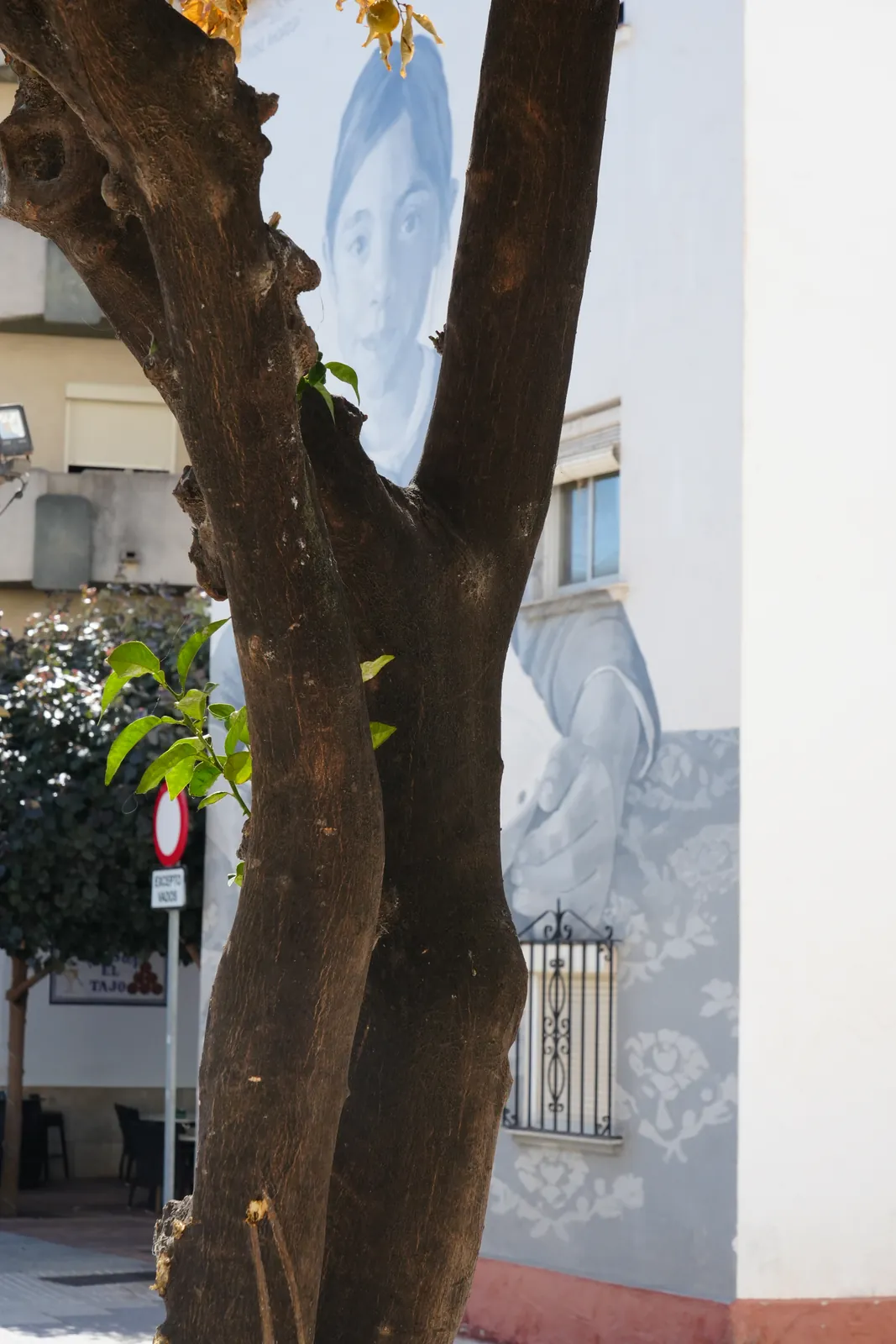
This is the one that made the Google Maps problem make sense. There’s a soft blue-grey painting of a child’s face and a small hand reaching up toward an adult’s hand, set against a pale floral wallpaper pattern, and directly in front of it an orange tree has grown tall enough to block a good half of the composition depending on where you stand. I shuffled along the pavement for a couple of minutes trying to find the angle that showed the whole thing, and never quite managed it.
It might be one wall of a two-wall pairing by Francisco Alarcón (more on him two murals from now), though there’s no plaque on this particular wall to confirm it.
Calle Fortuny’s palm tree
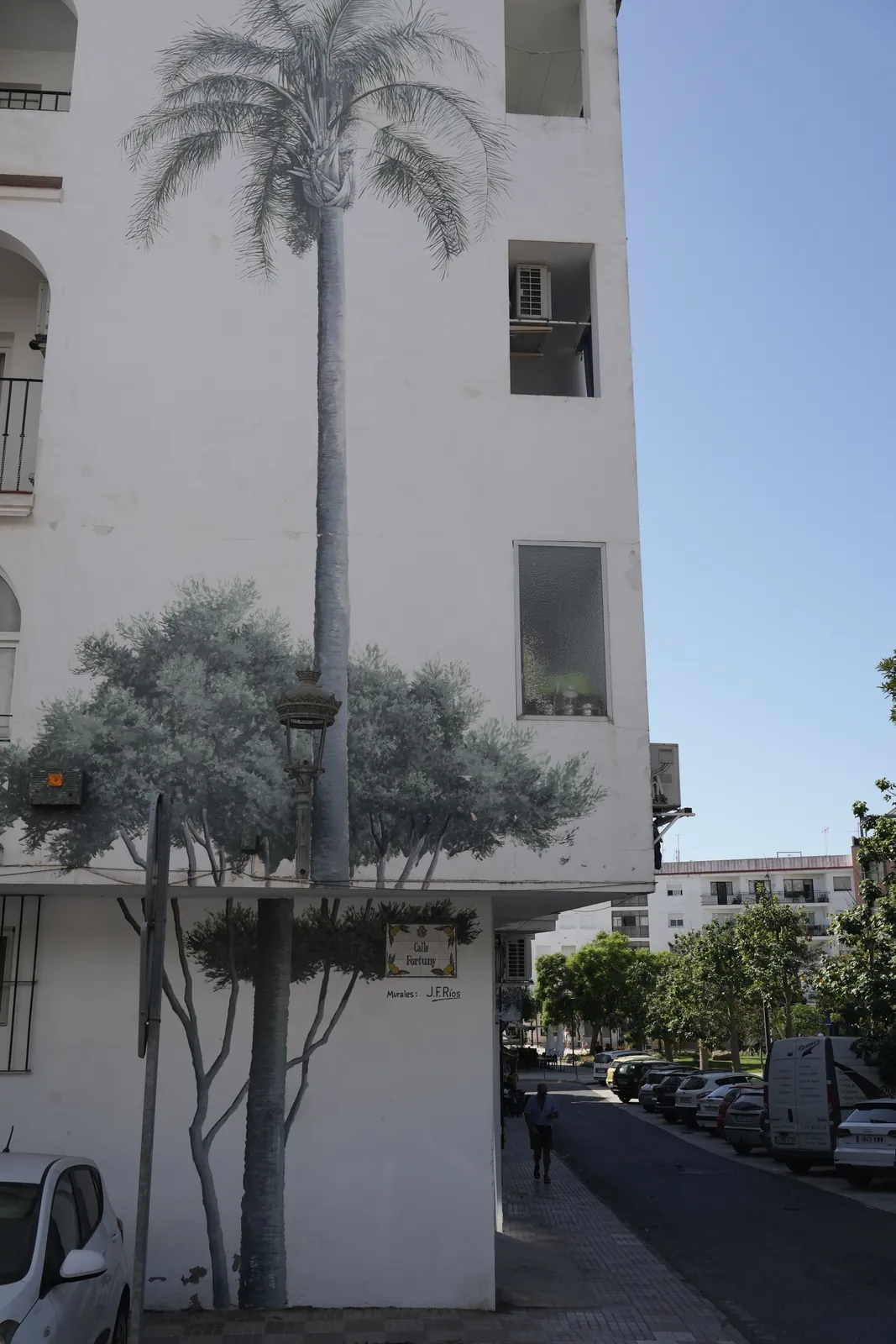
I actually stopped and stared at this one for a second longer than I meant to, because I genuinely couldn’t tell if it was painted or real. A full-height palm tree, done so photorealistically it fools you even close up, with a few smaller olive and bay trees painted in at street level for scale. The blue ceramic street sign right there on the wall confirms you’re on Calle Fortuny, and down at the base there’s a signature: Murales, J.F. Ríos.
That’s José Fernández Ríos, one of Estepona’s most prolific muralists.
Blossom, quietly
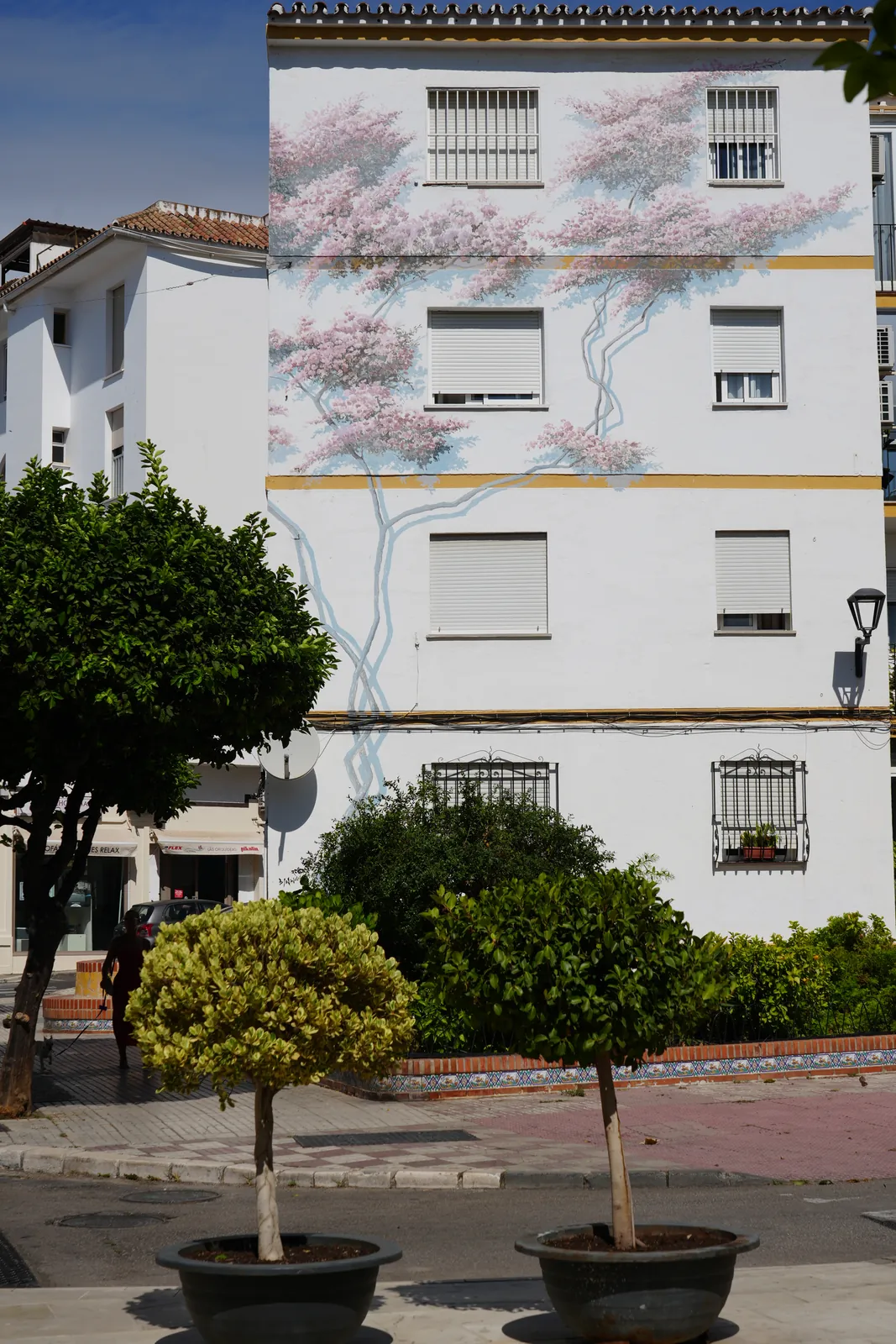
Then everything goes quiet for a moment. A pale pink blossom tree, might be almond, might be cherry, honestly hard to say, climbs the full height of a residential building, thin blue branch lines trailing between the windows across several floors. No bold colour, no figures, just a soft pastel sky behind it.
It’s a good pause between the louder pieces.
Olives, offered
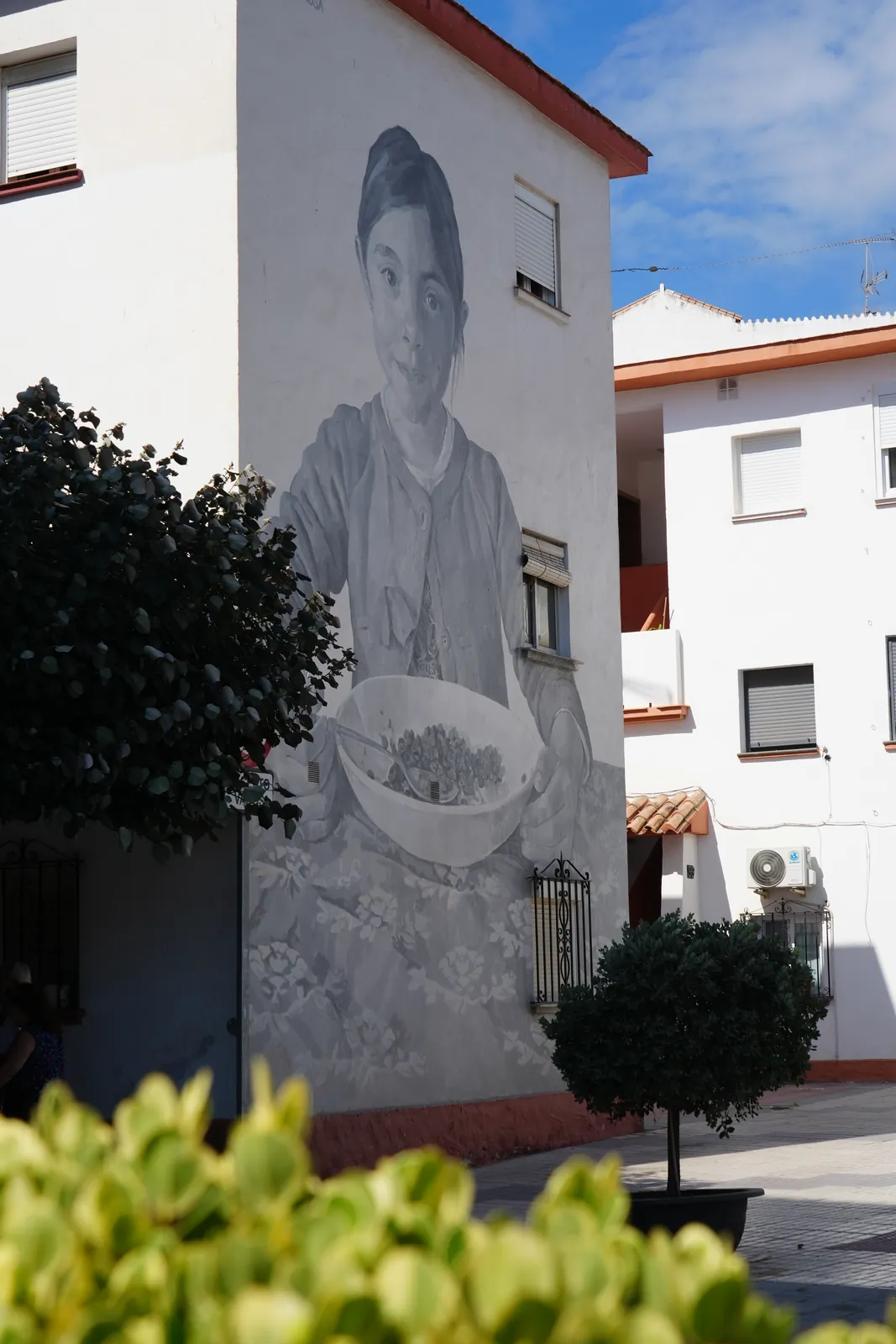
A young girl, hair pulled back, holds a bowl of olives out toward the street with both hands, like she’s offering it to whoever walks past. It’s painted in sepia tones, photorealistic, and if you get close you can make out the floral pattern woven into her skirt fabric. Something about the gesture, hands out, bowl tilted slightly toward you, makes this one feel less like a piece of art and more like an actual greeting.
The fisherman with a storm in his cap
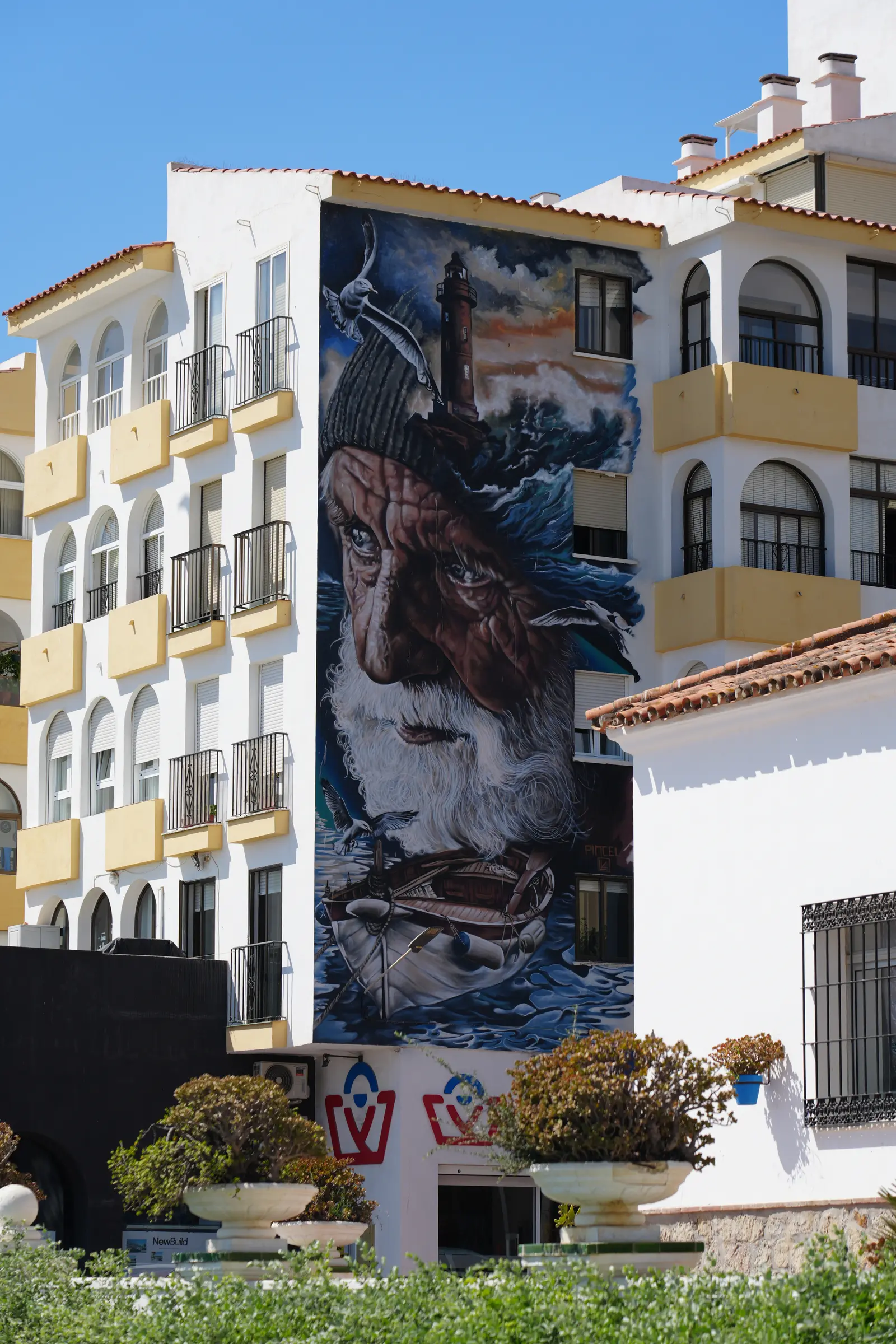
An old fisherman’s face fills most of this wall, hyperrealistic, weathered, a long white beard catching what looks like real light. Look closer at his dark knit cap and there’s a whole separate scene painted into the wool itself, a lighthouse standing against a storm, seagulls, rough waves. Below his beard, someone’s added a small wooden rowing boat, low in the water.
That storm hidden inside a knitted cap is one of the best bits of craft on the whole walk.
Everything’s done in muted blues, browns and greys, moodier than most of what I’d seen so far. It’s signed Pincel, down in the corner.
A lighthouse swallowed by Hokusai’s wave
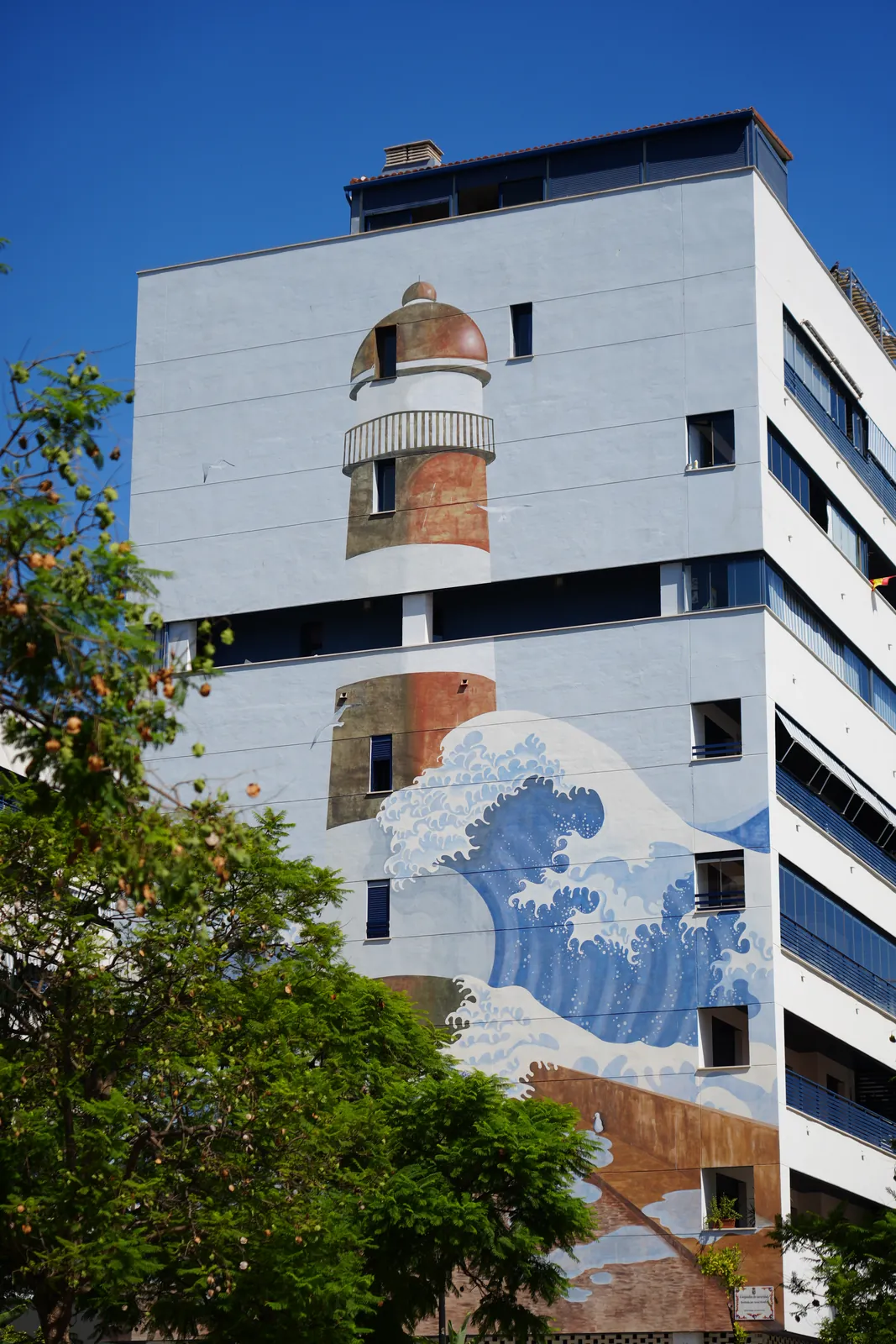
Four storeys up, a red and white striped lighthouse stands watch over the top half of a building, its little iron balcony catching the light. Follow it down and the whole thing dissolves into a wave, the unmistakable curling blue of Hokusai’s Great Wave off Kanagawa, foam picked out in white against a wall that was just a plain grey block before someone got up there with a brush.
A tiny figure stands at the base where the wave meets the shore, easy to miss against all that blue. It’s one of the boldest single images on the whole walk, no crowd of characters to compete with, just a lighthouse and one enormous wave.
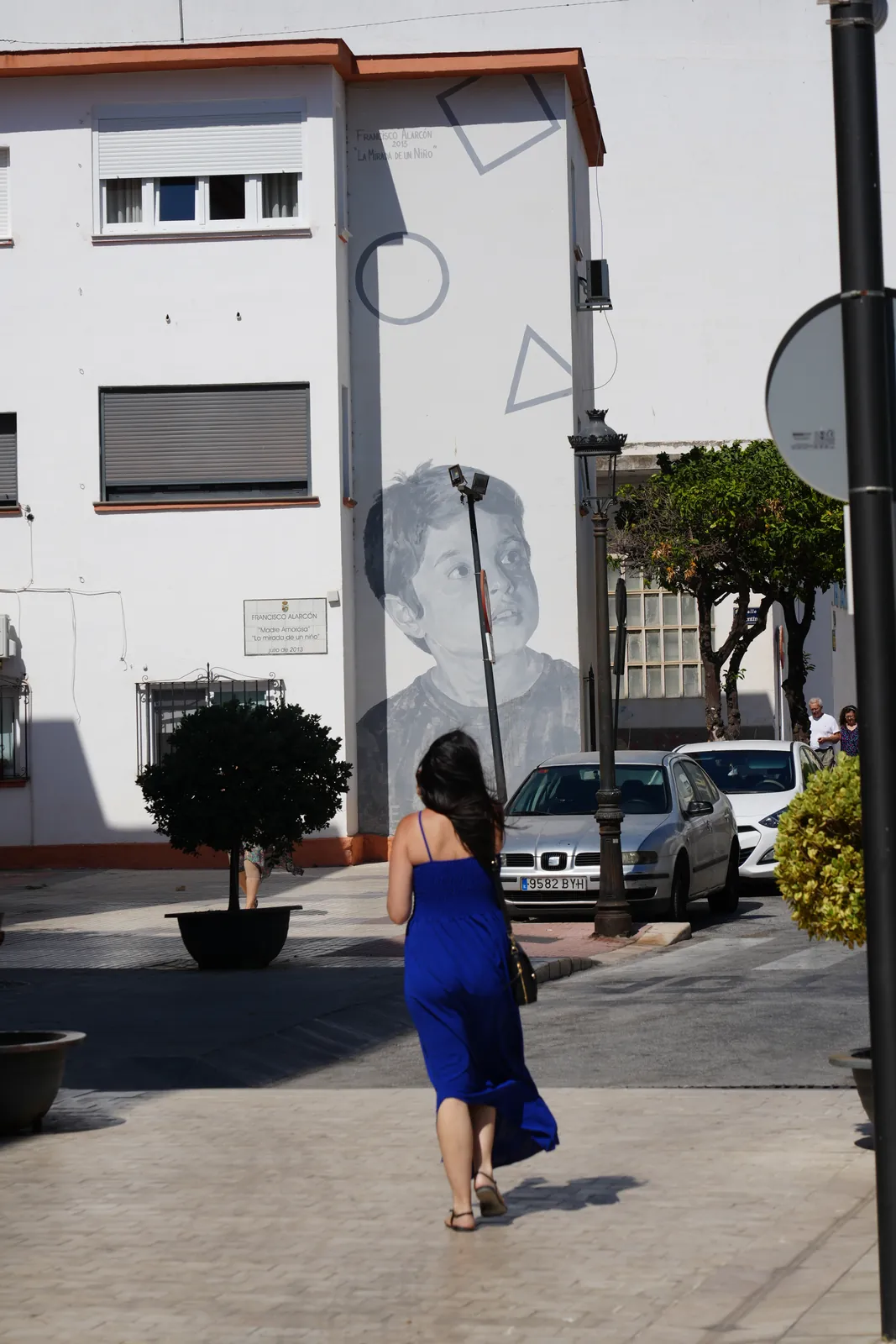
La Mirada de un Niño
A young boy looks slightly upward, painted in greyscale, with enough detail in the skin and eyes that it stops reading as flat paint the longer you stand there. Above him, someone’s added a few flat geometric shapes, a circle, a triangle, a square, floating in the sky like they drifted in from a different painting entirely.
There’s an actual plaque on this wall, which is rare enough on this walk to be worth mentioning: Francisco Alarcón, 2013, “La Mirada de un Niño”, A Child’s Gaze. It might be the second half of a pair with the child’s face and reaching hand a few streets back, both part of a theme called Madre Amorosa, but nothing I found actually confirms that.
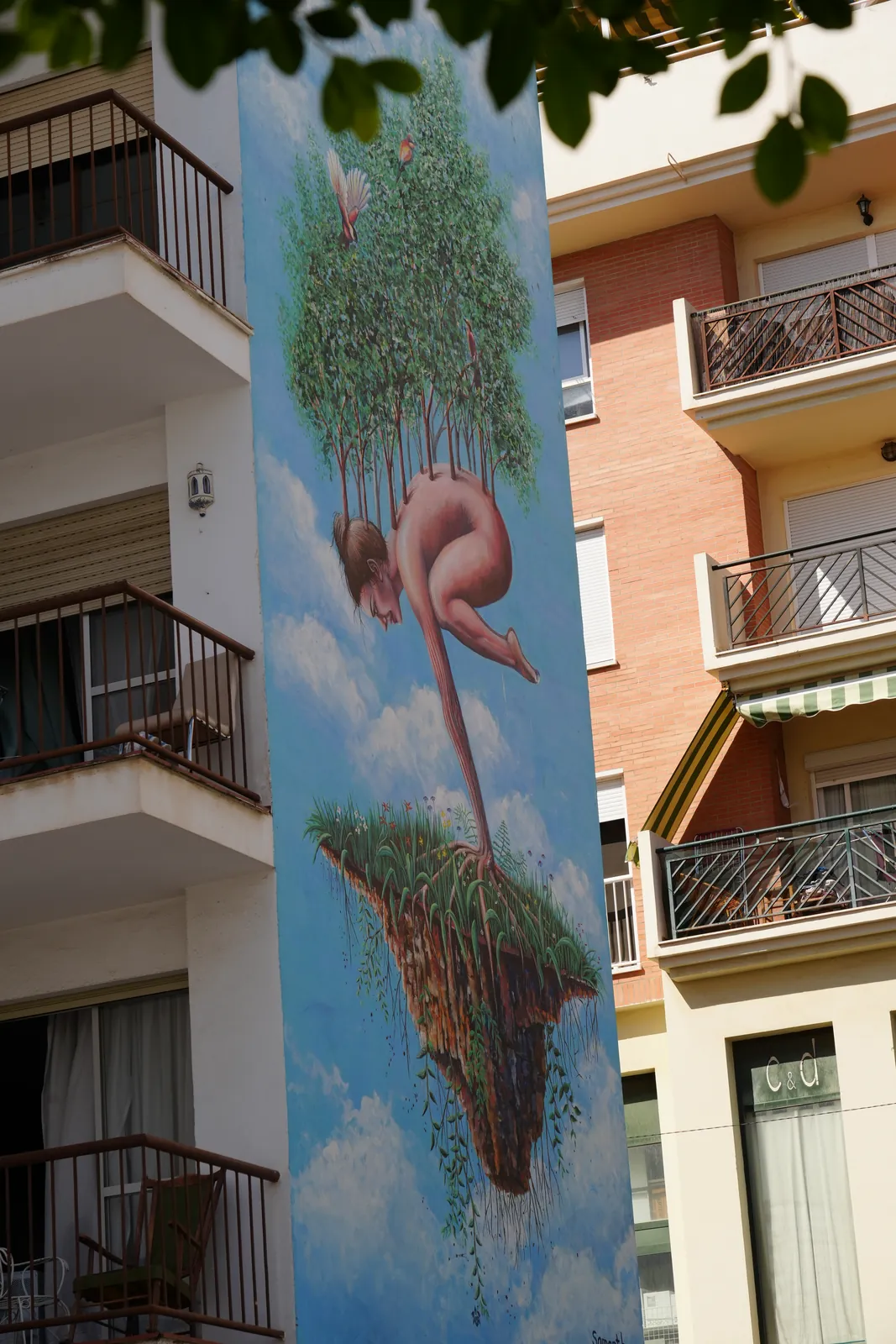
A diver turning into an island
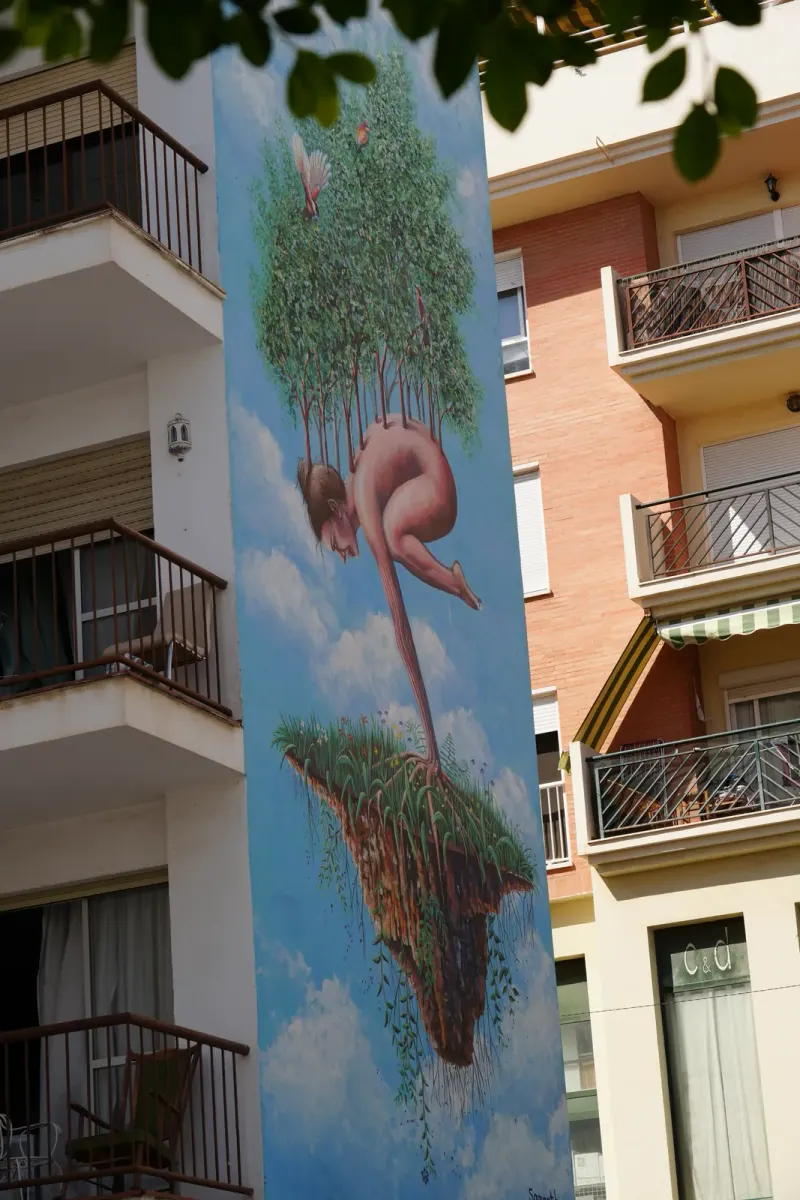
A figure dives head first into the wall, except its legs don’t stay legs, they stretch and twist into tree roots, and the roots grow up into a small floating island covered in grass and wildflowers, just hanging there in a pale blue sky full of clouds and tiny birds.
Half nightmare, half daydream, and I still can’t quite explain why it works as well as it does, easily the strangest and most magical piece on the whole walk. There’s a partial cursive signature near the bottom, maybe Samuel, though it’s too faded to be sure.
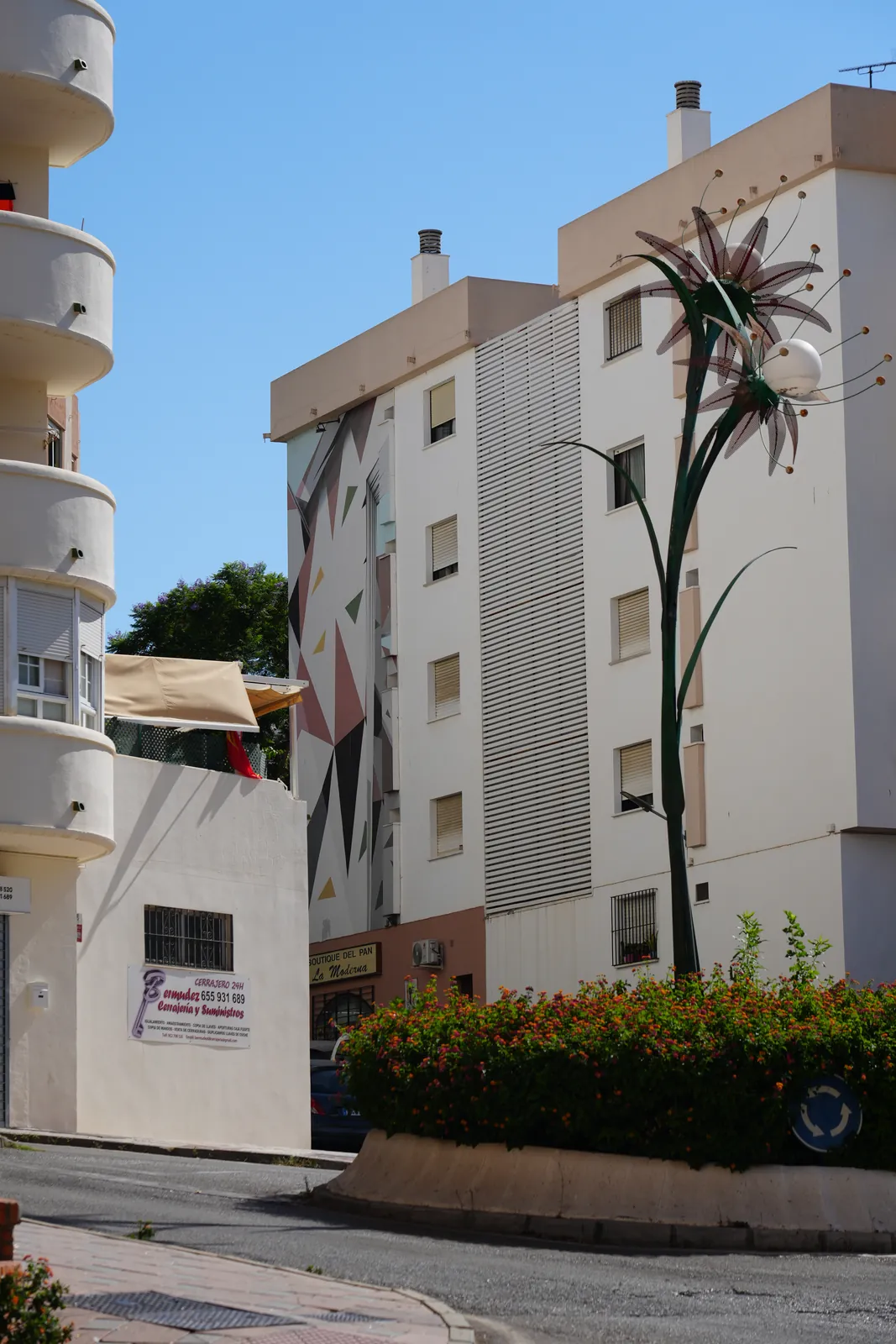
Triangles and an extra flower
Around the next corner the style shifts completely: bold triangles in pink, black, tan and cream, fractured like broken origami, wrapped around a building corner. Standing right in front of it, unconnected to the mural itself, is a big sculptural metal flower about as tall as a streetlamp. It’s not part of the artwork, technically, but by the time you’re standing on that corner it feels like it belongs there anyway.
The little brick kiosk
There’s a small brick utility building with a tiled roof tucked into this stretch, easy to miss if you’re not looking for it, and someone’s turned it into a triptych of traditional life. One panel’s a farmer swinging a scythe under a bright sun. Another’s a market seller, her basket spilling over with oranges. The third is a fisherman gripping a coiled rope against a stormy sky.
The painting style here is older and more classical than most of what surrounds it on this walk.

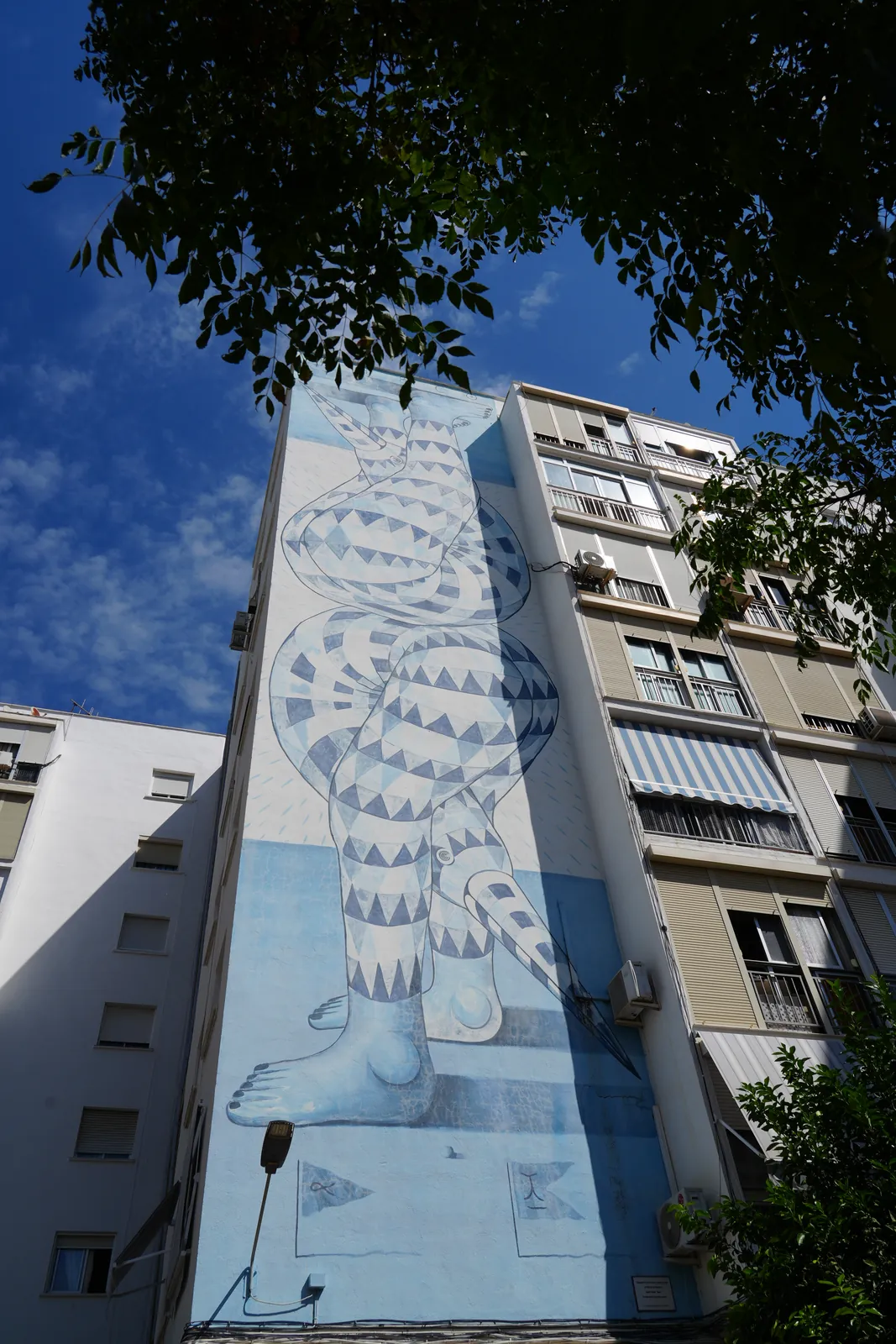
Triangles again, this time with wings
A crouching winged figure made entirely out of interlocking blue and white triangles, almost like stained glass if stained glass could crouch. Down at street level, easy to miss, a couple of small painted flags sit near its feet. It’s a brilliant piece precisely because it isn’t trying to look like anything real.
Three doors, three panels, one wall
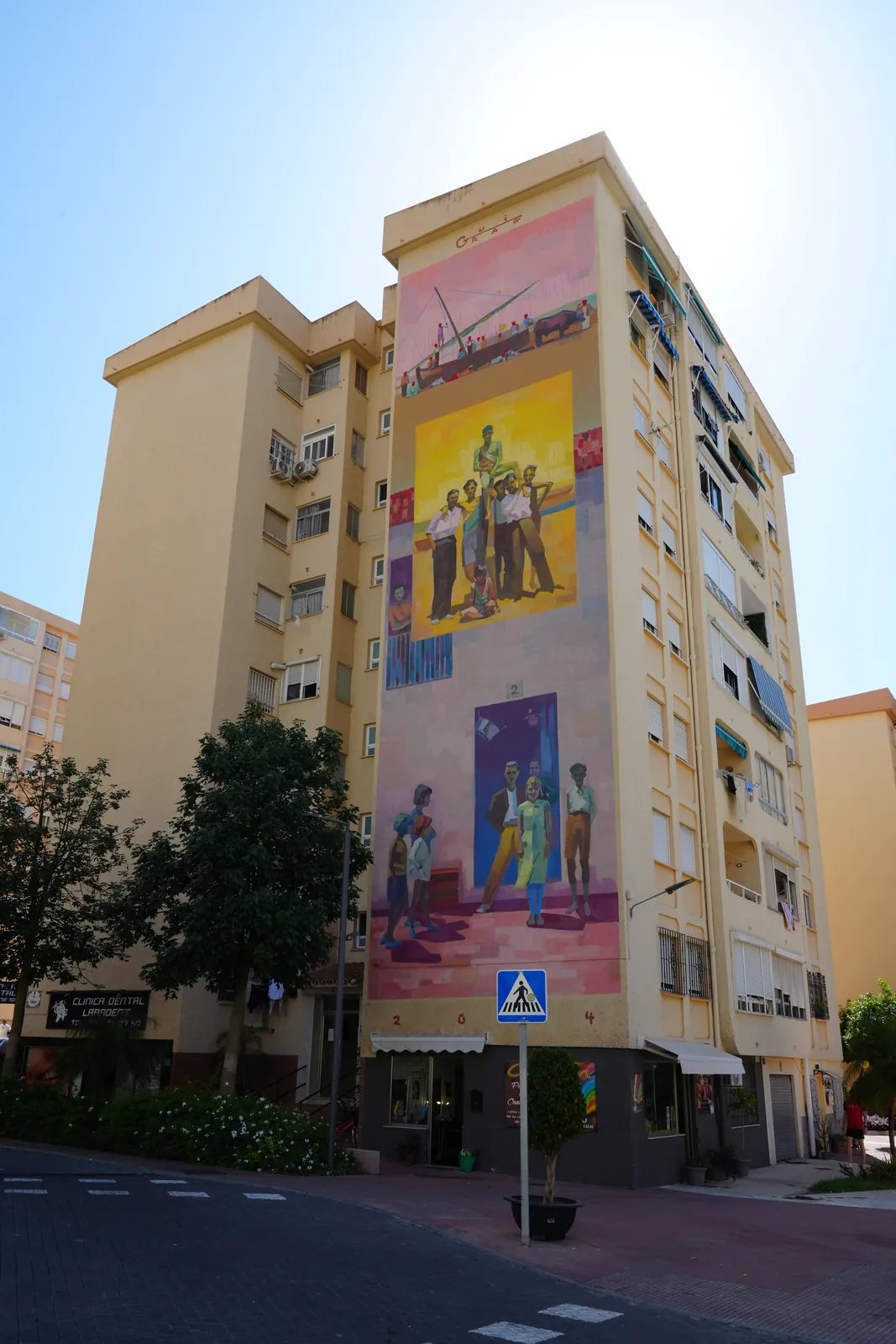
This one covers an entire apartment tower, split across three panels that line up with three separate entrances, numbers 2, 6 and 4 painted at street level. Up top, against a pink sky, there’s a small fishing scene. The middle panel drops onto a yellow background with a group portrait, a seated child out front of everyone else. Down at the bottom, purple this time, a family of four stands together on a street.
There’s a partial cursive signature near the top that I couldn’t read, and the numbers 2024 painted elsewhere on the same wall, my best guess for the year it went up.
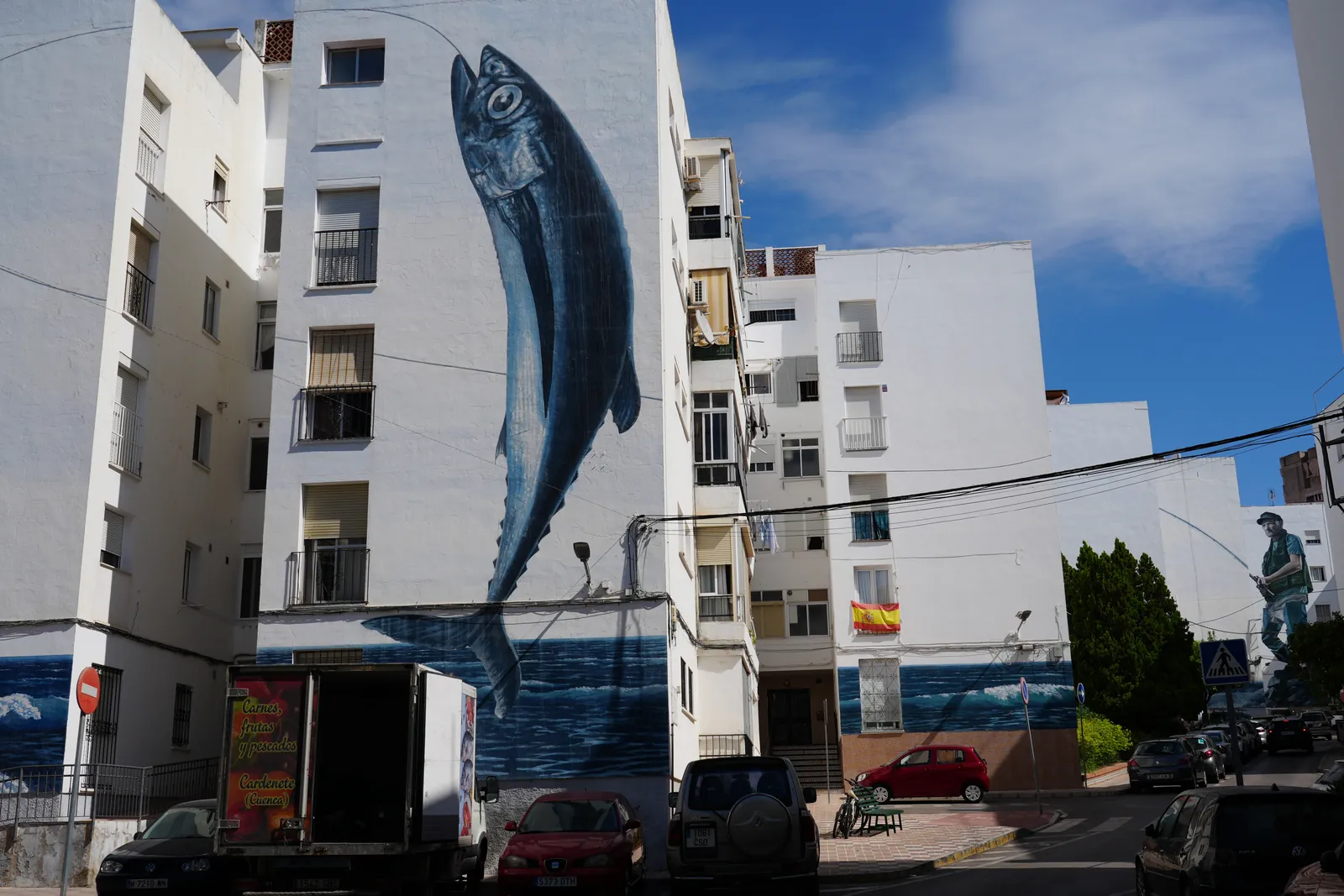
A tuna big enough to need its own building
You see this one from a block away. An enormous blue tuna leaps out of stylised waves across the whole corner of a building, its reflection painted into the water below like it’s really mid-splash. Somewhere in the background of the photo I took here, barely visible on a completely different building, there’s a tiny fisherman with a rod, so small I almost missed him going through the photos later.
That kind of scale, painted this close to street level, is spectacular.
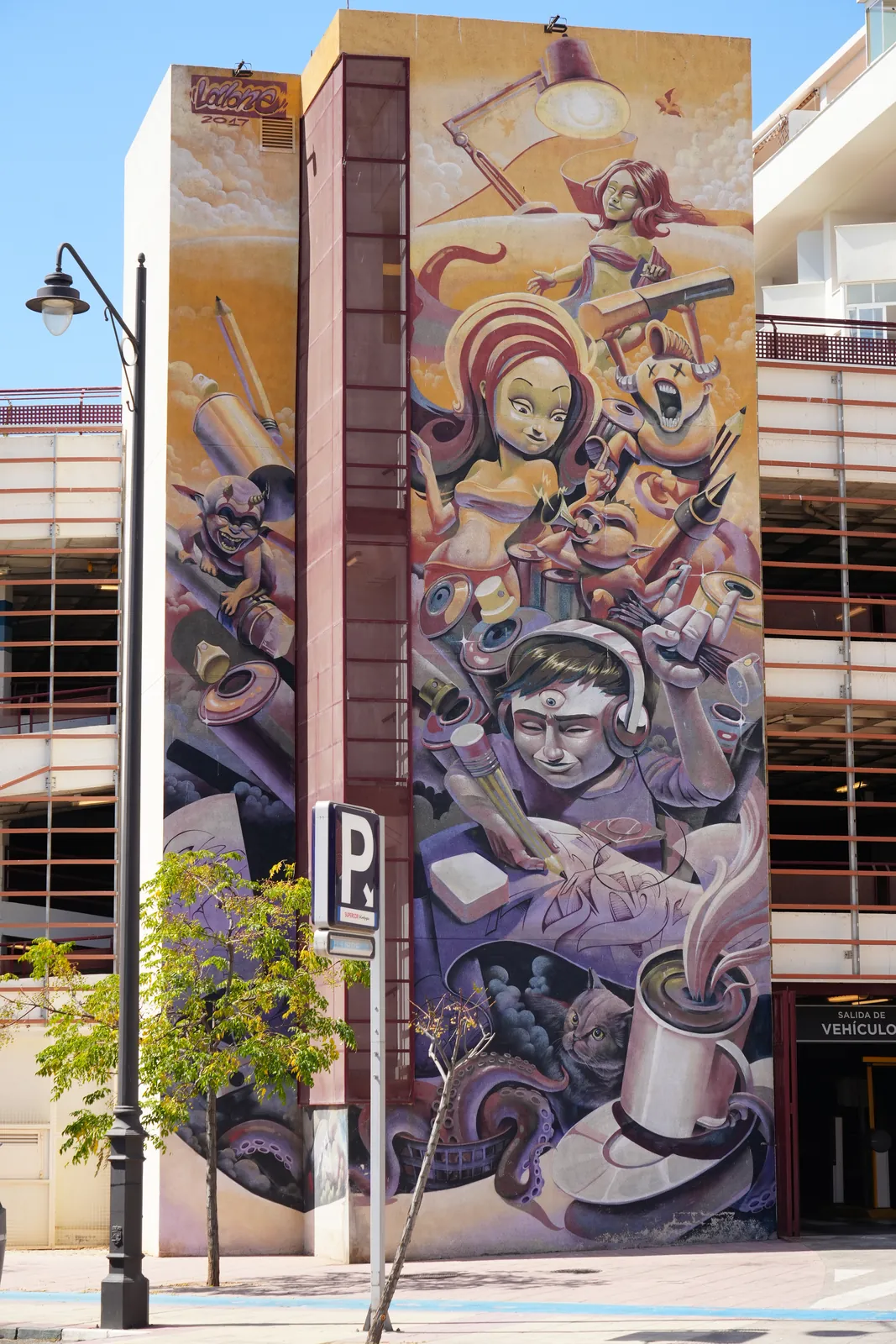
Lobo, on the side of a car park
This is the busiest piece on the whole route, painted across the corner tower of a multi-storey car park. There’s a boy at a desk drawing with a third eye on his forehead and headphones clamped on, a red-haired woman in a bikini top under a desk lamp, a couple of cartoon devils, a grey cat, an octopus with its tentacles wrapped around a steaming coffee cup, paintbrushes and paint tubes and an eraser all floating around the edges like the whole thing spilled out of someone’s sketchbook.
Lobo signed it, and dated it 2017, both right there in the paint for anyone to read. The octopus making off with someone’s coffee cup is the best joke on the whole route.
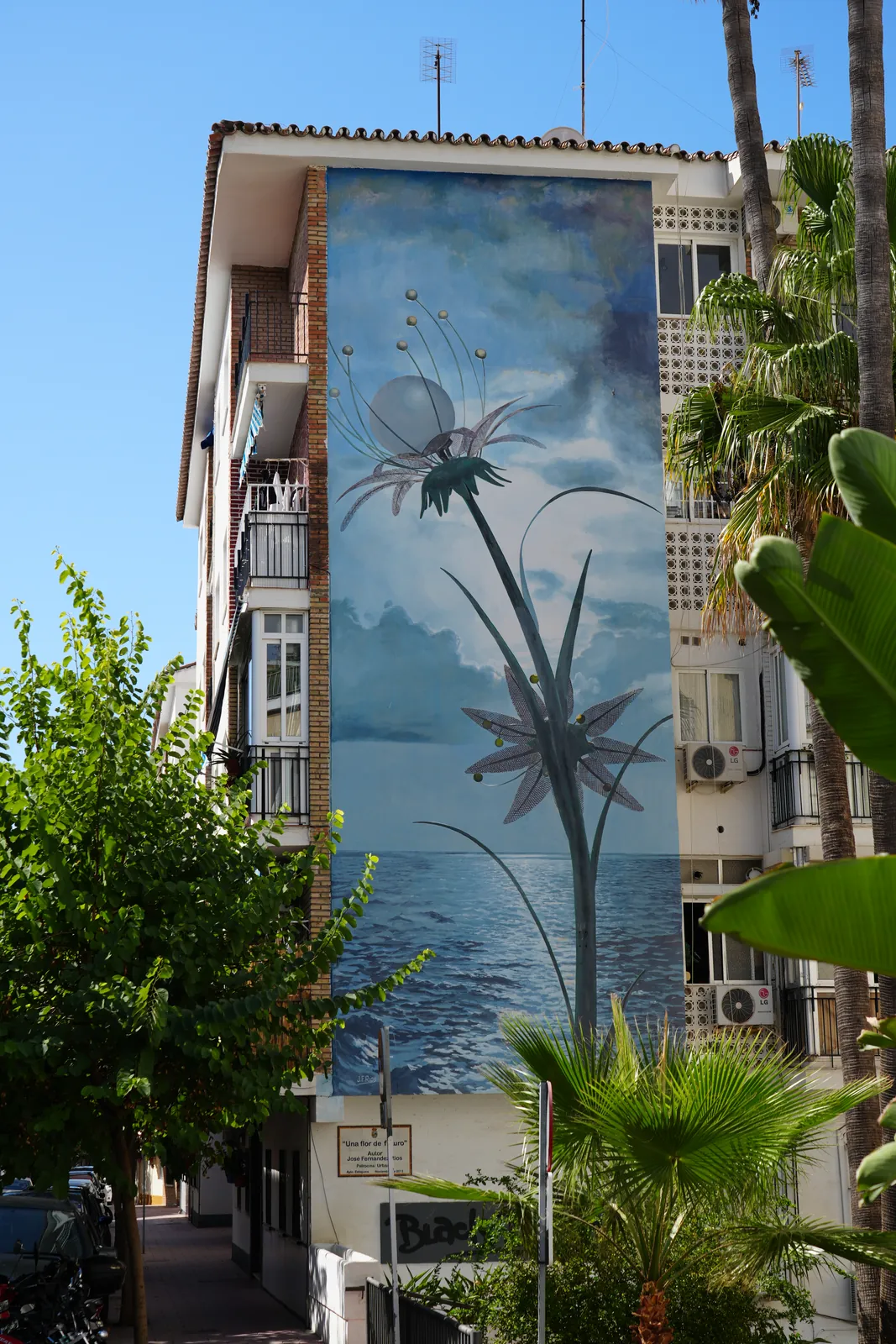
Una Flor de Futuro
A dandelion, but painted the size of a building, its seed head so delicate you’d think a strong wind could take the whole wall apart. Behind it, the sea and sky sit soft and pale, and a couple of real palm trees lean in front of the base.
There’s a plaque naming it clearly: Una flor de futuro, a flower of the future, by Jose Fernandez Rios, the same name behind the palm tree back on Calle Fortuny and that giant Día de pesca piece elsewhere in town.
The one that isn’t paint at all
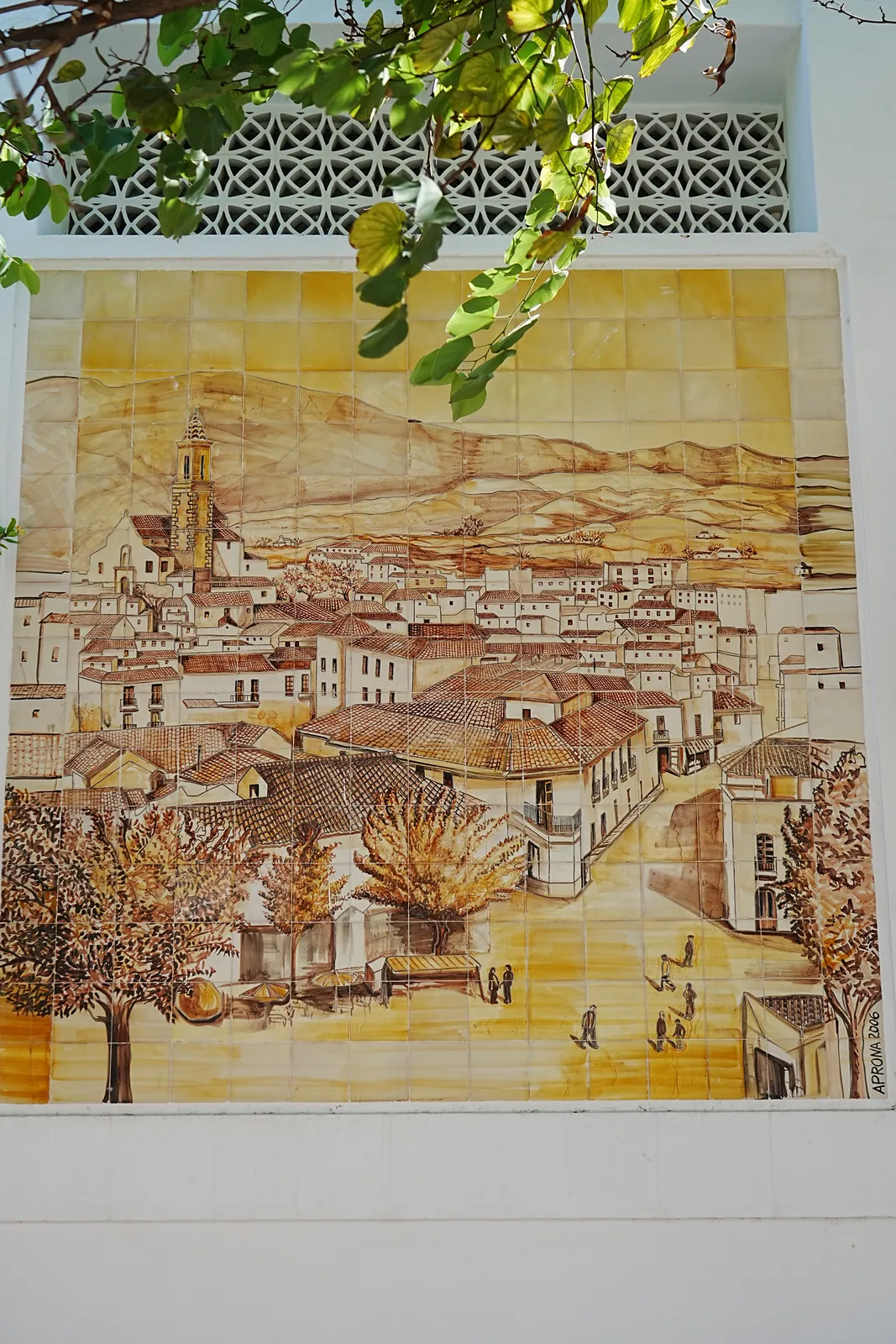
Get close to this one and you realise your eyes have been lying to you. It’s not a painting, it’s hundreds of individual glazed ceramic tiles, each one part of a bigger picture of a hillside Andalusian village in sepia and ochre, a church bell tower, whitewashed houses climbing the slope, tiny figures dotted around a plaza.
It’s signed and dated, APRONA 2006, and it’s worth slowing down for, because everything else on this walk is paint on plaster and this one is a completely different craft.
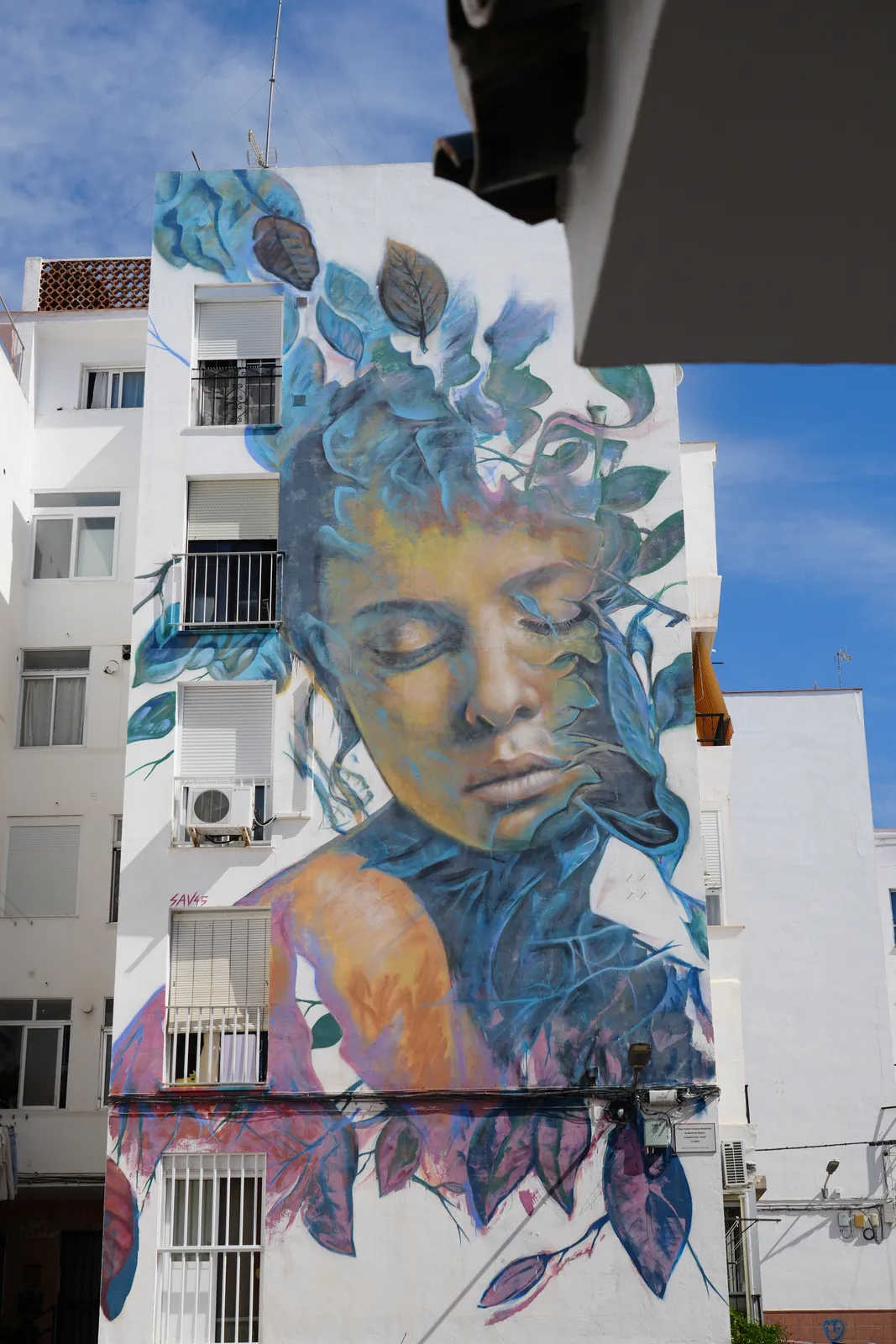
SAV45
A woman’s face, eyes closed, and from her hair and shoulders down she dissolves into blue-teal leaves and vines, the odd flash of coral or pink breaking up the green. One shoulder stays bare and warm orange beneath all that foliage, like she hasn’t fully turned into a plant yet, a lovely, quiet touch amid all that tangled colour.
SAV45 tagged it in red, though I couldn’t find anything else about who that is.
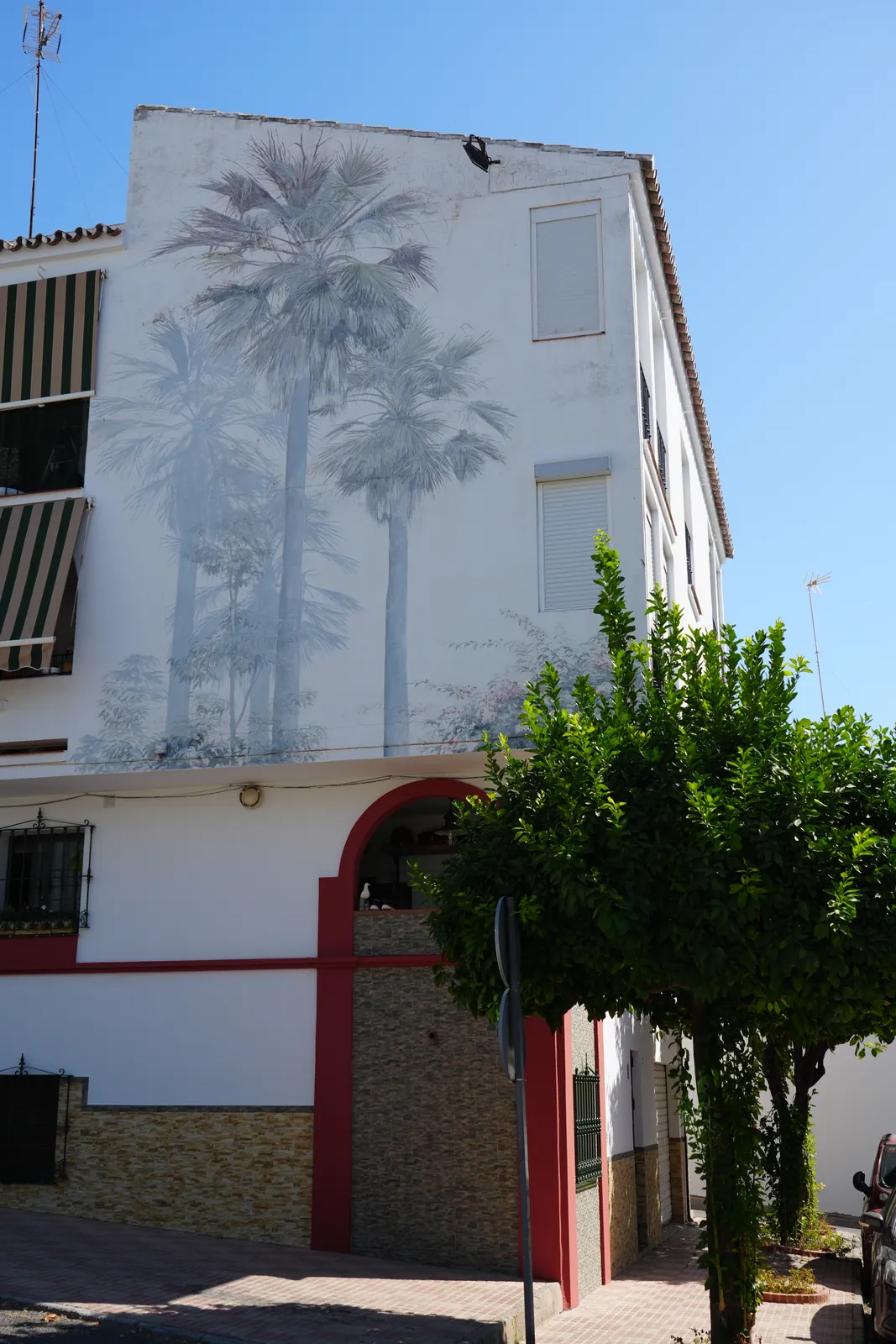
A second palm tree, all in grey
Two streets on from Calle Fortuny, and here’s another palm tree mural entirely, several tall palms in muted grey tones stretching across a corner building, quieter than J.F. Ríos’s colour version. It’s a really interesting pairing, two different artists tackling the same subject a short walk apart in the same neighbourhood.
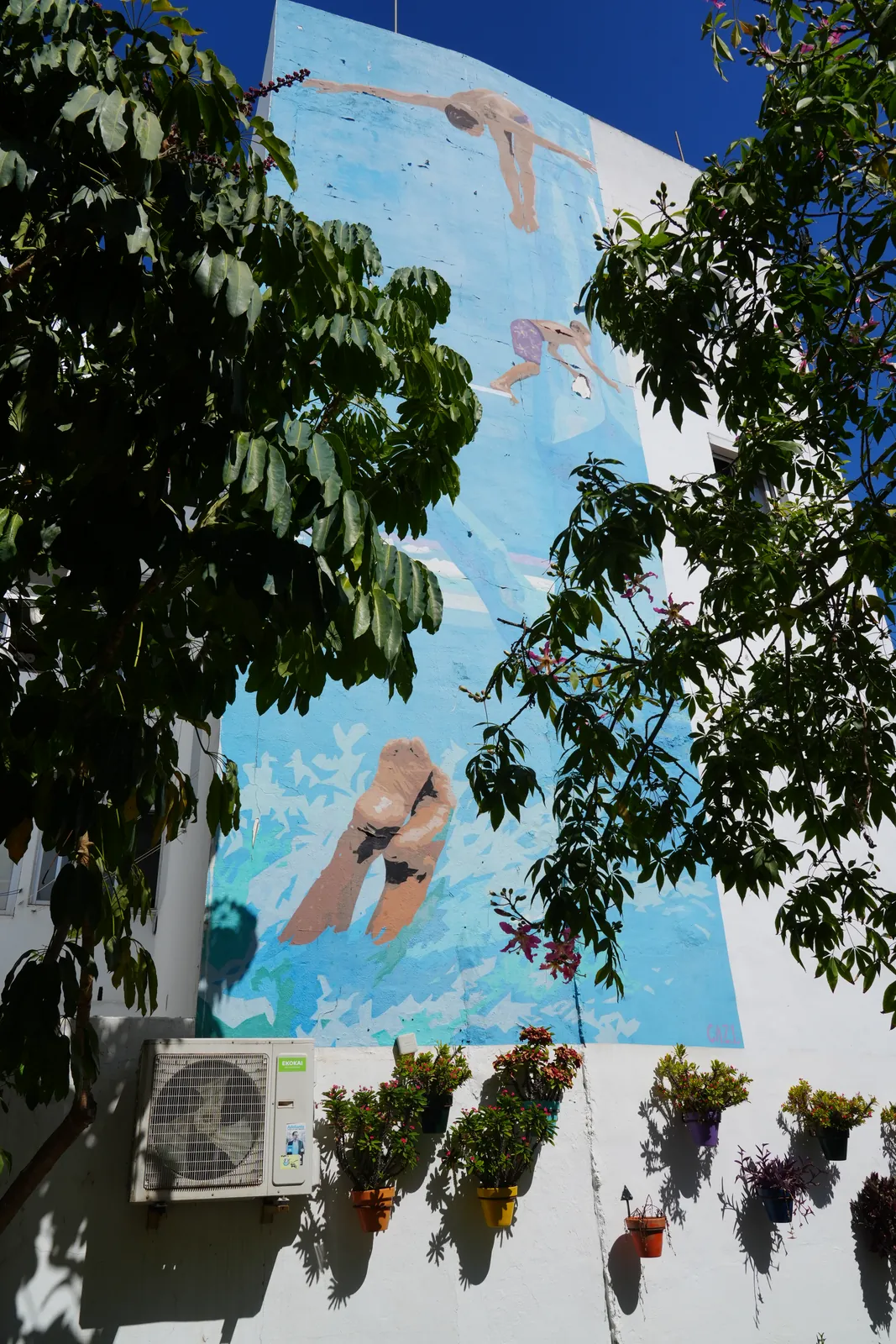
Three swimmers in a flat blue wall
By the last one, I’d slowed right down, in the way you do near the end of something without quite planning to. Three swimmers, nothing else, set against a single flat blue wall: one diving in from the top, one mid-stroke through the centre, and down near the bottom just a pair of feet and calves, the rest of that swimmer already out of frame.
GALL tagged it, clean and legible, no year, no plaque, nothing more to explain. After twenty-one murals thick with detail, colour, plaques and half-legible signatures, ending on something this stripped back felt right.
Like Estepona had decided to let the last word be a quiet one.
The detour down to Puerto Pesquero
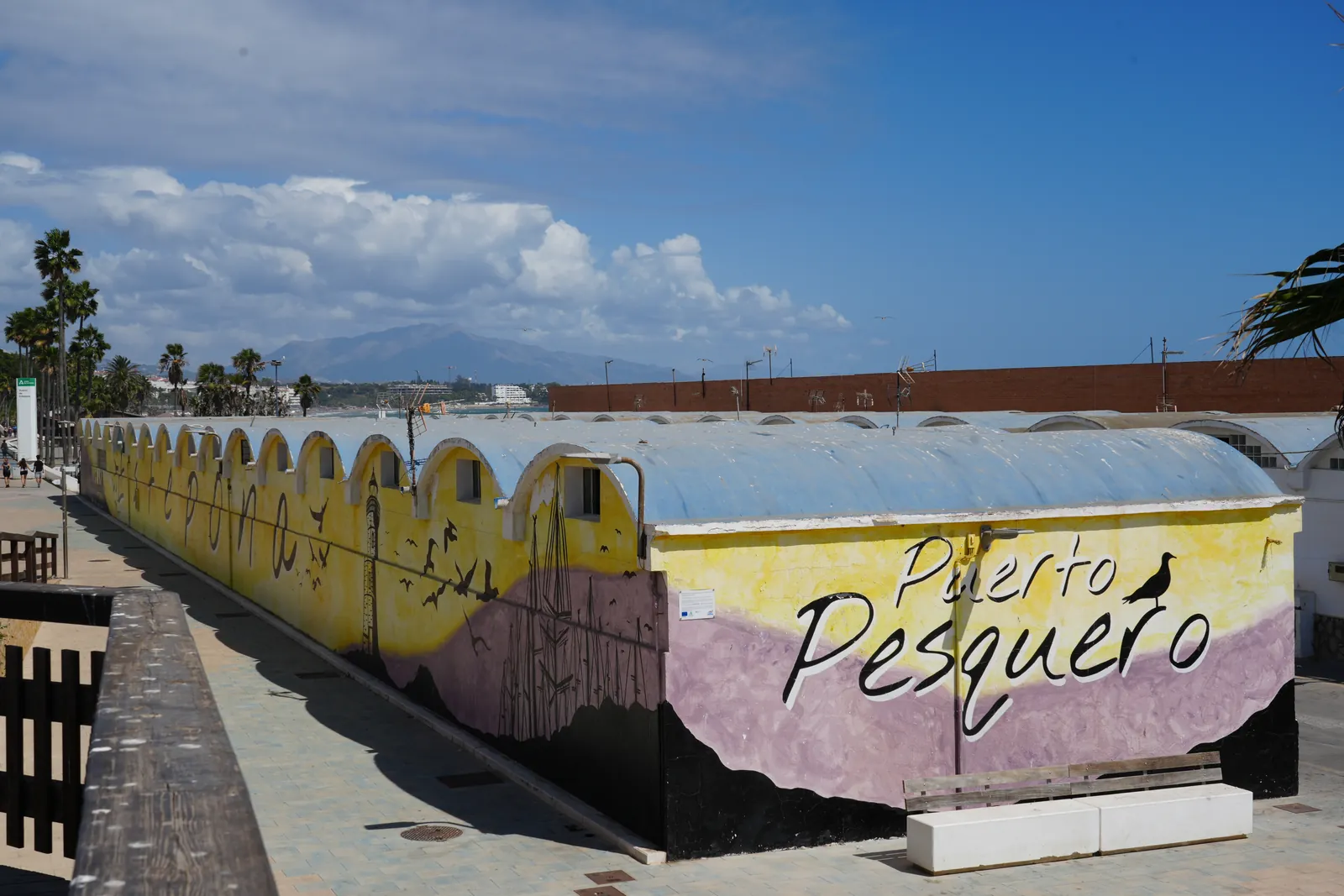
The apartment-block cluster runs out eventually, and if you keep going past where most maps of the route stop, there’s one more mural worth the extra walk down to the old fish-market building on the seafront, Puerto Pesquero. It wraps the whole length of the building in a gradient that shifts from yellow into purple, silhouettes of fishing-boat masts and walking figures worked into a painted pier along the way. Puerto Pesquero is written out in large cursive script at one end, and further along, in the same handwriting, so is Estepona.
Most versions of the official route leave this one off entirely, which is a shame, because after all those apartment blocks, ending somewhere with an actual sea view in front of you is a good way to close out the walk.
Why Estepona is covered in painted buildings
The murals started back in September 2012, an initiative from the then-mayor, José María García Urbano, aimed at giving Barriada Primavera’s blank apartment walls something better to look at than bare concrete. What began as a local revitalisation project has kept growing since, with international competitions adding fresh pieces in 2017, 2020 and 2024, which is likely why the styles jump around so much from one building to the next, comic art next to photorealism next to abstract geometry next to hand-glazed tile.
Nobody seems to agree on exactly how many murals there are now. Counts vary from the low forties into the sixties depending on the source, and at least one figure circulating online claims over 120, though that number likely folds in Estepona’s separate poetry route and sculpture route, not painted murals alone.
I stuck to the 22 I actually found and photographed rather than padding this out with ones I never saw. If you want to keep going after that, Casa Laborrega’s guide to the full route digs a lot further into the rest of them than I did here.
Either way, it’s grown well beyond its original neighbourhood-improvement brief into one of the more unusual open-air art collections on the Costa del Sol, free to walk through any day of the week.
What it actually takes to do this properly
Budget two to three hours for the whole thing at an easy pace, more if you stop to really look at each wall, which you probably will. Parking at Paseo Marítimo cost me under five euros total, right in the centre, an easy walk from where the murals start. Wear shoes you can actually walk in. Most of this is on regular pavement through a residential neighbourhood, nothing technical, but you’re on your feet the whole way and there’s a fair bit of looking up involved, which does something strange to your neck after the tenth building.
The map, whichever version you use, will get you close. It’ll get you onto the right street, more or less, and after that it’s on you to look up, walk the block, check the next corner, and trust that the wall you’re after is somewhere nearby even if the pin’s decided otherwise. I missed a couple of murals doing exactly that, circled back for others, and by the end had stopped minding the detours altogether.
Twenty-two murals, Jethro’s patience for my backtracking, and every single wrong turn still led somewhere worth standing in front of.