I passed my driving test in South Africa in 1999, when I was 18. By the time I moved to Spain in 2022, that was 23 years of driving experience. None of it mattered.
Spain looked at my licence, at all those years, and told me to start again from zero, medical, theory, lessons, the lot. I did it, and I passed everything first time, needing only five lessons. My husband and daughter didn’t have quite the same luck (more on that later).
So here’s everything I wish someone had told me before I started getting a Spanish driving licence: the paperwork, the exams, where to actually book each step, the real costs, and what happens once you pass.
⭐ Don’t miss >> If you’re still new to Málaga and haven’t sorted longer-term accommodation, my neighbourhood guide
Why South Africans (and Americans, Canadians, Australians) can’t just exchange
Turns out there’s a list. Spain will swap your foreign licence for a Spanish one, no exams needed, but only if your country has a bilateral agreement with them for it. It’s decided country by country.
South Africa never made it onto that list. Neither did the US, Canada, or Australia. I didn’t know this until I actually looked into it, and I’ll admit I assumed my 24 years of licensed driving would count for something. It counted for nothing.
If your country isn’t on that list, you’re doing the whole process from scratch: medical exam, theory test, lessons, a practical test, exactly like an 18-year-old Spanish first-timer walking into a driving school.
Check your country’s status before you assume anything, because that assumption is exactly what got me.
The six-month countdown nobody warns you about
For a while none of this seemed urgent. As a visitor, I could drive around on my South African licence indefinitely.
Then I actually became a resident, and the clock started. Once your residency comes through, you get six months to drive on your foreign licence before it stops being valid in Spain at all.
So you’re a perfectly good driver one day, and the next day you’re not allowed behind the wheel.
Is that a catch-22? It sure feels like one.
I started counting down the moment my residency card arrived, because six months sounds like plenty of time until you’re the one trying to book a medical appointment, a theory exam, and enough lessons to pass, all before a deadline you didn’t choose. Once that clock runs out, I book trains and buses through Omio for anything further than a walk.
The Costa Rica loophole that doesn’t work
When we lived in Costa Rica between 2019 and 2022, I converted my South African licence into a Costa Rican one, no fuss, and drove around perfectly legally for three years.
So when we moved to Spain, I thought I’d found a shortcut. Costa Rica is on Spain’s list of countries with a licence exchange agreement, so surely I could just swap my Costa Rican licence for a Spanish one and skip the whole process.
I couldn’t.
Turns out Spain looks at where a licence actually came from, not just what it says on the card. Because my Costa Rican licence was itself a conversion of a South African one, and South Africa doesn’t have an agreement with Spain, the DGT (Spain’s traffic authority) treated it as still South African underneath. Costa Rica being on the list didn’t matter, because in Spain’s eyes I hadn’t really got a Costa Rican licence, I’d just repackaged a South African one.
There’s a second catch that trips people up too: the licence you’re exchanging has to have been issued before you became a resident in Spain. The DGT checks the dates. I get why, it stops people moving here, finding the test too hard, then nipping off somewhere easy for a quick licence and bringing it back to swap.
The part that still gets me is that I actually learned to drive “the Spanish way” in Costa Rica. Cars there sit on the left and drive on the right, same as Spain, so by the time I got here, driving on that side of the road already felt completely normal. Three years of driving on the correct side, and it counted for nothing with the DGT.
Cl@ve, NIE and padrón: the paperwork before any of this starts
Before you even start any of this, you need your residency paperwork sorted, your NIE or TIE, and your padrón certificate from the town hall, that’s your proof of address, and every town hall runs its own version of it (here’s Málaga’s own padrón page if that’s where you live). Book the NIE or TIE appointment through Spain’s official immigration portal, cita previa extranjería, you never pay for the appointment itself.
To do anything online with the DGT, you’ll also need Spain’s digital ID system, called Cl@ve, set up at clave.gob.es. It has an English-language option.
The medical certificate
Book the medical online, at an approved driver medical centre, not just any doctor. The DGT publishes an official directory of approved centres searchable by province, though most centres then take your actual booking directly through their own website or by phone rather than through that directory.
It’s quick: they check your eyesight, your coordination, and give you a general once over. It costs somewhere in the €35 to €70 range these days, and you walk out with a certificate saying you’re fit to drive.
One thing that’s actually improved since I did mine: you used to have to bring your own passport photos along. Since a rule change in late 2024, most centres now just take your photo on the spot and send it straight to the DGT themselves, one less thing to organise. Worth double checking with your own centre when you book though, in case some still ask for one.
The theory test: 30 questions, two chances
You pay before you even sit down to a single question, €94.05 to the DGT, and that fee covers both your theory and your practical test together, plus issuing the licence itself once you pass.
The exam itself is 30 multiple choice questions in 30 minutes, and you’re allowed exactly 3 wrong, so you need 90% to pass. Fewer than half of people pass on their first go, which tells you everything about how seriously to take it.
You can sit it in English, and I was grateful for that, but don’t expect the translation to make life easy. It’s what I’d call creative. More than once I had to work out what a question was actually asking before I could even think about answering it. Since February 2026 there’s also a video section, where you watch a real traffic clip and have to spot the hazard in it before it plays out.
The €94.05 only covers the DGT’s side of things. Your driving school will usually charge its own fee each time it presents you for the practical exam, often €30 to €100 depending on the school, so ask what’s included before you sign up.
You apply for the exam, and pay that €94.05 tasa, through the DGT’s own exam application page, online if you’ve got Cl@ve or a digital certificate sorted, or in person at a DGT office if you’d rather hand over paperwork than click through a government website. If you’re going in person, print and fill out the official Mod.04 application form beforehand, it saves you doing it standing at the counter. Whichever way you do it, ask specifically for the exam in English right there at registration, it doesn’t default to English on its own, and you don’t want to find that out on the day.
In our house, the results were properly mixed. I passed first time. My husband failed once, then scraped through on his second attempt. My daughter failed twice, which used up her fee entirely, meaning a third go means paying the full €94.05 all over again from zero. She still hasn’t found the courage to book it.
If you’re about to start, here’s what actually helped. Sort your paperwork and your Cl@ve before anything else. Do practice tests every single day, in whichever language you’ll actually sit the real exam in, the DGT itself runs a free official practice test tool with no registration needed, in the same format as the real thing. And don’t book the real thing until you’re consistently landing 27 or more out of 30.
GETTING AROUND MÁLAGA WHILE YOU SORT ALL THIS OUT?
🚆 Trains and buses: I book through Omio
🏨 Somewhere to stay while you settle in: Find a place in Málaga
An appointment to book an appointment
I had to book an appointment just to go to the office to book my test. Read that again. An appointment, to make an appointment.
Once you’re finally sitting across from someone at the DGT, you still don’t get to choose your date. You apply, and they assign you whatever slot happens to be free. There’s no calendar to scroll through, no “does Thursday suit you”, you just wait to be told.
And it has to happen in the province where you’re officially resident, no exceptions.
That one caused real headaches for my daughter, who was away at university in Monda and could only sit her test on the days she happened to be home visiting us in Málaga. Her test dates weren’t built around her studies, they were built around whenever she next came home.
So instead of planning her visits around us, she ended up planning them around the DGT. At least book that first appointment through the right door: the DGT’s own cita previa page is free to use, and it’s the same portal you’ll end up back on for pretty much every other DGT errand for as long as you live here.
Manual or automatic? Choose carefully before your test
We knew about this one going in, so I tested in a manual on purpose. The car you take your practical test in decides what you’re allowed to drive afterwards for the rest of your life. Pass in a manual and your licence covers both. Pass in an automatic and you get “code 78” stamped on it, automatics only, and that restriction travels with you across the whole EU, not just Spain.
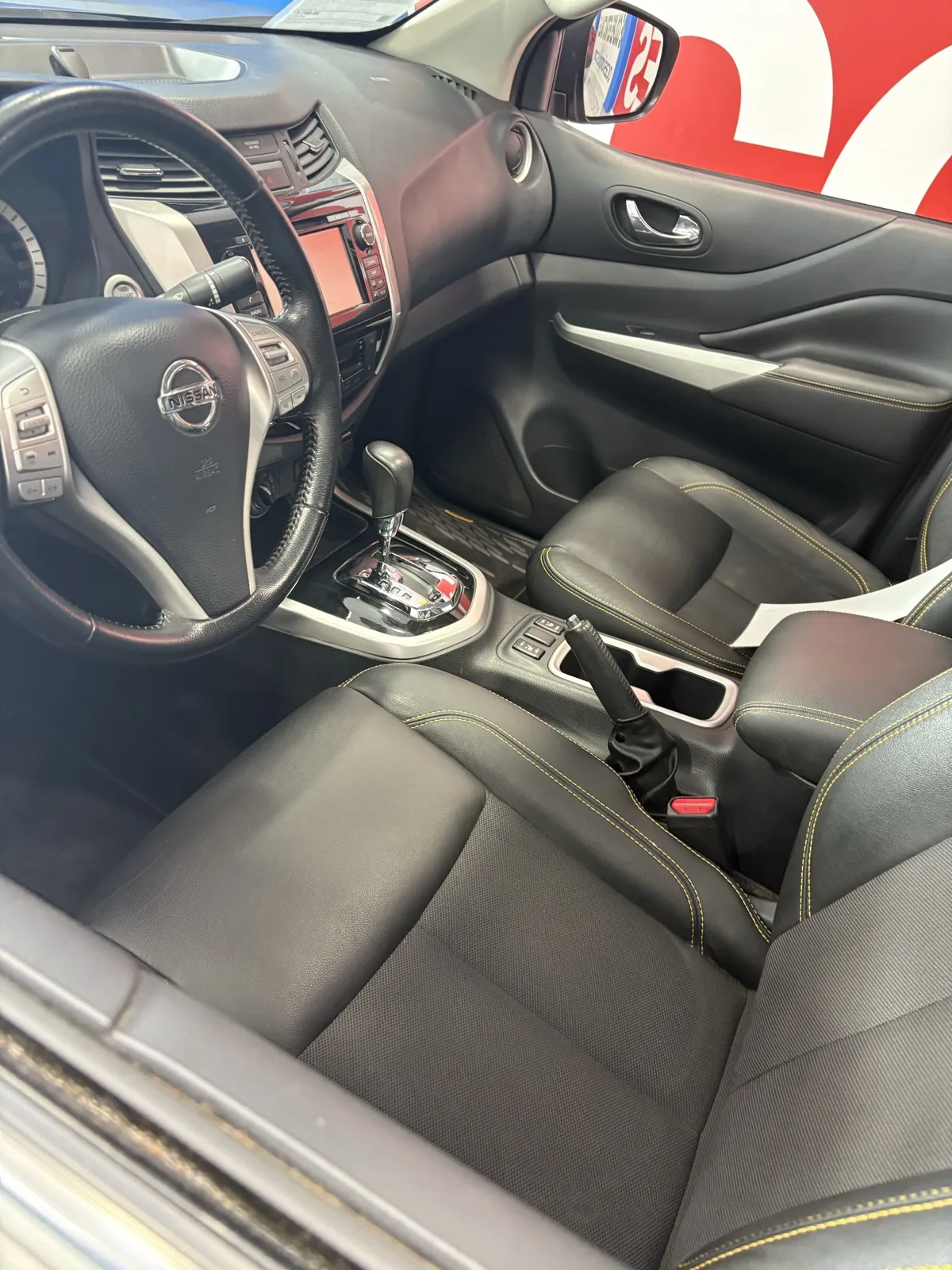
Get caught driving a manual with code 78 on your licence and it’s a real fine, €200, or €100 if you pay within 20 days, plus 4 points gone. Right now the only way to remove the restriction is to retake the whole practical test in a manual. An EU rule is coming that lets you clear it with a 7-hour course instead, no new test, but Spain doesn’t have to bring that in until 26 November 2029, and has until 26 November 2028 just to update its own regulations for it.
Automatic lessons tend to cost more at driving schools too, and most learners here still train in manual anyway, which says something about how normal it still is. If you’re exchanging a licence rather than starting from scratch, check whether your home country’s licence was automatic-only, because the Spanish one will likely carry the same restriction over.
The practical test: a car full of strangers
Forget teaching yourself, or your kid, to drive in the family car on a quiet Sunday. In Spain you learn in a driving school’s car, dual controls and all, with a qualified instructor sitting right beside you.
Before you’re even allowed to book a lesson, the school takes you out, watches you drive, and decides how many lessons you need. There’s no legal minimum, it’s entirely their call.
I was lucky, apparently, because I only needed 5. Lessons currently run somewhere between €30 and €50 each, depending on where you live.
The bit that really tests your patience is what comes after the lessons: the wait for an actual test date. In Málaga, driving schools will tell you straight up that people wait three, four, even five months for a practical slot. There simply aren’t enough examiners, which makes Málaga one of the worst provinces in Spain for this.
Plenty of people keep paying for extra lessons the whole time they’re waiting, just to stay sharp, or lean on Málaga’s public transport a bit longer than they planned.
🚆 Stuck waiting months for a test date? You don’t need a car to get around Spain in the meantime. I use Omio to book trains and buses when I don’t want to drive.
Then test day comes, and you realise exactly how many people fit in that car. You, driving. The examiner, scoring every move you make. Your instructor from the driving school, up front beside you. And whichever other students from your school happen to be along for the ride, waiting their turn once you’re done.
The test itself only runs about 25 minutes, covering town driving, the highway, or a bit of both, and more than half the people who take it fail. Some mistakes don’t even let you finish those 25 minutes. Run a red light, and it’s over right there.
So you sit in that car, engine running, examiner’s pen already hovering over the sheet, and you pull out onto the road knowing that whatever happens in the next 25 minutes, there’s no version of “let’s try that again.”
The independent driving trap
Then it happened. The examiner, without even looking up from his clipboard, told him in Spanish to take him to the nearest hospital. No hint after that. Not even a raised eyebrow.
“Okay,” he said. Then, “Left or right?”
Nothing. Silence. He didn’t know.
This was already his second attempt. The first time round, he’d failed for something almost funny in hindsight: he was in a Mini, an actual small car, and being a big man, he couldn’t see the traffic lights properly from the driver’s seat (we still call them “robots” back home in South Africa, which never fails to confuse people here). Cramped in like that, he genuinely couldn’t see what he needed to see. Fail number one.
So the second attempt mattered, and this was the part that got him. No directions, no help, nothing.
It’s a fair idea in principle. The DGT wants to know you can actually read and follow signs like any competent driver, not just repeat a memorised route. But if you’re a non-EU resident who could only drive on your foreign licence for six months before being grounded, you’ve had almost no real, unsupervised time to learn your own city by ear. Our lessons had mostly covered the roads near the exam centre, not general geography, so when the examiner said “hospital,” he genuinely had nothing to go on.
And failing isn’t just embarrassing, it’s expensive. The DGT itself charges nothing extra for the practical, but your driving school does, billing you separately every single time for the car you sit the exam in (typically €30 to €100, depending on the school and city), on top of the DGT’s own fee.
A fail sends you straight back into the waiting list. Fail twice, and that DGT fee, which only covers two attempts, is used up. A third go means paying the full €94.05 all over again, from scratch.
He didn’t go for a third.
”He’s not wasting any more money,” he said.
That was 2023. As of writing this in 2026, he still hasn’t gone back.
If you’re reading this before your own test, do three things differently. Ask your instructor to actually practise independent driving with you, following signs to the hospital, the town centre, the motorway, not just the exam route on repeat. If the test car has a sat nav, you’re allowed to use it, but you have to type in the destination yourself, the examiner won’t do it for you. And if you’re tall, or just a big person, ask what car model you’ll actually be tested in before you sign up with a driving school. We wish someone had told us that before the Mini.
So what does it actually cost?
Somewhere between €500 and €1,500, depending on how many attempts it takes you, and if things go badly, potentially a lot more than that.
In the best case, mine, more or less, here’s what it looks like: the medical certificate runs €35 to €70, the DGT fee is €94.05 (this covers both the theory and the practical exam together, plus issuing the licence itself, so it’s not a separate charge for each), driving school enrolment is roughly €200 to €400, and 5 lessons at €30 to €50 each.
Best case: getting a Spanish licence from scratchchecked 2026
- Medical certificate€35-€70
- DGT fee (theory + practical + licence issue)€94.05
- Driving school enrolment€200-€400
- 5 lessons, at €30-€50 each€150-€250
- Driving school's car for the practical exam, per attemptcharged by the school, not the DGT, and varies a lot by city€30-€100
Best case, first attempt€510-€915
Add it up and you’re at roughly €500 to €800, plus what the driving school bills you for the car itself on exam day, typically another €30 to €100 per attempt.
Most people don’t get off that lightly. The average total lands somewhere between €800 and €1,500, with one estimate putting it around €1,200.
Then there’s the worst case, which in our house has a name. My husband paid the full DGT fee twice, once at the start, and again once he’d used up his two attempts across the theory and practical exams, plus the driving school’s car fee every single time he tested.
One driving school in Sevilla, for reference, charges €50 for that car fee, on top of a further €25 admin charge once you’ve failed the practical twice. It varies a lot by city: expect somewhere around €30 to €50 in Málaga or Sevilla, and closer to €100 somewhere like Bilbao. He still, as of today, doesn’t have a Spanish licence.
Is it a bit of a racket? The official reason is that these agreements are treaties between governments, and South Africa and Spain simply haven’t signed one. Honestly? I’ll let you decide. But your wallet definitely feels it.
His plan now is to wait until South Africa eventually gets added to Spain’s list of exchange agreements. I’ve checked. There’s no sign of that happening any time soon.
Spanish roundabout rules nobody follows
You’ll hit your first one before you’ve even properly left the car park. Spain has more than 15,000 roundabouts, and somehow it’s still not the country with the most, that title goes to France.
The rules, straight from the DGT, are simpler than they look once you’ve actually driven one a few times:
- Whoever’s already on the roundabout has priority, always. You wait to go in.
- Pick your lane by your exit: for the first or second exit, stay in the outside lane; for the third exit or later, you can use the inside lane.
- You can never exit from the inside lane. As your exit comes up, indicate and work your way out to the outside lane. Can’t get over safely in time? Just go round again, genuinely, that’s the correct move, not a mistake.
- Indicate, always. Skipping it can get you a €200 fine.
My own rule of thumb: stay in the outside lane until you’re confident, watch the car on your right specifically (that’s who you need to check before moving out), and if you’re ever in doubt, just go round again. Nobody will judge you. Well, maybe a little. But you’ll be safe.
What happens after you pass?
You get treated as a brand new driver, no matter how many years you’ve actually been driving. That’s the part nobody warns you about.
For your first year, you legally have to display an L-plate (a sign with an L on it) on the back of your car. I’d been driving since I was 18, licensed in South Africa back in 1999, so by the time I passed my Spanish test in 2023, I had 24 years behind the wheel. Spain still stuck an L-plate on my car like I’d just turned 18.
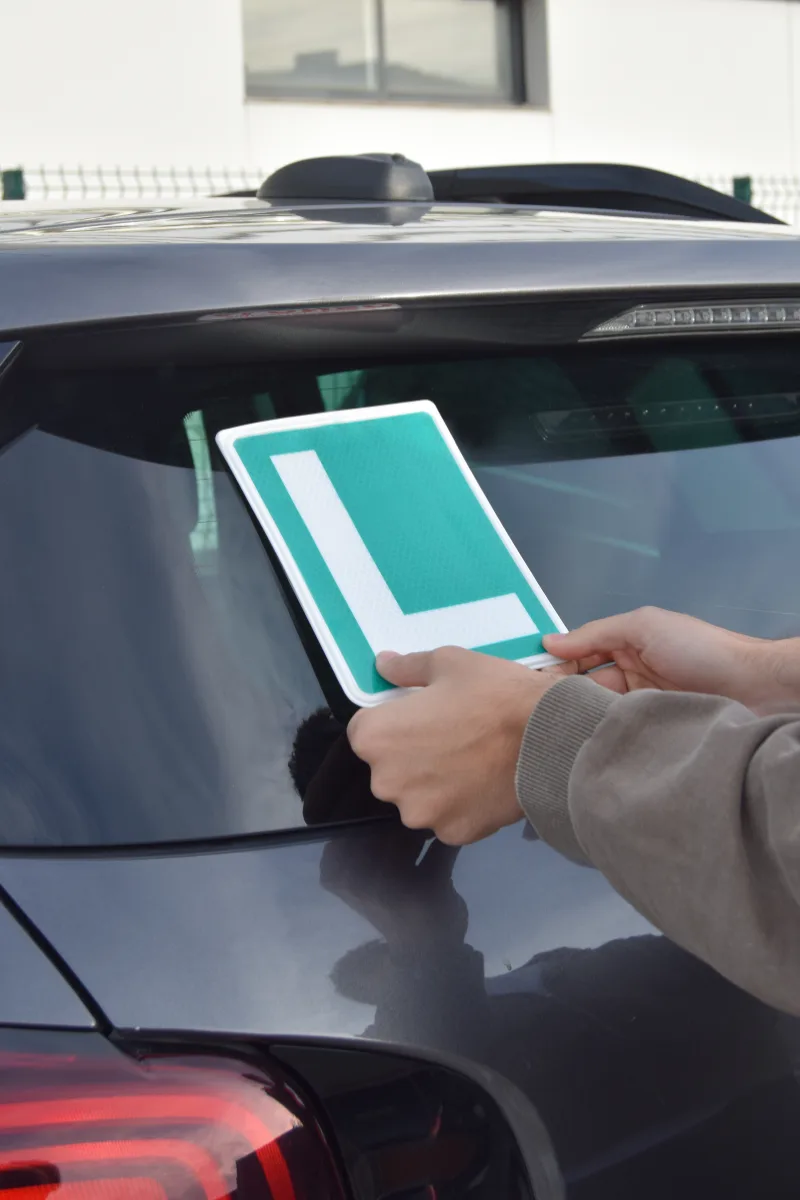
New drivers also start with only 8 points on their licence instead of the usual 12. You get the full 12 back after two full years without losing any.
The alcohol limit is lower too, for those first two years, and Spain doesn’t go easy on drink-driving fines for anyone. Honestly, my advice is just don’t drink and drive at all.
Once you pass, you’re issued a temporary licence, and it’s only valid inside Spain. No road trip to Portugal until your actual card arrives, which usually takes about six weeks.
A couple of practical things while you wait: get a magnetic L-plate, it’s so much easier to take on and off. And don’t forget it if you ever borrow someone else’s car, the rule follows the driver, not the car.
Three of us in this family took the Spanish driving tests. Only one of us has a Spanish licence today.
That’s me. I’m officially the only legal driver in this house, the family’s permanent taxi service. Still true in 2026.